1. What has been removed, and what is left?
- The original centroid fits did not estimate an additional local background; they relied on the prepared images. This makes a residual-background test necessary.
- We inspect calibrated FFIs, saved large-scale background (
ks_b), saved Hotpants background (hp_b), and centroid input (hp_d) separately. Their differences are not assumed to be pure sky or an exact reconstruction of the historical recipe. - The “first” samples occur 2.5 hours after science observations begin; “last” samples occur 2 hours before they end. One interior reference is used separately for each orbit.
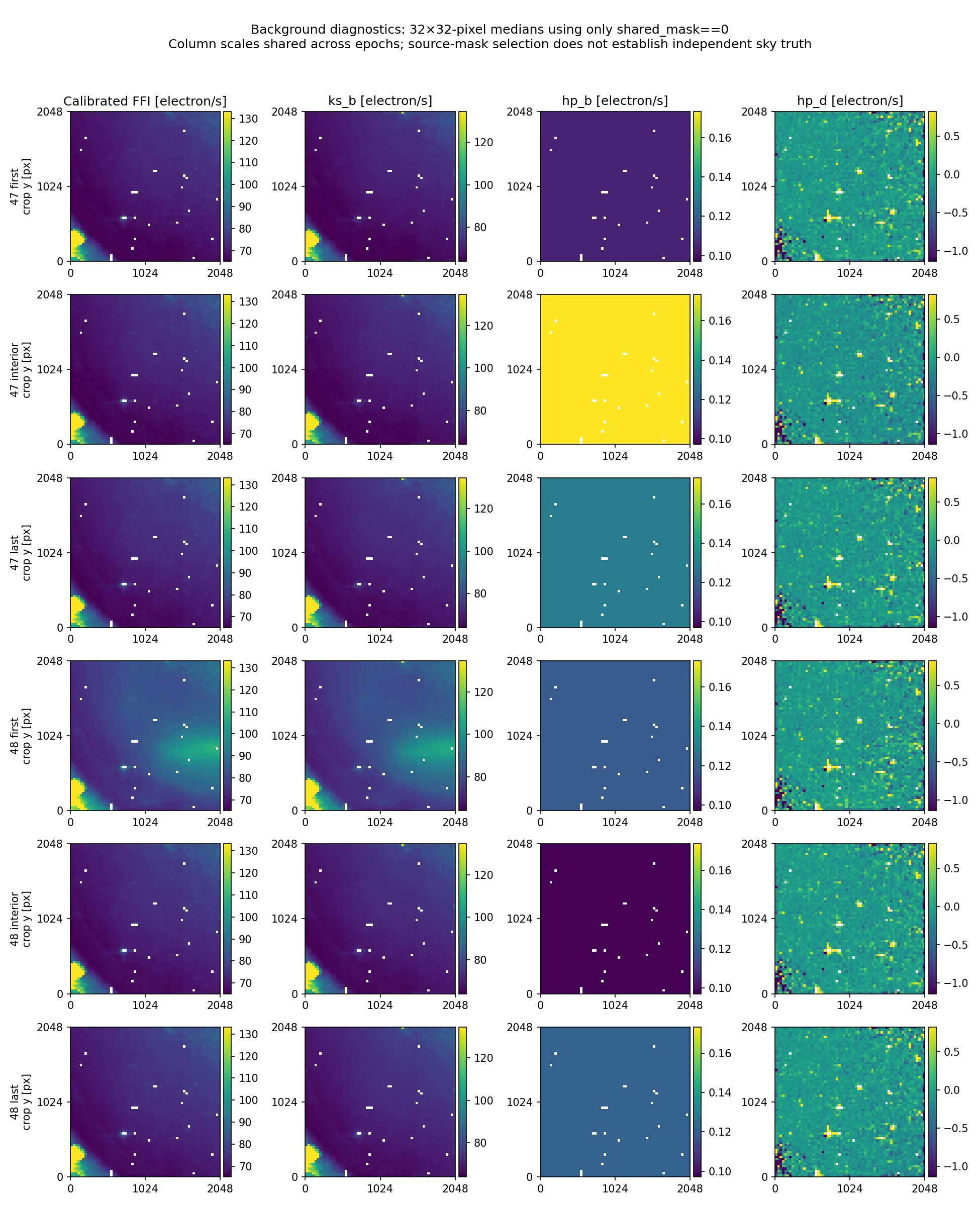
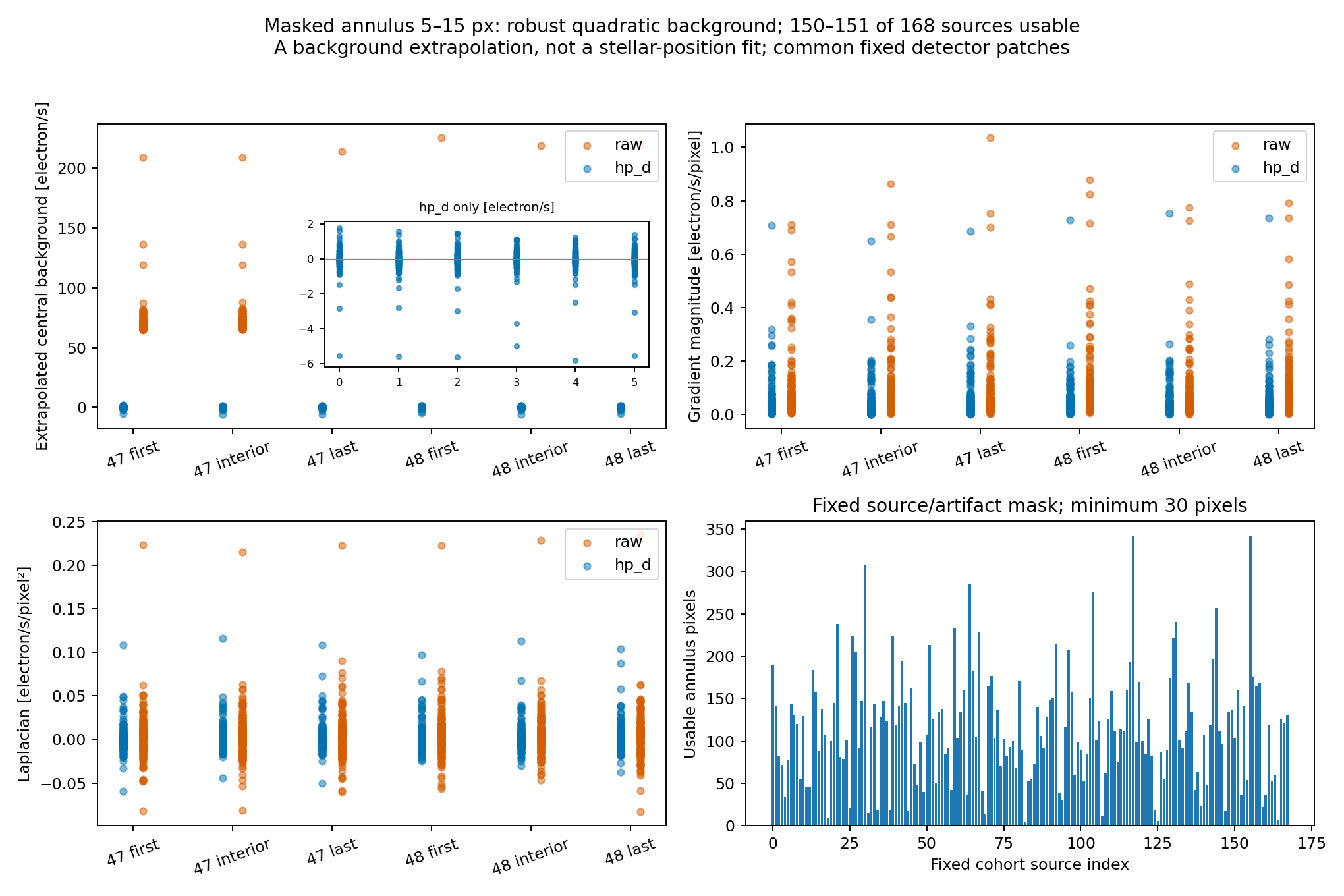
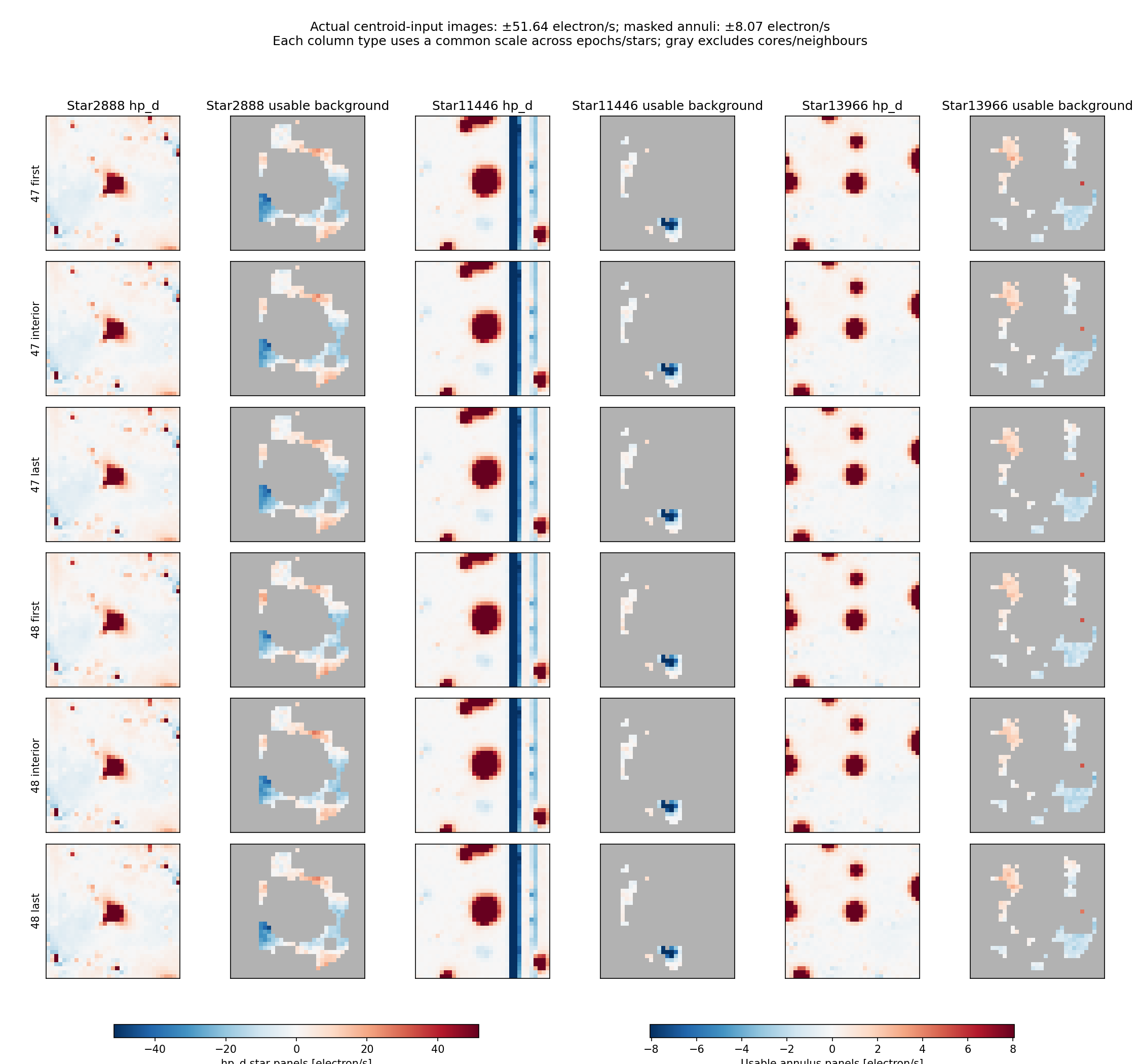
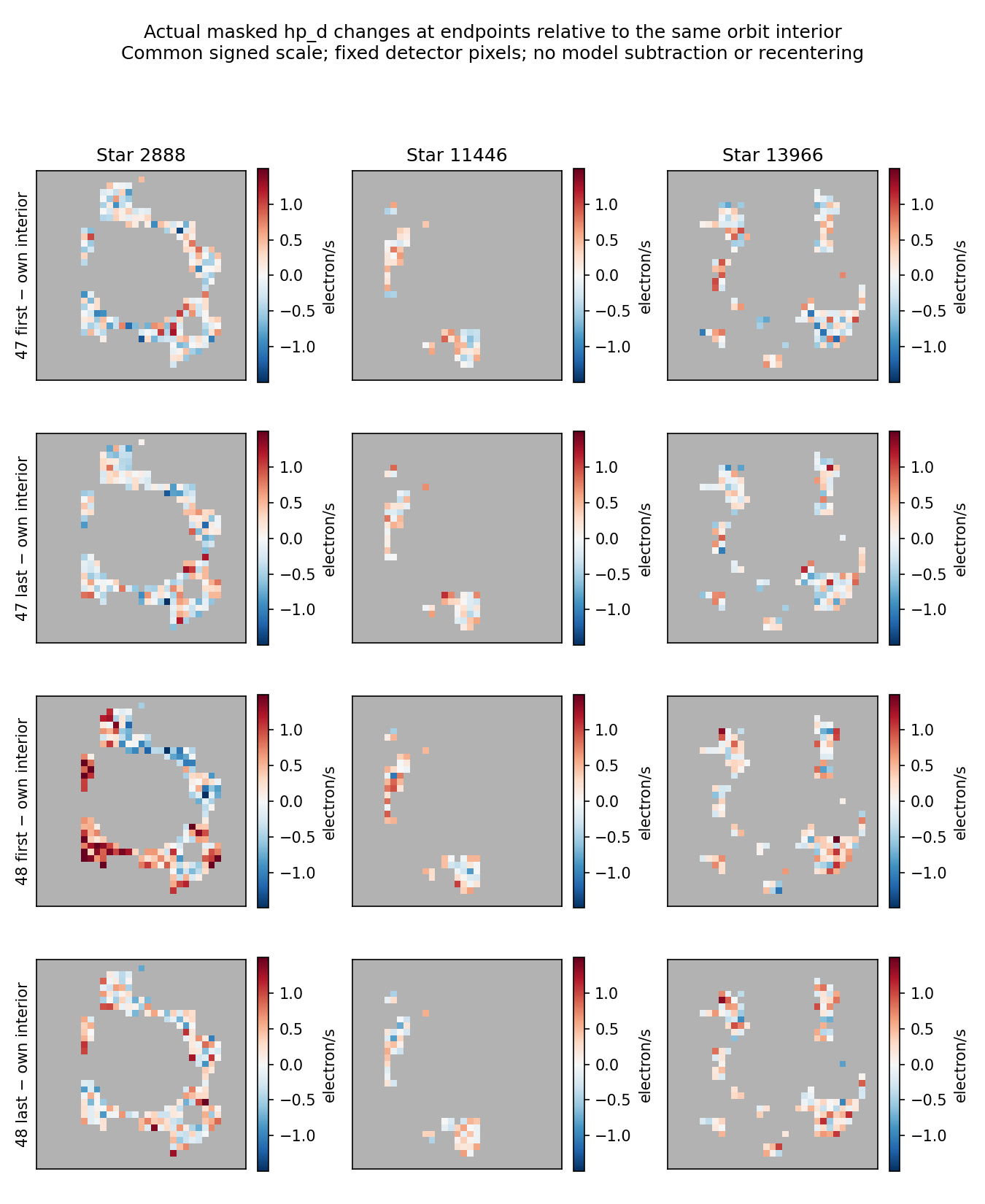
Finding: no strong endpoint-only elevation appears in median local gradient magnitude on this cohort. That does not establish a pure-sky measurement or zero centroid bias.
2. Refit the same stars with different local backgrounds
- Frozen saved ePSFs; identical 11×11 native pixels and weights for zero, constant and planar background arms. Positions and amplitudes are free; the ePSF itself is unchanged.
- 168 selected isolated stars with Tmag 9–12.8; 133 retain adequate valid support at every epoch. The 35 excluded sources are not validated. Raw-image convergence does not select the primary subtracted-image cohort.
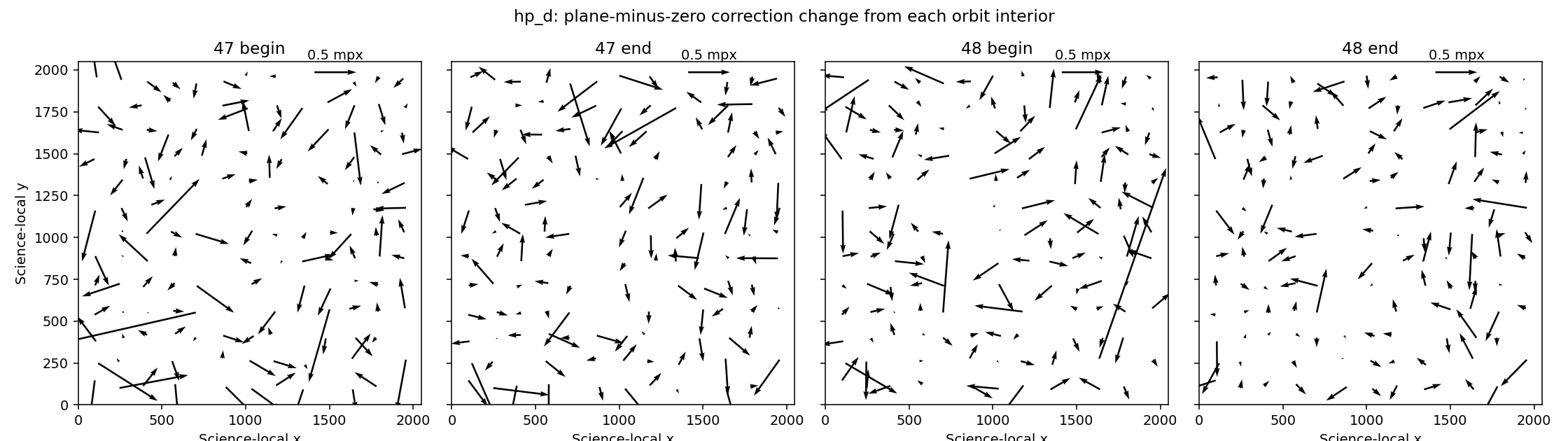
- The metric is the change in the plane-minus-zero correction from each orbit's interior exposure. Static biases and inter-orbit jumps are removed by this definition.
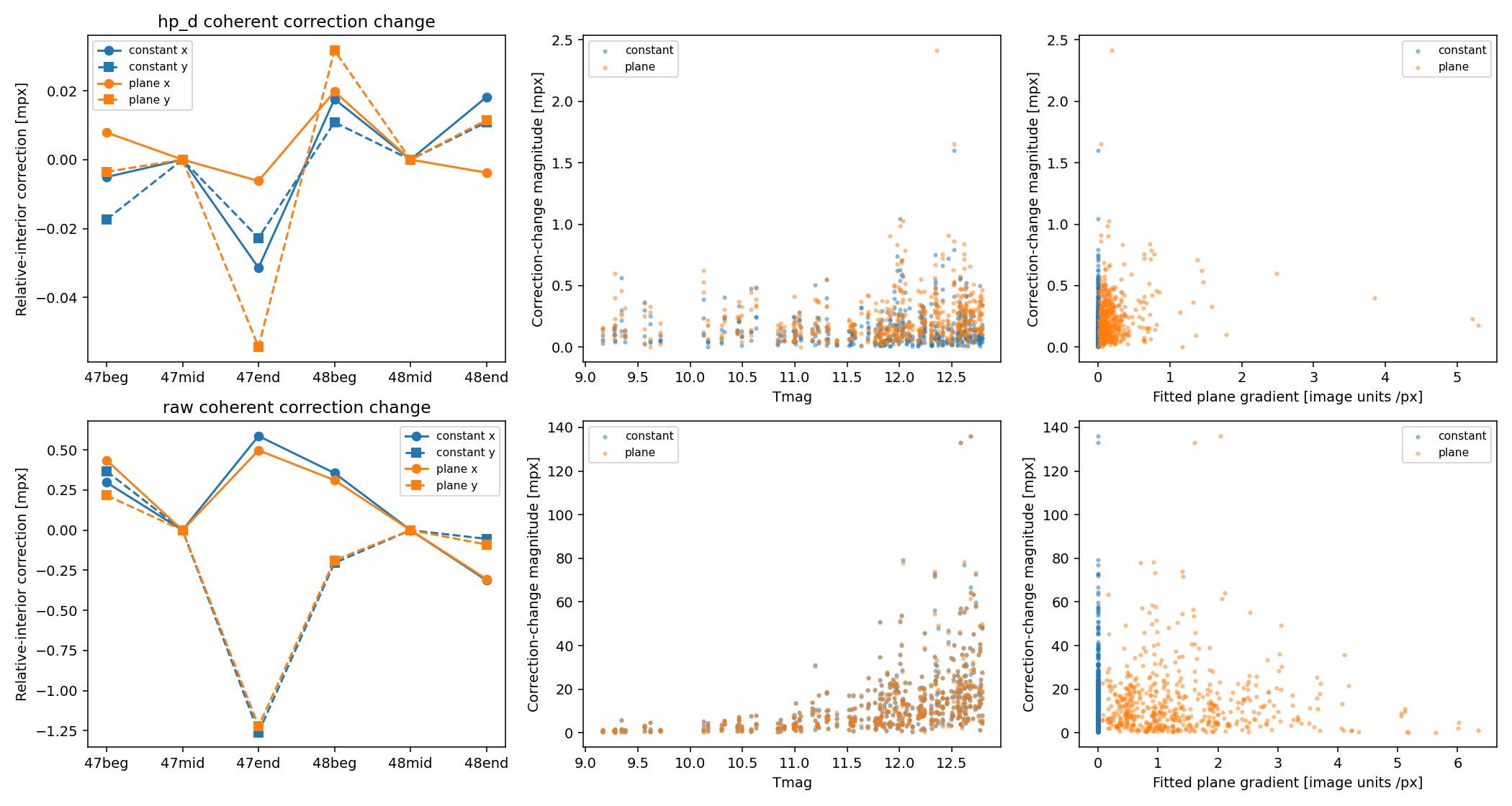
| Window | n | Median x [mpx] | Median y [mpx] | Star RMS [mpx] |
|---|---|---|---|---|
| Orbit47 start sample | 133 | 0.008 | -0.004 | 0.337 |
| Orbit47 end sample | 133 | -0.006 | -0.054 | 0.304 |
| Orbit48 start sample | 133 | 0.020 | 0.032 | 0.349 |
| Orbit48 end sample | 133 | -0.004 | 0.011 | 0.236 |
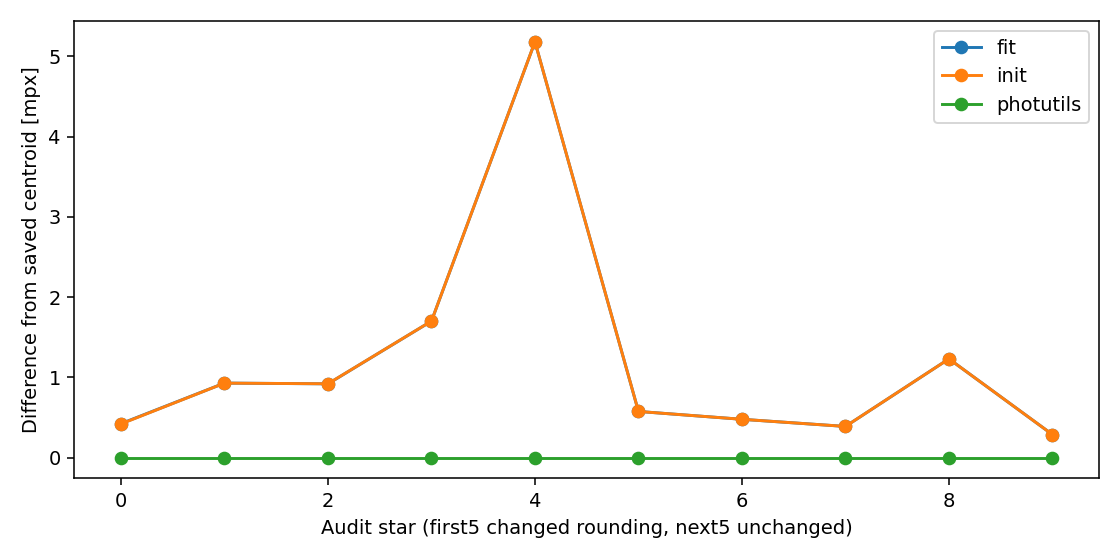
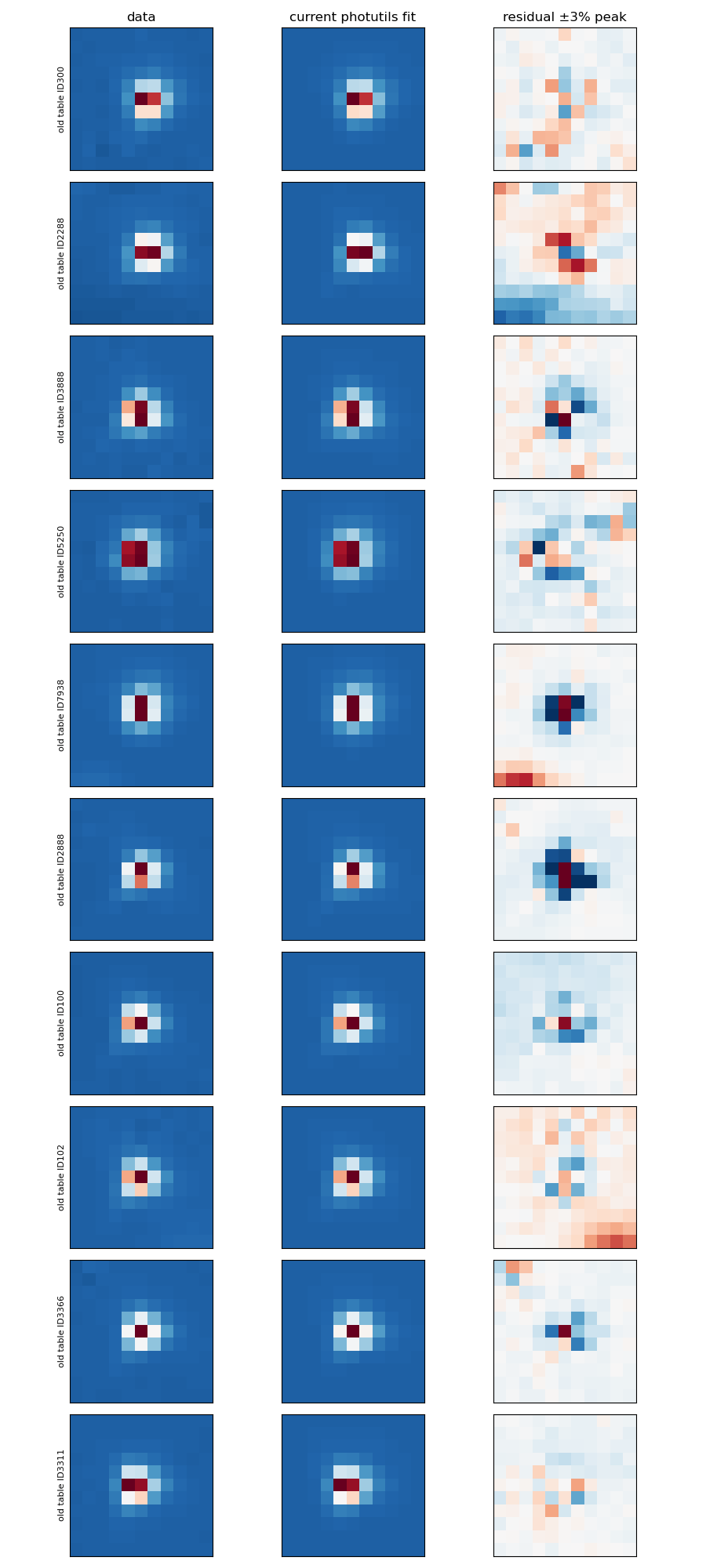
Interpretation limit: the new optimizer’s zero-background positions differ from the saved centroid solution (about 1.5–2.1 millipixel median on full support). An original-path 10-star audit reproduces the archive; our paired sensitivity remains an alternative-fitter result, not a literal correction to the archived WCS. A frozen ePSF may already contain upstream background bias.
Original-path reproduction and alternative-solver audit
3. Add known backgrounds while keeping the true position fixed
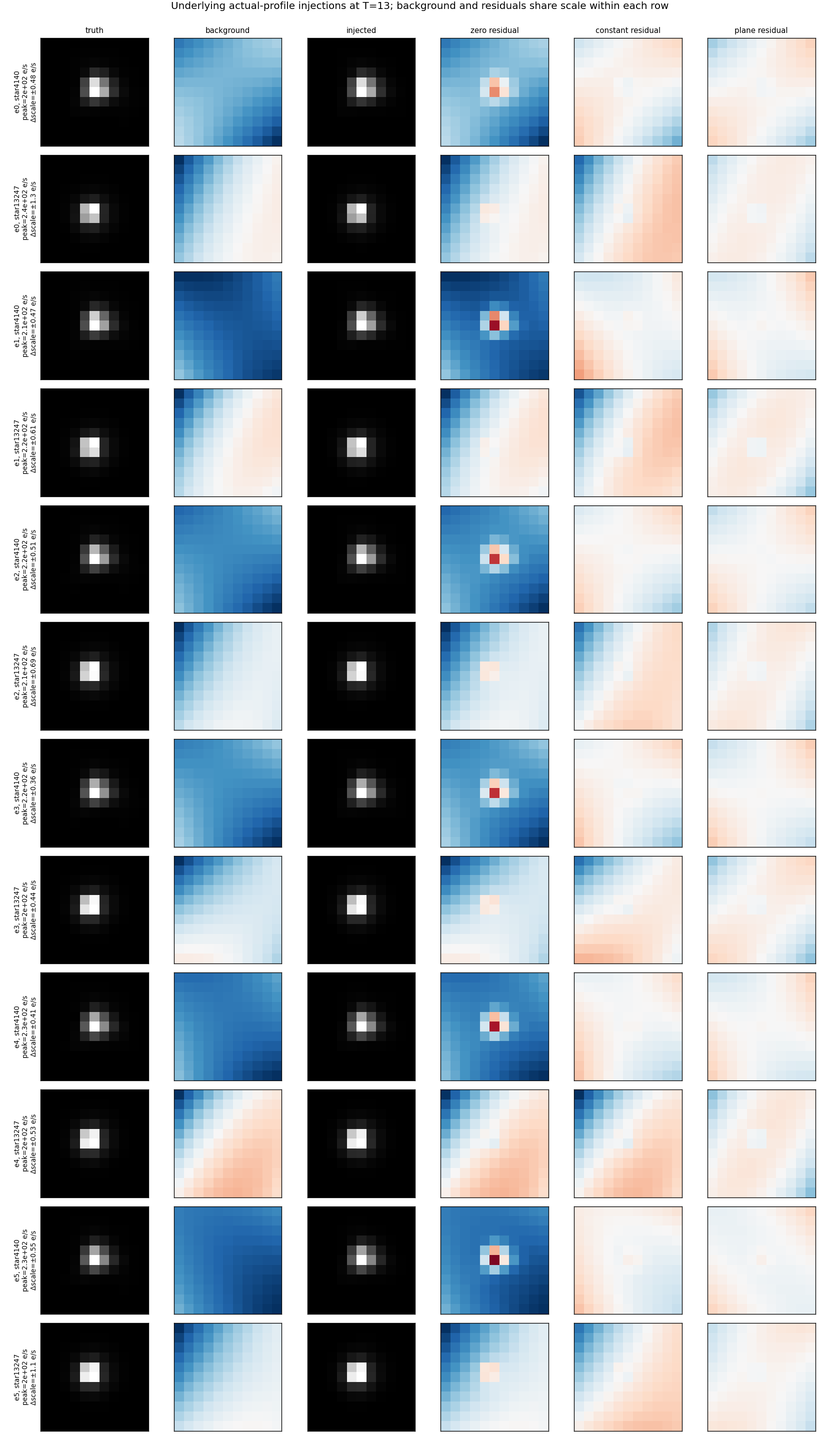
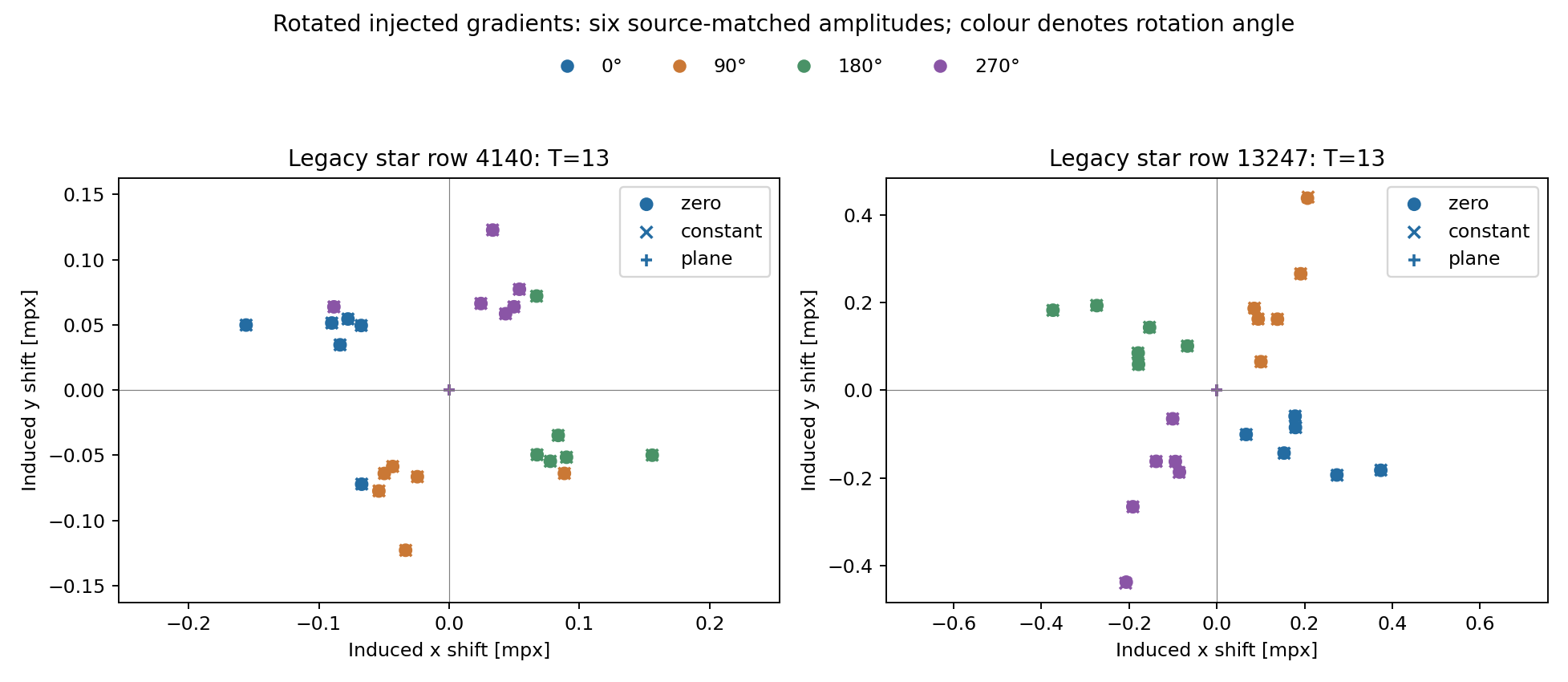
- Two preselected detector locations and their six saved profiles; brightness scaled to Tmag 9, 11, 13. No noise, neighbours or ePSF retraining: these are conditional shared-profile controls.
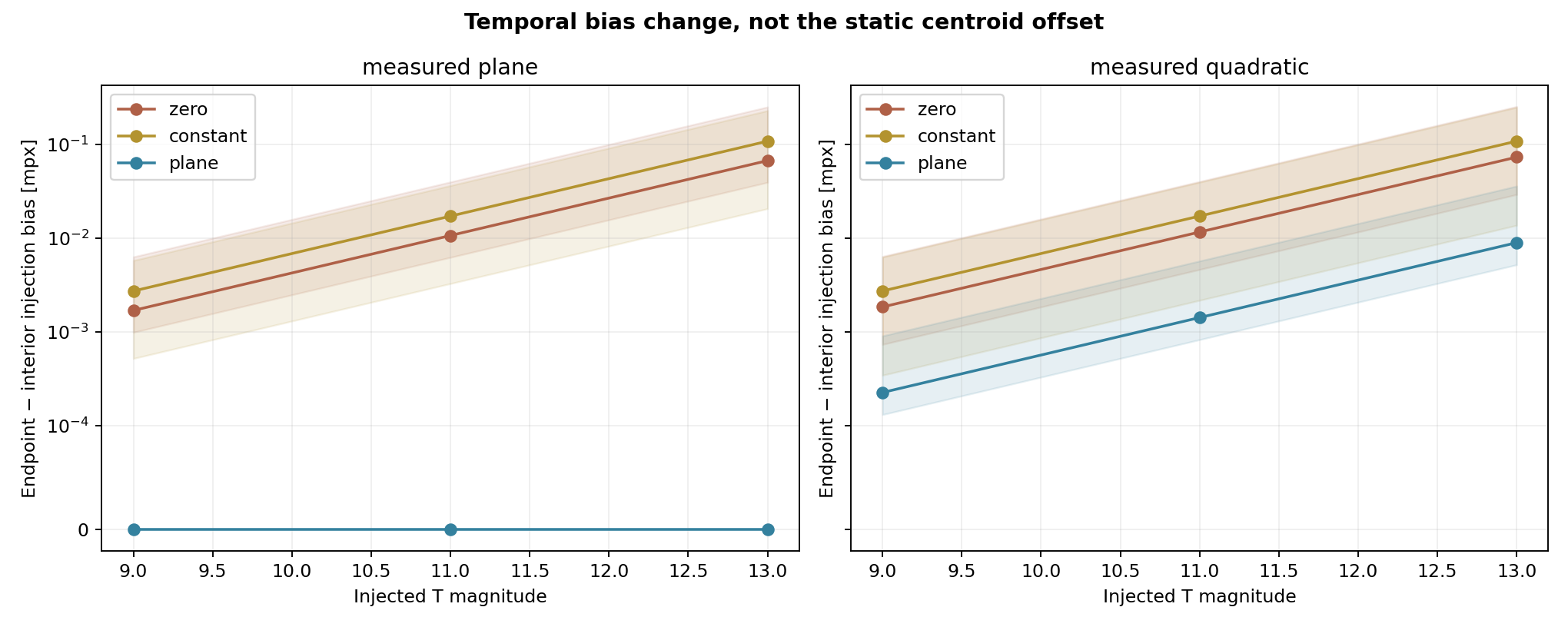
- Source-matched annular quadratic fits set the injected backgrounds. “Measured plane” retains only that quadratic fit’s constant and linear terms; it is not an independently known sky surface.
- At Tmag 13, the full quadratic injections give median 0.074 and maximum 0.255 millipixel endpoint-relative bias without a fitted background, across eight endpoint/source pairs. A fitted plane leaves median 0.009 and maximum 0.036 millipixel here.
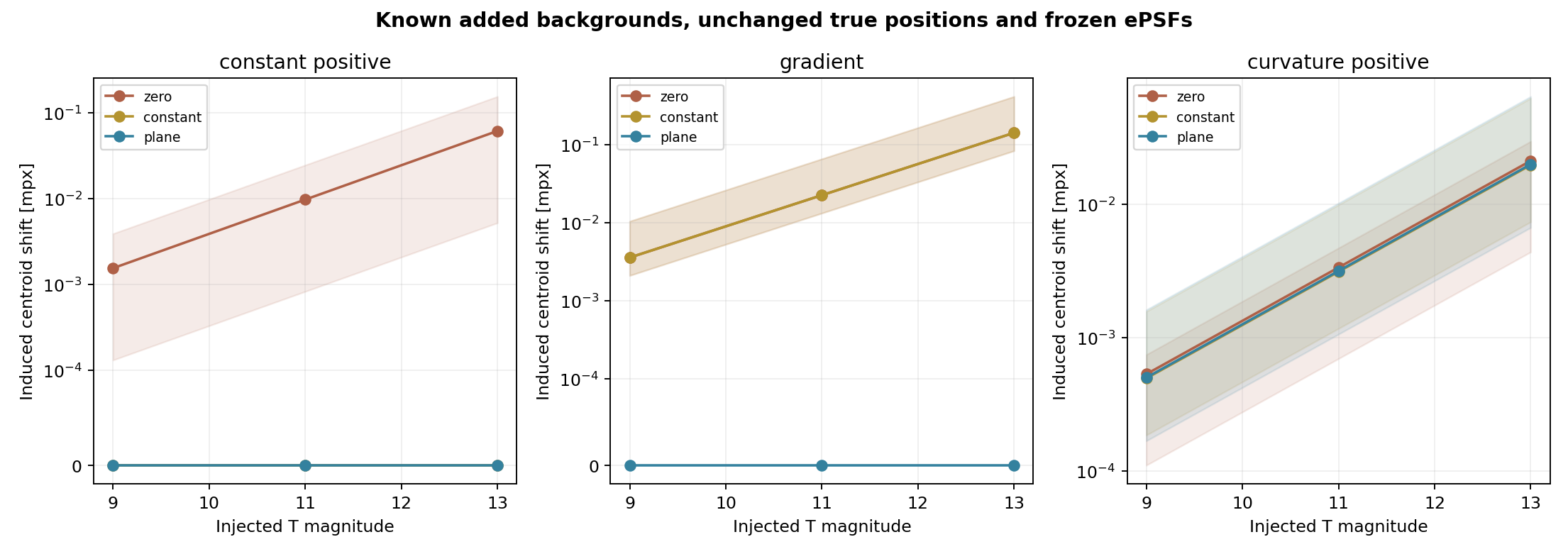
Brightness and gradient-direction controls
4. What this establishes—and what it does not
Could background removal bias orbital WCS measurements?
- Yes in principle; the direct additive effect is small in this bounded C 3/CCD 3 test. This does not certify every exposure or rule out errors inherited by the trained ePSF.
- Scope: Sector 20 camera 3 CCD 3, six exposures:2.5 hours after each orbit's science start, one interior exposure per orbit, and 2 hours before each ending. These are representative snapshots, not complete first/last-day coverage.
- Our subtraction cannot alter the independently produced mission-header WCS. It can affect our image centroids and trained WCS. Mission processing may have its own background sensitivity, not tested here.
What was actually fitted
- Historical centroid ECSV metadata records no additional local background estimator. The temporal fitter likewise used prepared images without a nuisance background column. The modern single-image fit uses a different image generation; its upstream harmonic background processing must not be confused with the historical lane.
- The old lane has saved background products but no frozen subtraction recipe establishing every historical parameter. Raw-minus-hp_d includes removed sources/templates; it is not a pure background estimate.
- New positional test:168 spatially selected isolated sources, Tmag 9–12.8;133 have sufficient common native-pixel support. All attempted fits converge. The 35 excluded sources are not certified.
- The same saved ePSF,11×11 pixels, uniform weights and fixed valid-pixel mask are used for zero, constant and sloping-plane background fits. Source positions and amplitudes are refitted; ePSFs are not retrained.
- Report the change in each star's background correction relative to its own orbit-interior exposure. This removes static offsets and does not test the inter-orbit jump.
What the images show
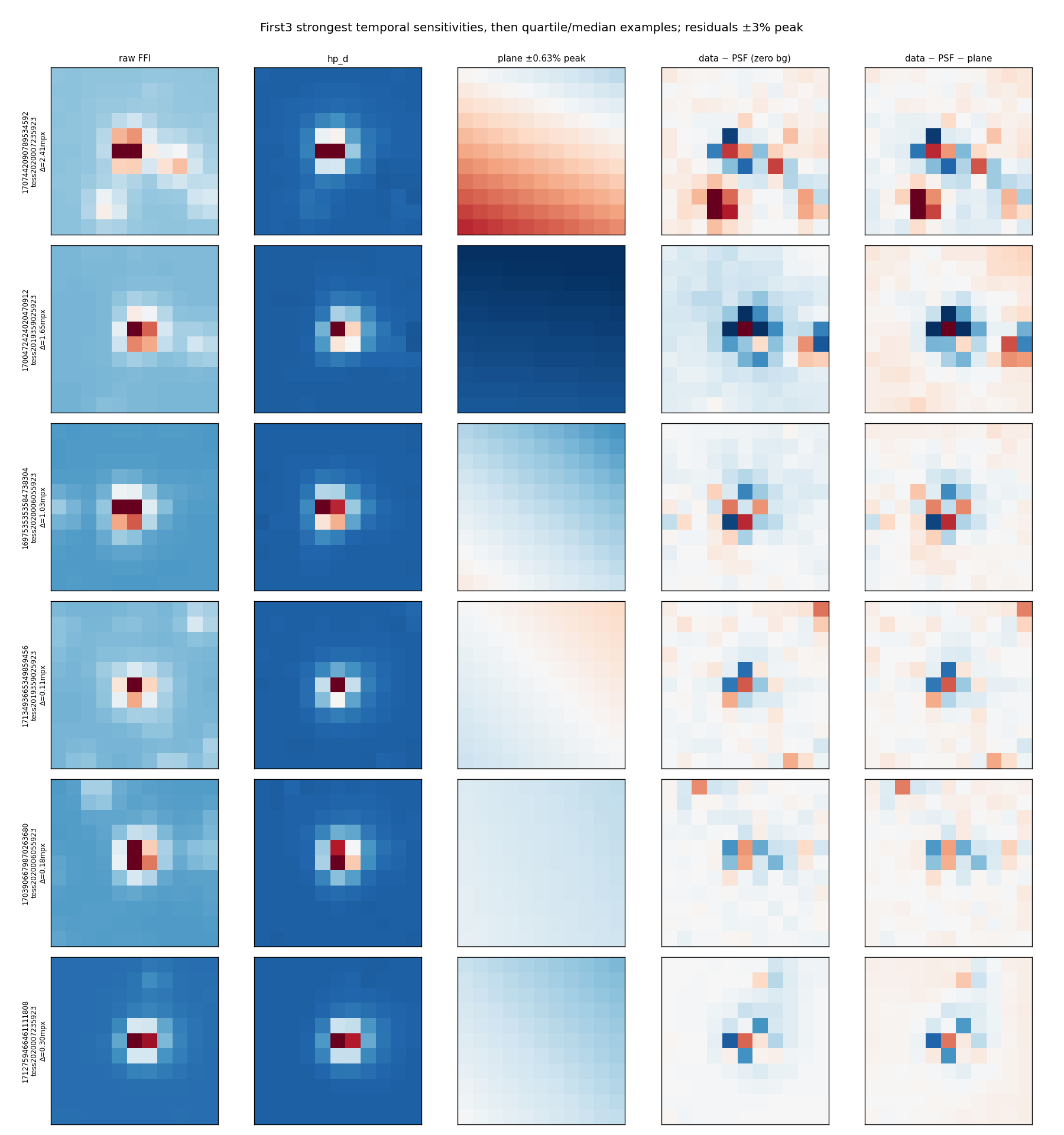
- The large background patterns, including extra broad light at the second startup snapshot, appear in the calibrated FFI and saved background estimate. A comparable broad enhancement is not apparent in the subtracted centroid-input map.
- In the 168-star annulus diagnostic,150–151 sources are usable per exposure and 150 are common to all six. Median residual gradient magnitudes range 0.0246–0.0288 electron/s/pixel, without a strong endpoint-only elevation.
- Masked annuli still contain arcs and compact residuals. Sky background, stellar wings, neighbours and template errors remain mixed; a fitted surface is not independently known sky.
What changes the positions
- Allowing a plane changes endpoint-minus-interior corrections by 0.236–0.349 millipixel RMS across the 133 stars. The corresponding median vector is below 0.055 millipixel in each endpoint snapshot. A millipixel is 0.001 native detector pixel.
- These quantities describe sensitivity within the new fitter, not absolute positional accuracy. No projection onto the thermal WCS modes was fitted, and the star and WCS-probe populations have different denominators; no explained fraction is claimed. Spatial maps and outliers accompany the medians.
- The new optimizer's zero-background solution differs from archived centroids at roughly 1.5–2.1 millipixel median even on full 121 pixel support. A separate 10-star audit using the original photutils path reproduces the saved positions to numerical precision; the new-solver difference is retained as a limitation, not attributed to bad saved products.
- Changing a local background term cannot undo errors already absorbed into ePSF shape/origin, source removal or template construction. That end-to-end pathway remains untested.
Controlled injections
- Two preselected detector locations, their six saved profiles, Tmag 9/11/13, known fixed positions and source-matched annular background surfaces;2052 fits, no noise or neighbours and no ePSF retraining.
- AtTmag 13, full measured quadratic surfaces produce a median endpoint-relative bias 0.074 millipixel and maximum 0.255 millipixel when no background is fitted, across eight endpoint/source pairs. Fitting a plane leaves median 0.009 and maximum 0.036 millipixel in this shared-profile control.
- Stronger injected gradients can produce millipixel shifts. The control demonstrates the mechanism and scales for these profiles; it is not proof that all real backgrounds are this small.
Paper consequence and next decisive test
- The sampled direct residual constant/gradient is unlikely to be the main source of the several-millipixel orbital remainder. This is a constrained negative result for one CCD and these sources/exposures.
- Keep background-induced profile/centroid bias in the physical-cause budget. Thermal correlation alone cannot rule it out.
- To close the remaining pathway, rebuild backgrounds and ePSFs from the same raw endpoint images under alternative source masks/background models, then score fixed held-source positions and residual images. Expand to other detectors and the earliest science exposures.
Conclusion: broad background removal appears effective in the inspected images, and direct local-background sensitivity is small for the tested cohort. Background effects inherited by the ePSF or upstream subtraction remain a live uncertainty; no blanket all-camera or full-day certification is justified.