S24 C2K2: temporal WCS and PSF measurements

Both orbits · October 16, 2026 · Measurement before temporal-model selection

Measurement complete: 24/24 inputs prepared; 24/24 first-pass WCS fits complete; 24/24 native residual exports. No final temporal mode or flat-light-curve result is accepted.

Question

How do image positions and stellar profiles change across the two orbits, when measured with our current single-FFI radial/coma colour model and jointly fitted faint neighbours?

The model is not forced to follow a spline, temperature or jitter during this measurement. Each exposure has free WCS coefficients and source fluxes. The first pass holds the current reference PSF fixed; its remaining native-pixel residuals are then tested for local shift and shape responses.

Exposure selection and actual input images
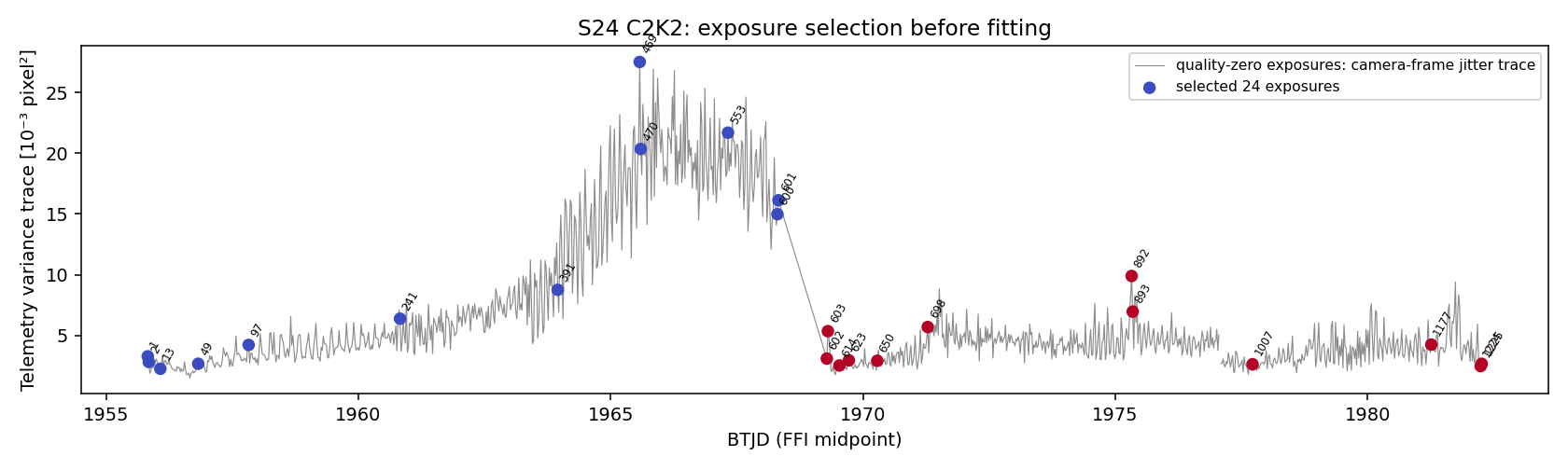
Selection uses timing and telemetry before photometric scoring: 12 exposures per orbit, including startups, endpoints, high jitter and adjacent controls. Quality-zero exposures are shown.
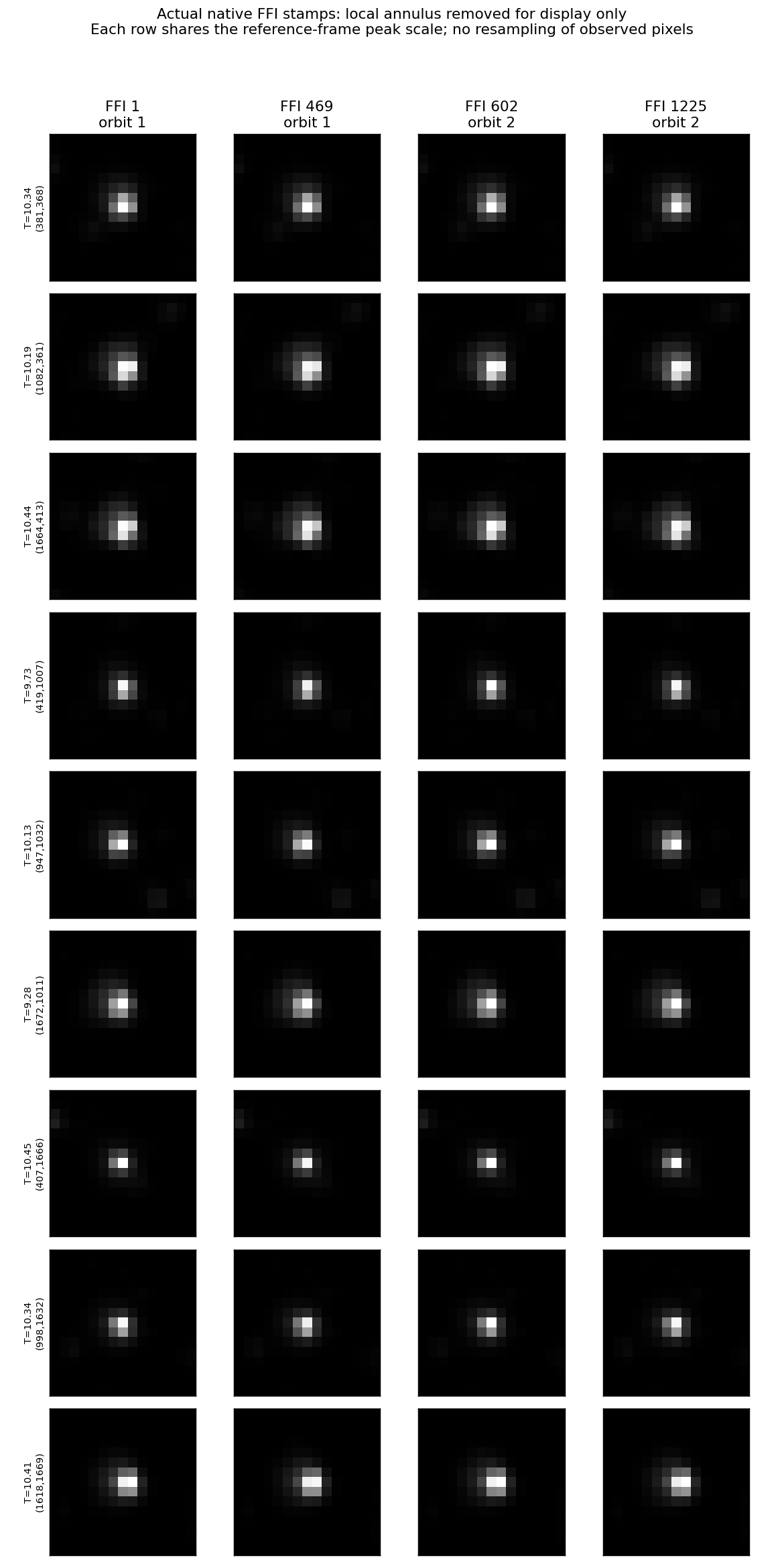
Actual native FFI stamps at four selected times. A local annulus is removed for display only. Each row shares the reference-frame peak scale; observed pixels have not been resampled. Click for full resolution.

Actual fitted images and residuals

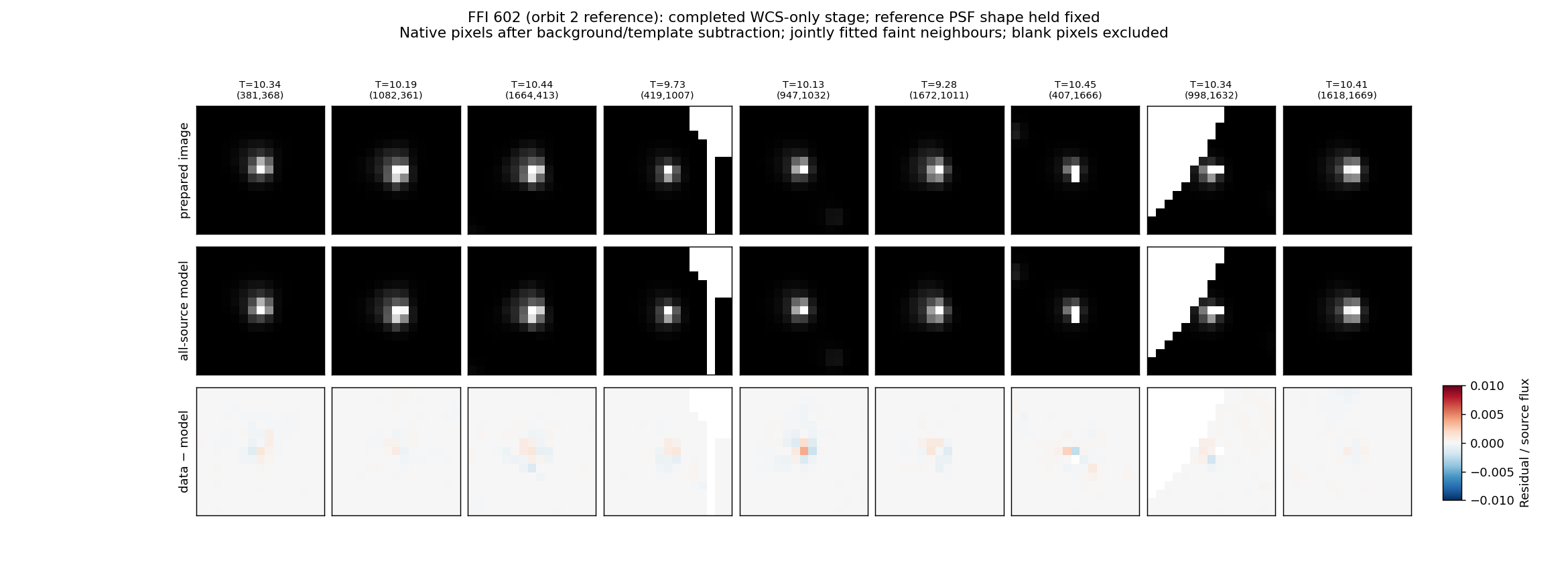
Reference FFI 602: completed GPU WCS-only stage, fluxes evaluated locally at that checkpoint. Shape is held fixed; this is not the later full-PSF control.
Native data, all-source model and residuals
Same source IDs and reference-flux scales. Masked pixels are blank. Residuals use one common scale.
Native residual, local shape/shift response, and remainder
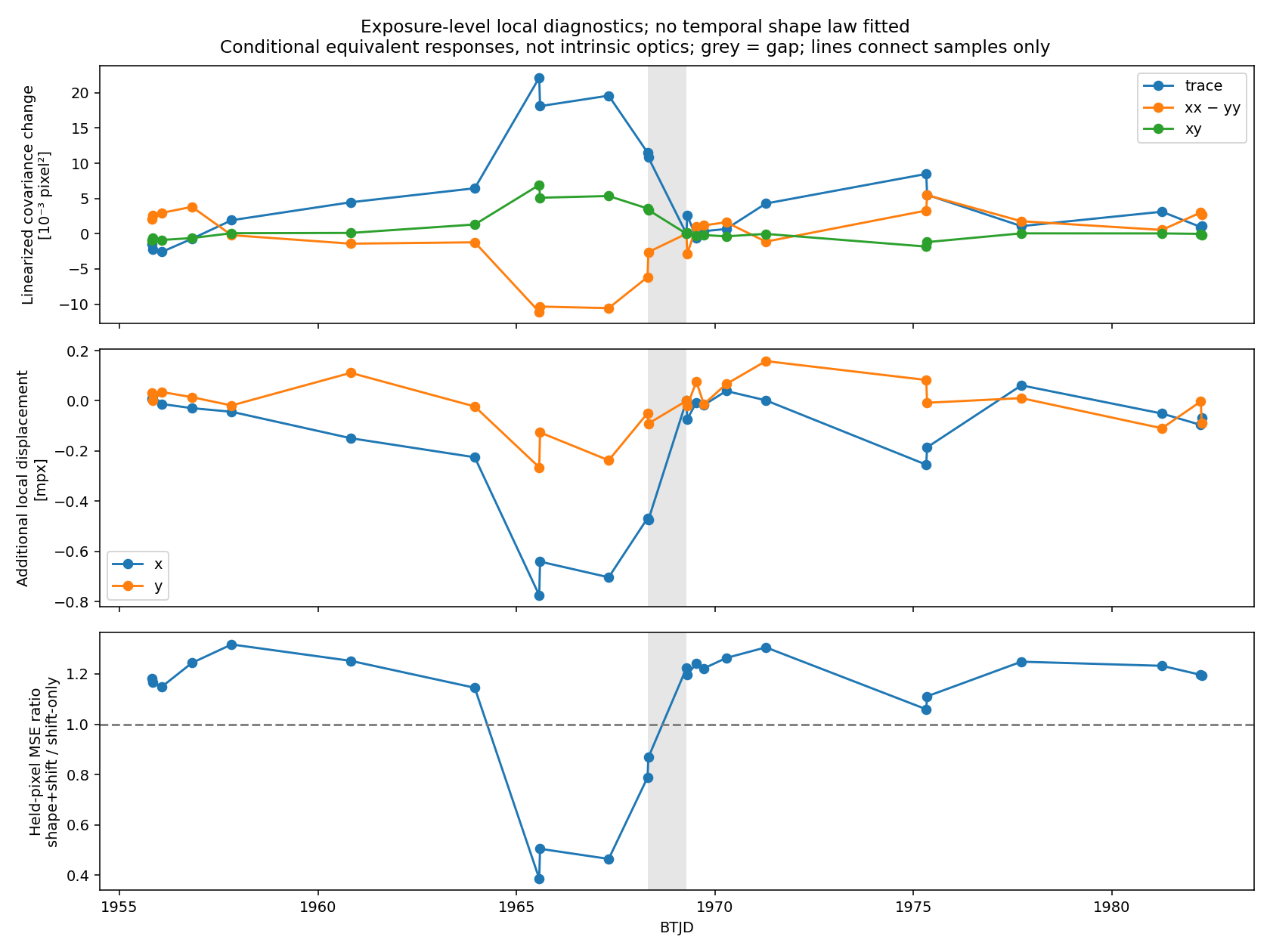
Local response is a diagnostic, not a selected temporal law. It includes amplitude and background freedom; a separate checkerboard test evaluates held pixels.

Measured changes

Completed independent single-FFI controls

All four full fits met the existing plateau criteria in every stage. Both T4 campaigns have synchronized and stopped; no GPU remains allocated by this task. These are in-sample controls, not a held-source precision certification.
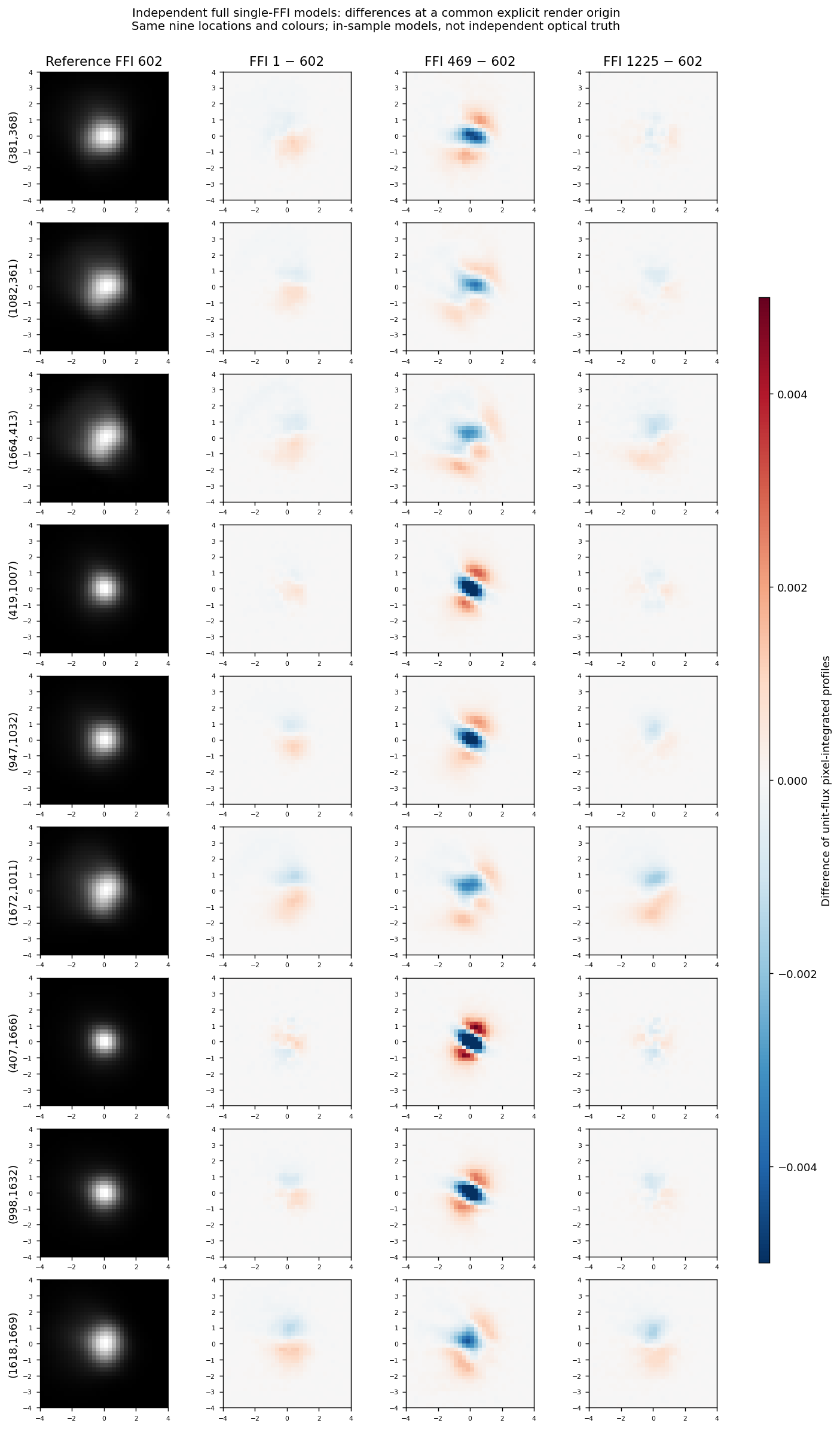
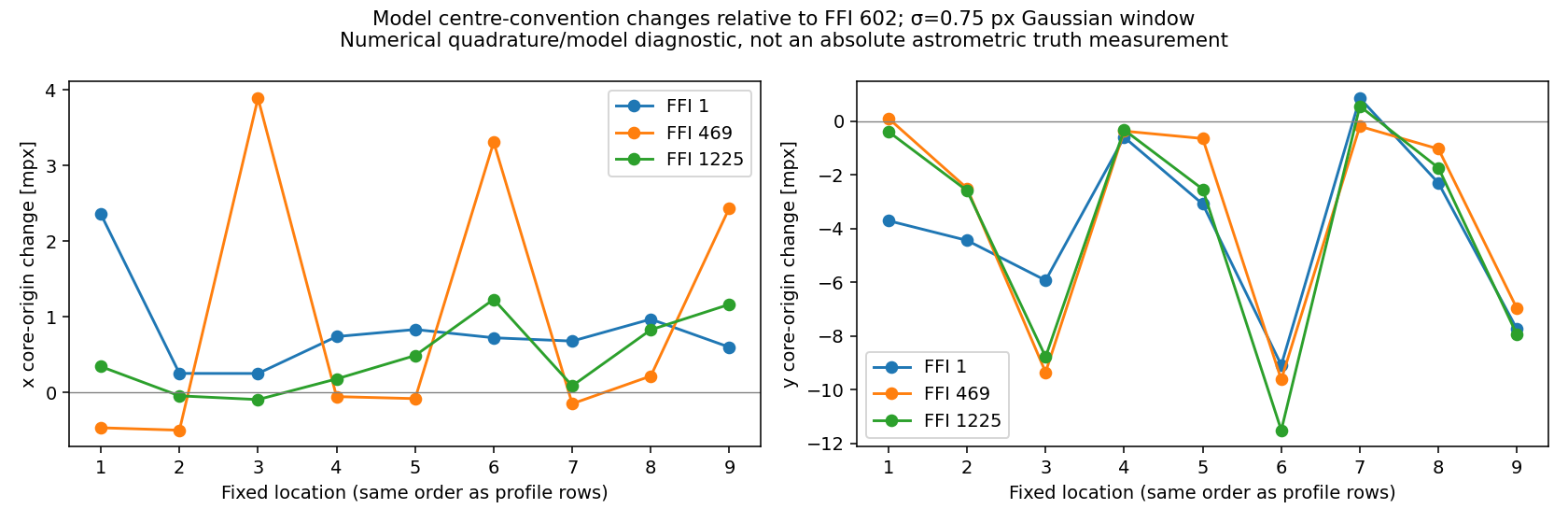
Four independently fitted profiles at the same locations, colours and explicit render origin. These differences still include changes in the model core-centre convention.
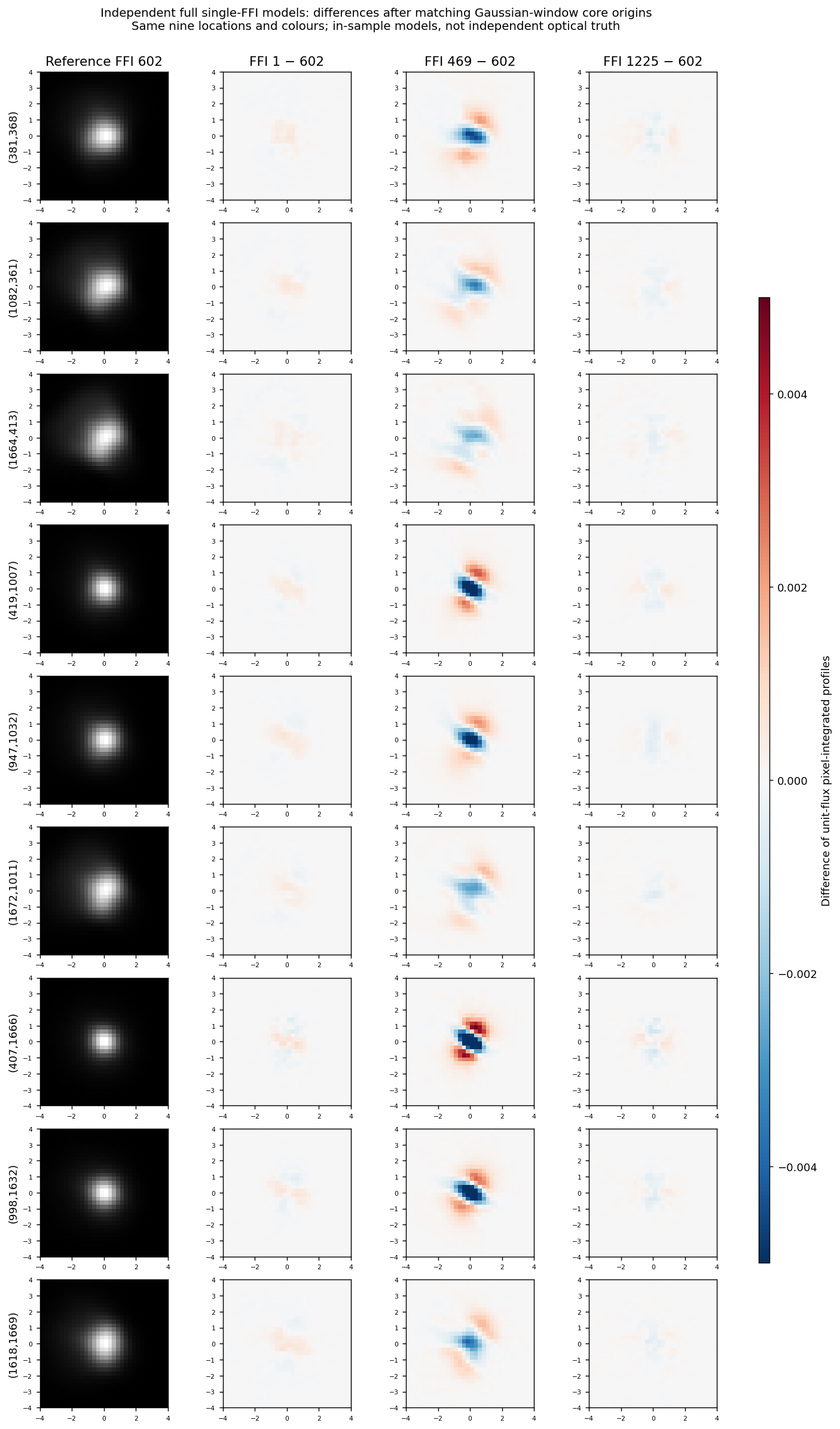
After matching Gaussian-window core origins, strong directional broadening remains in FFI 469; the lower-jitter controls differ much less. This is a comparison of fitted profiles, supported by the actual image residuals below.
The model-core origin changes by several millipixels at some locations. This model-only diagnostic uses float64 coordinate arithmetic and a 0.75-pixel Gaussian window; it does not establish production astrometric accuracy.
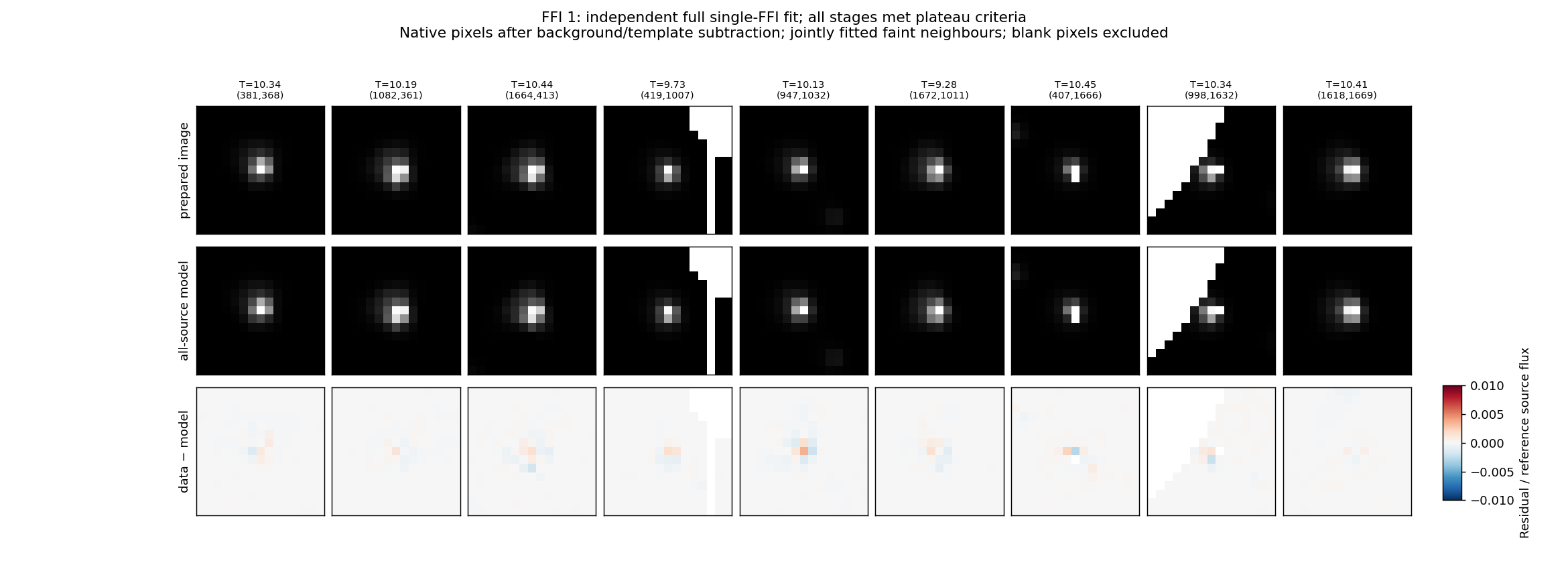
Actual full-fit images and residuals: FFI 1
Native prepared image, joint-source model and residuals from the independent full fit. Same reference-flux scale; masked pixels are blank.
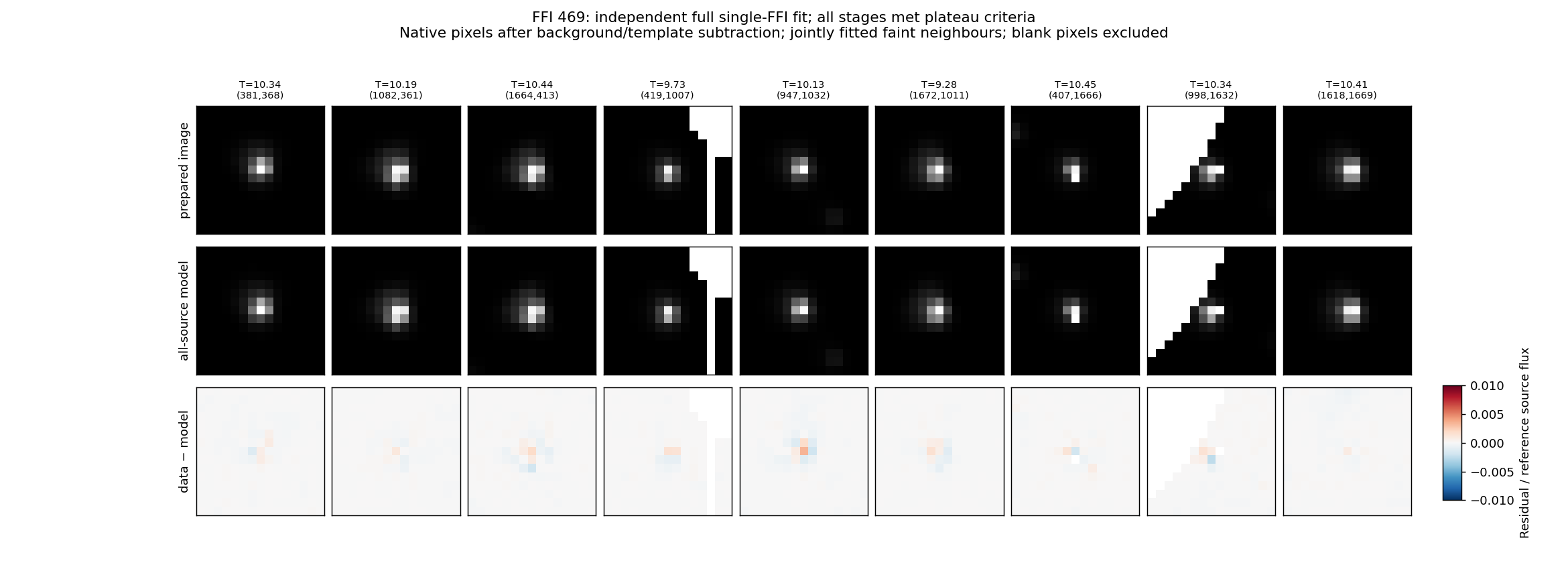
Actual full-fit images and residuals: FFI 469
Native prepared image, joint-source model and residuals from the independent full fit. Same reference-flux scale; masked pixels are blank.
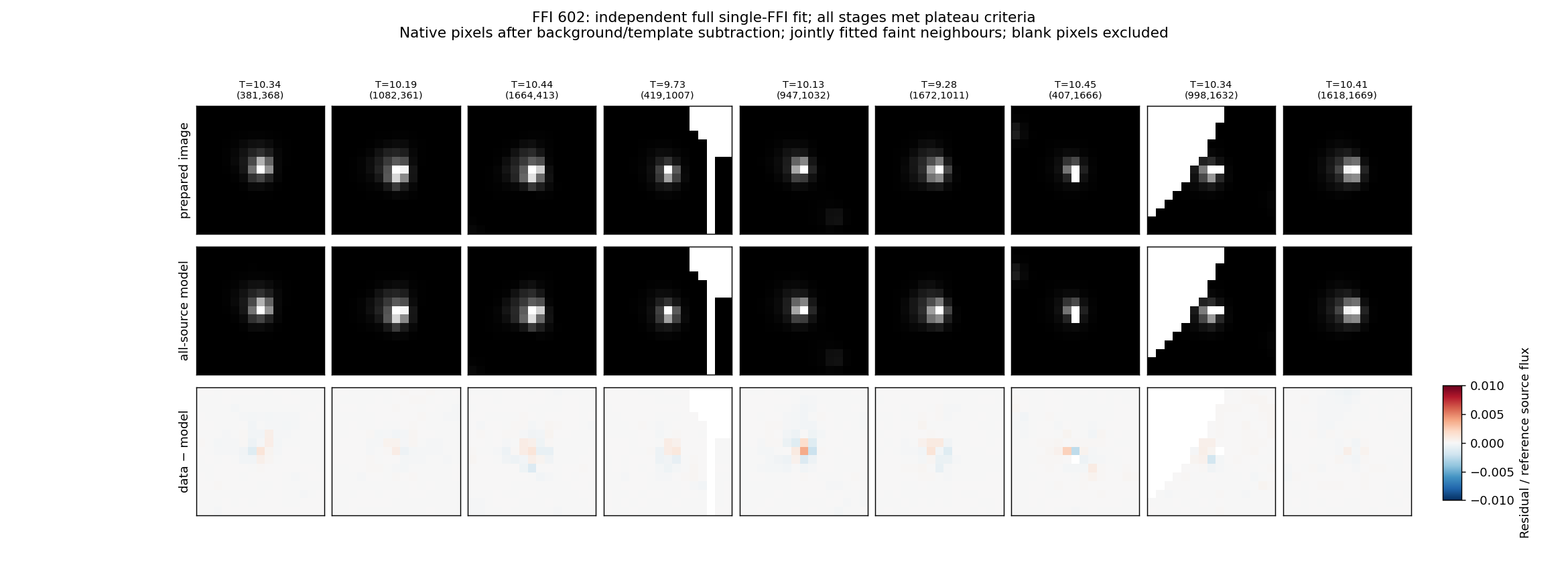
Actual full-fit images and residuals: FFI 602
Native prepared image, joint-source model and residuals from the independent full fit. Same reference-flux scale; masked pixels are blank.
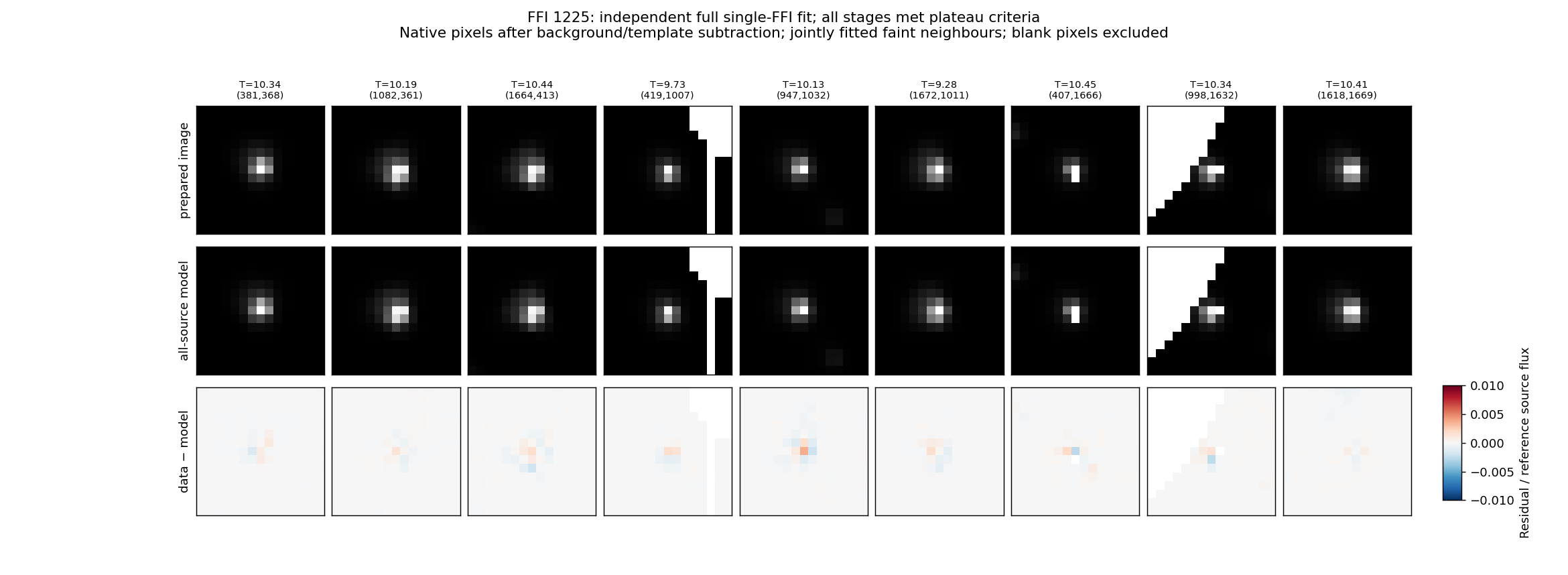
Actual full-fit images and residuals: FFI 1225
Native prepared image, joint-source model and residuals from the independent full fit. Same reference-flux scale; masked pixels are blank.

High-jitter/reference diagnostic pair

FFI 469 versus FFI 602, 2829 sources. The final pair uses matched CPU WCS-only fits. A separate CPU/GPU checkpoint comparison found negligible differences for this reference diagnostic.

MeasurementResult
Median equivalent covariance-trace change0.02214 pixel²
Conditional blend-island bootstrap 95% interval0.02177–0.02245 pixel²
Camera-frame telemetry trace change0.02444 pixel²
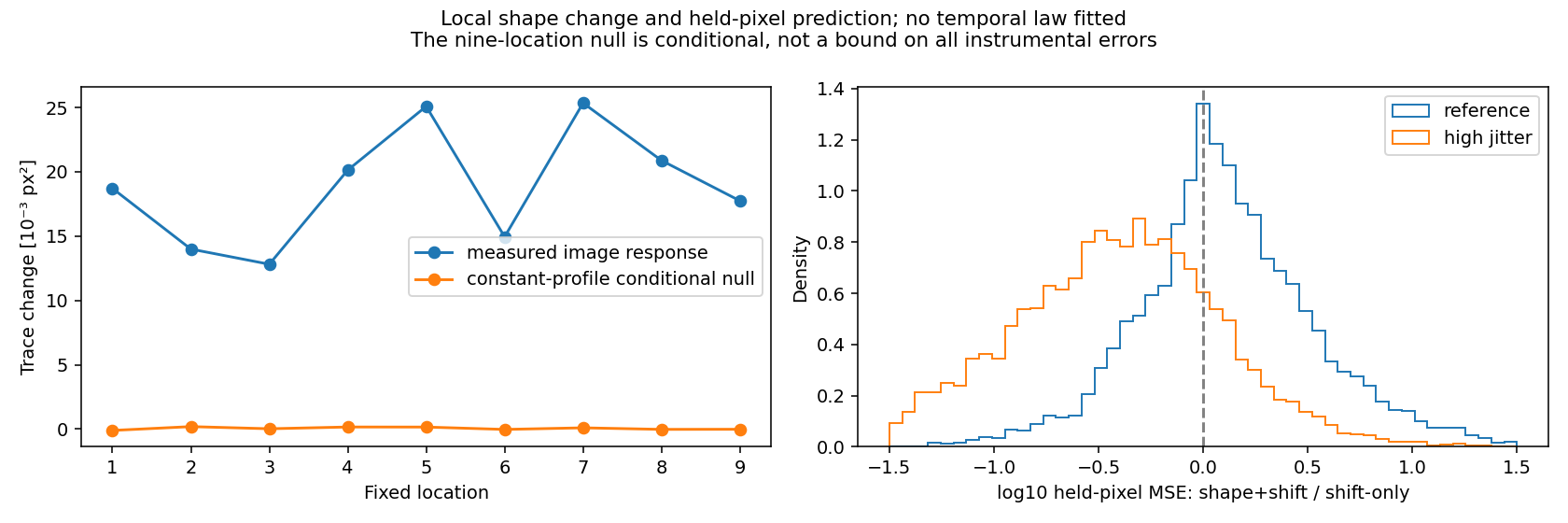
Median held-pixel MSE ratio, shape+shift / shift-only0.387 high jitter; 1.223 reference

The interval holds the shared fitted model/WCS/background fixed. Telemetry is not yet converted into a complete detector-projected physical law. The held-pixel comparison is conditional on the global scene fit; it is not full-pipeline cross-validation.
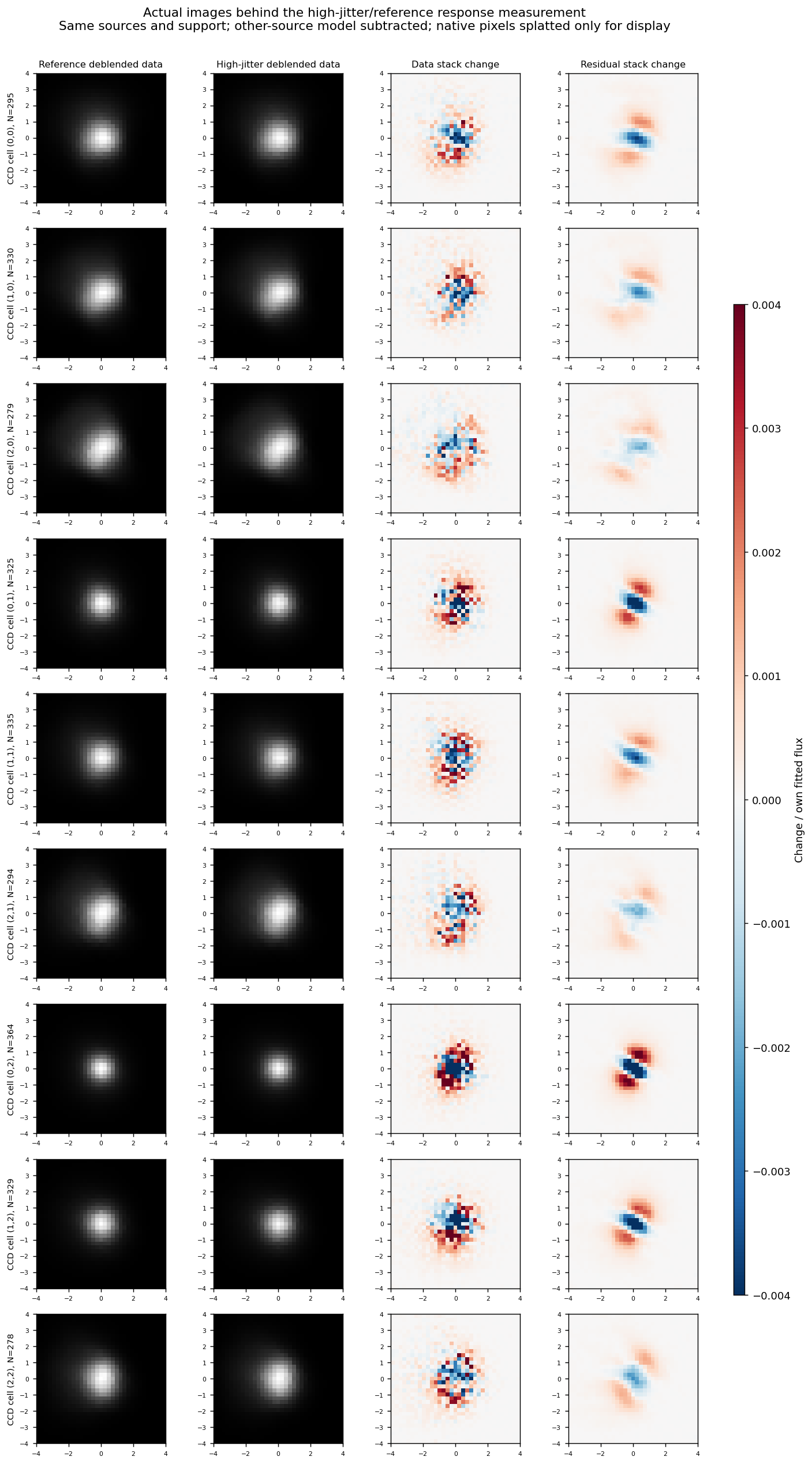
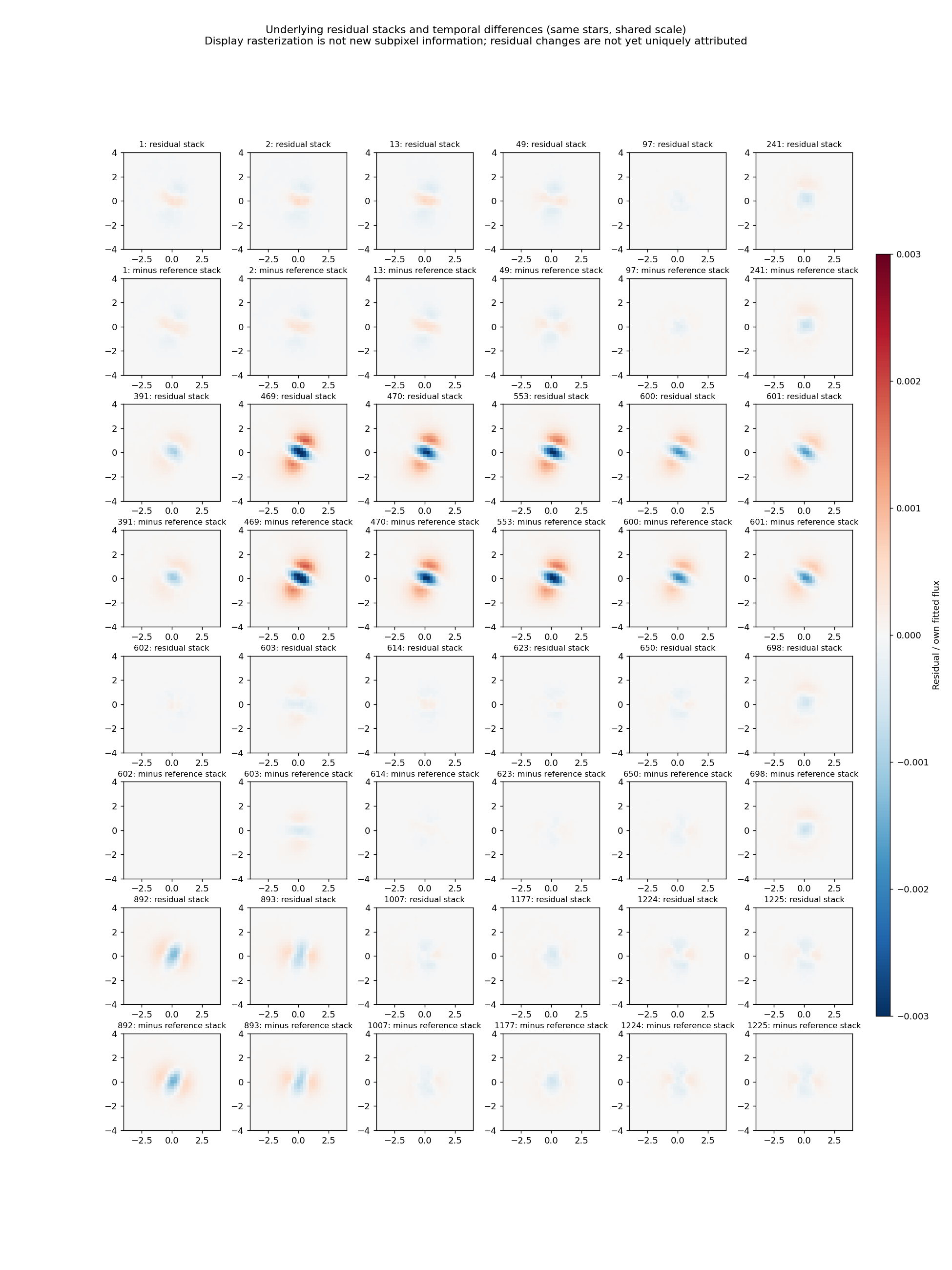
Underlying actual deblended data and residual changes across all nine CCD cells. Same sources/support and shared difference scale. The direct data-stack difference also shows phase-sampling structure; residual differences separate the much smoother mismatch pattern.
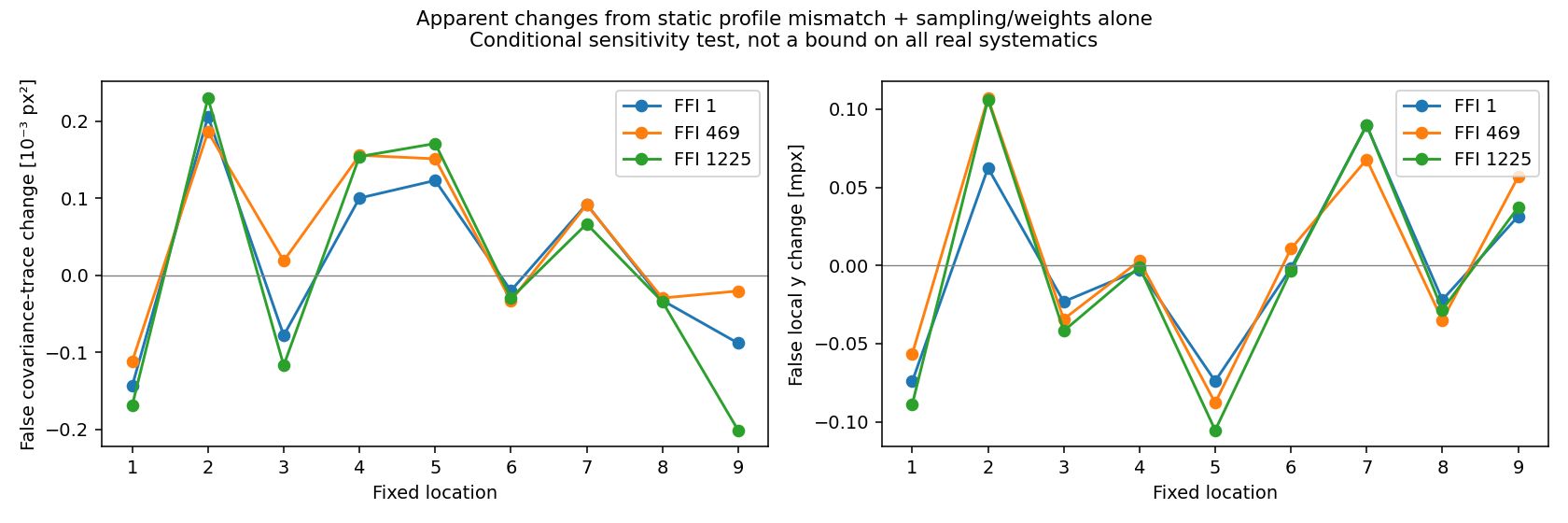
The measured high-jitter shape response is large compared with the nine-location conditional static-field null. Additional shape freedom improves held-pixel prediction in the high-jitter image; it does not automatically help the reference.
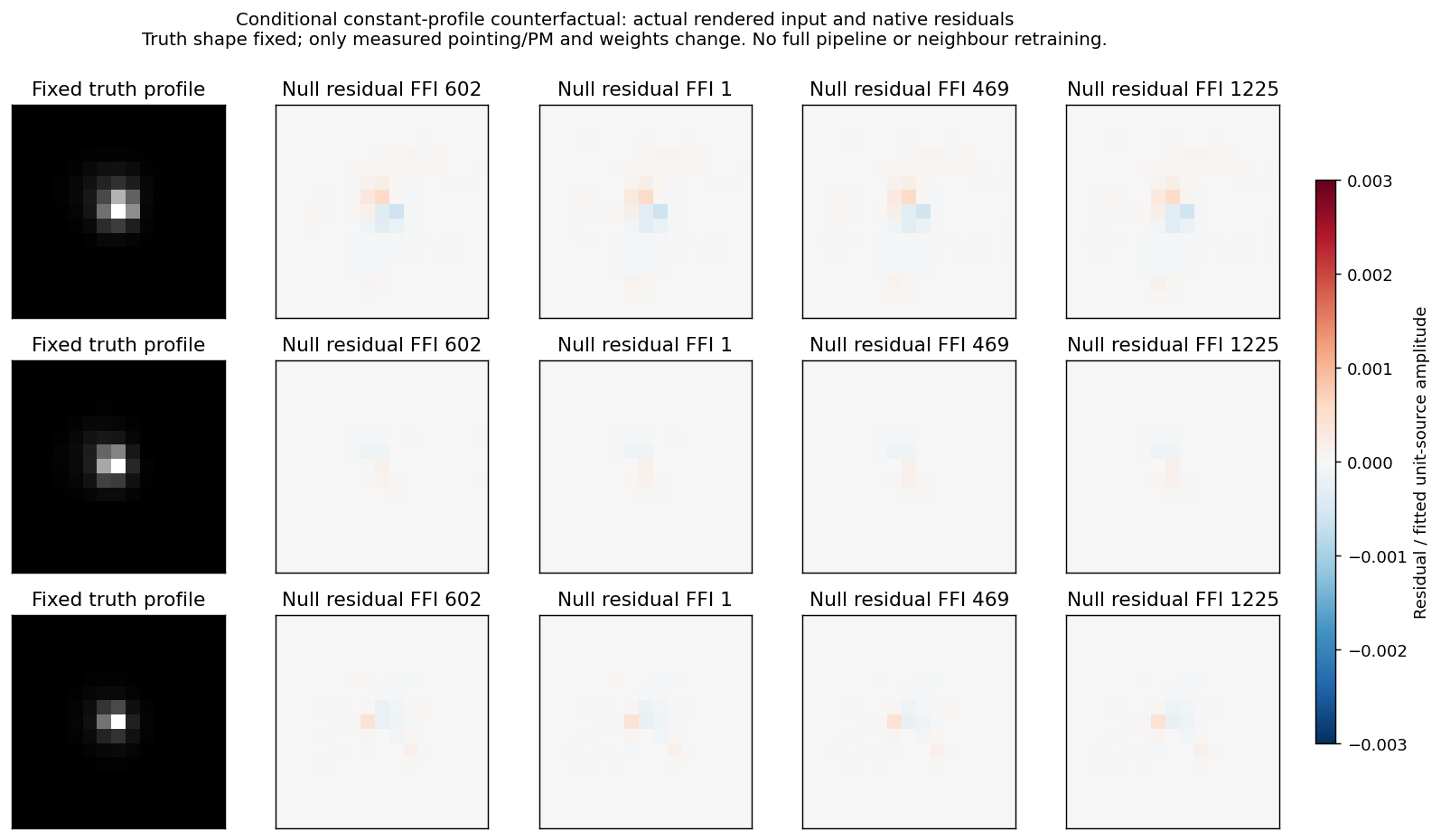
Inputs and native residuals for the conditional static-PSF-field test. The truth field is fixed while pointing/PM and weights change; no neighbour or global-WCS retraining is included.
Apparent response changes in that restricted null. This is a sensitivity test, not a bound on all real instrumental errors.

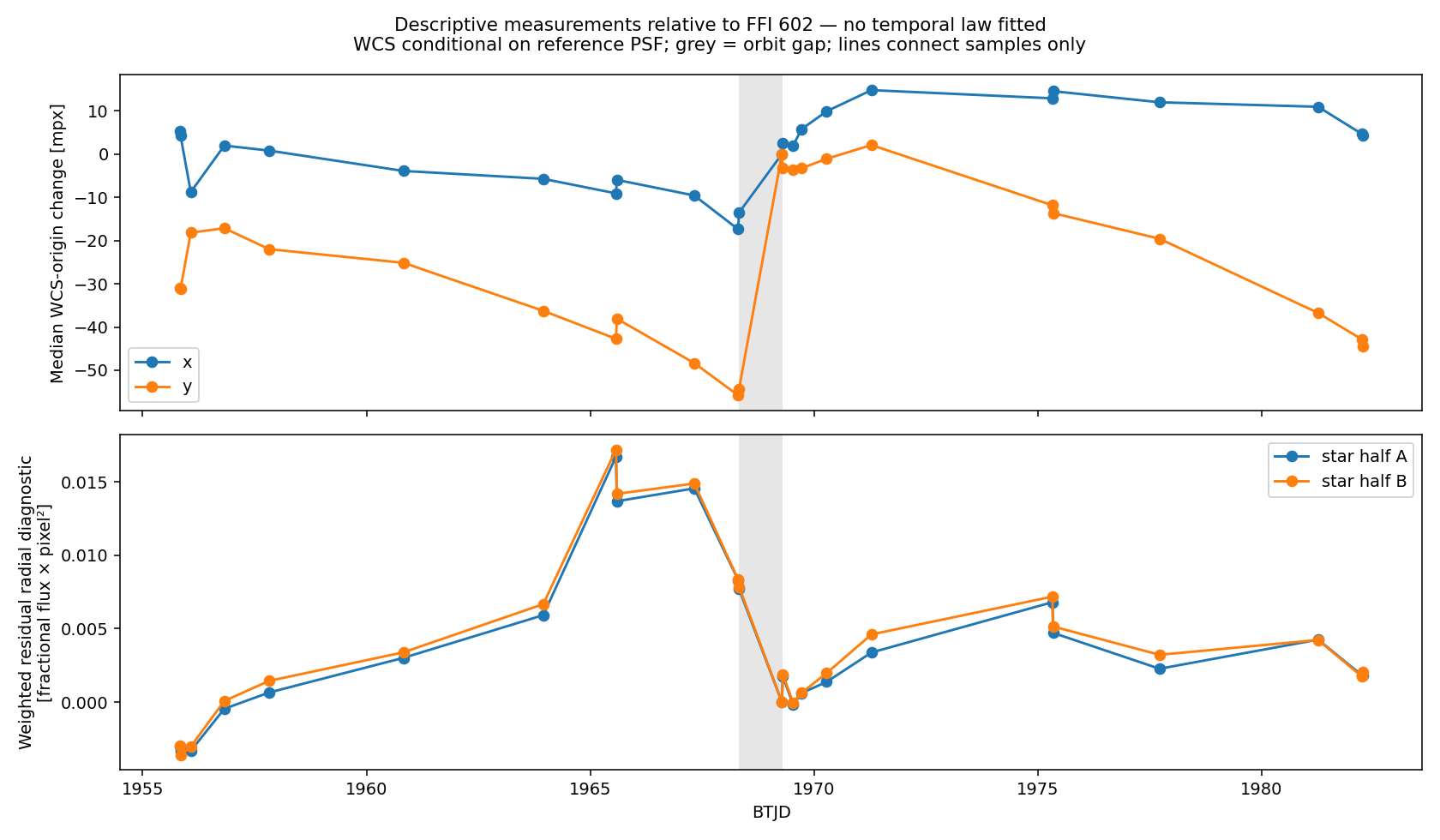
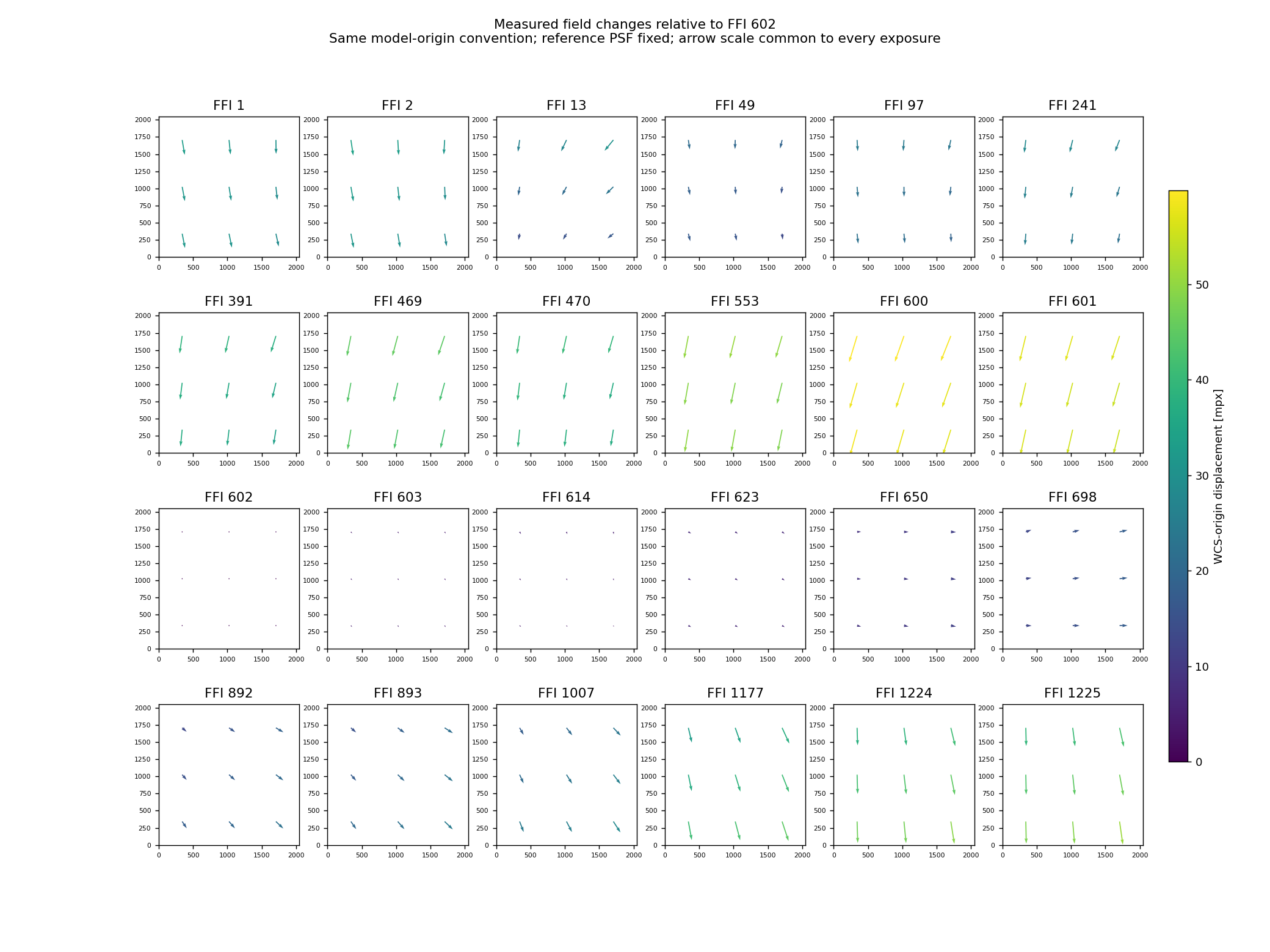
Across 24 snapshots, the median WCS-origin displacement spans 32.2 millipixels in x and 57.9 in y, conditional on the fixed reference PSF. The equivalent covariance-trace response has Pearson correlation 0.982 with camera jitter trace (an association, not a calibrated physical law). All 24 first-stage fits reached the existing plateau criterion.

Shared colour × magnitude × CCD residual grids: all 24 WCS fits and four full controls. Legacy raster-grid annotations are distinct from the calibrated native-pixel response diagnostics here.
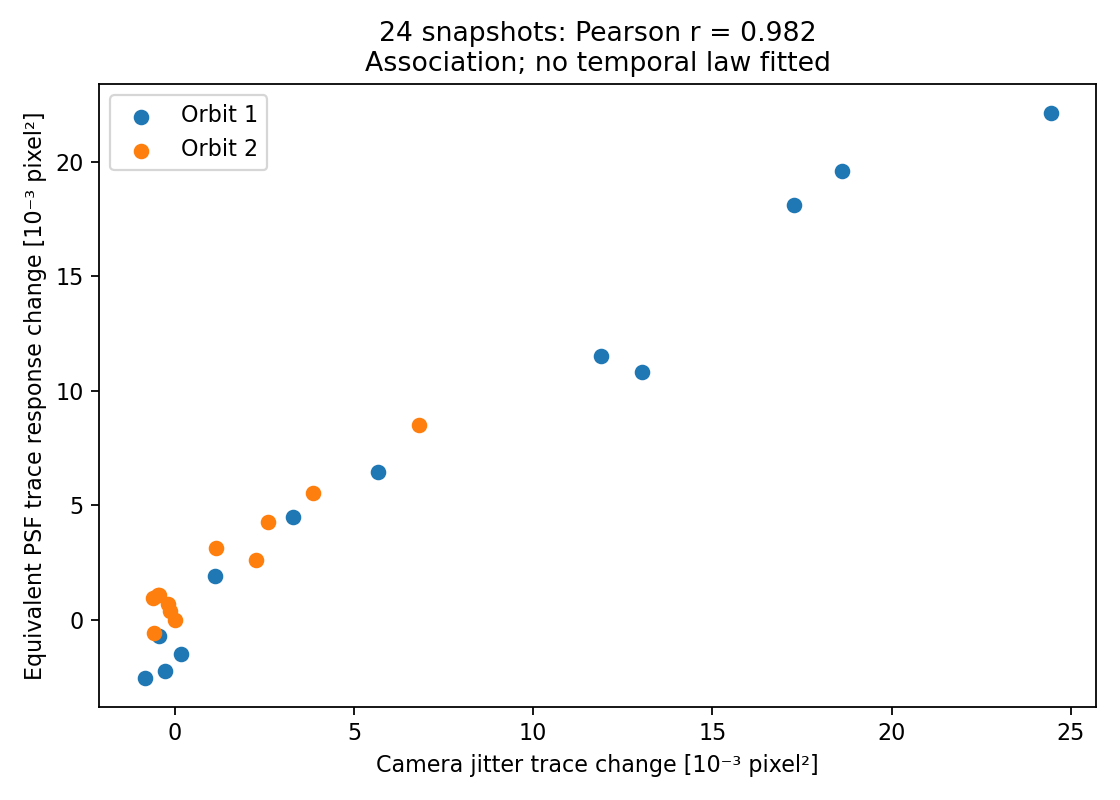
Measured trace response versus camera-frame jitter, with both orbits distinguished. The underlying images are shown above and in the full residual history below.
Spatial displacement maps relative to FFI 602. These are consistent model-origin positions, conditional on the reference PSF, not absolute astrometric truth.
Descriptive position and residual-shape histories. The star-half comparison checks reproducibility; it is not an independently trained WCS validation.
Underlying residual images and reference differences on a shared colour scale. Rasterization is for display and does not supply additional subpixel information.
Native-pixel equivalent covariance/shift changes and conditional held-pixel prediction. These are local diagnostics, not a fitted temporal mode or a certified optical mechanism.
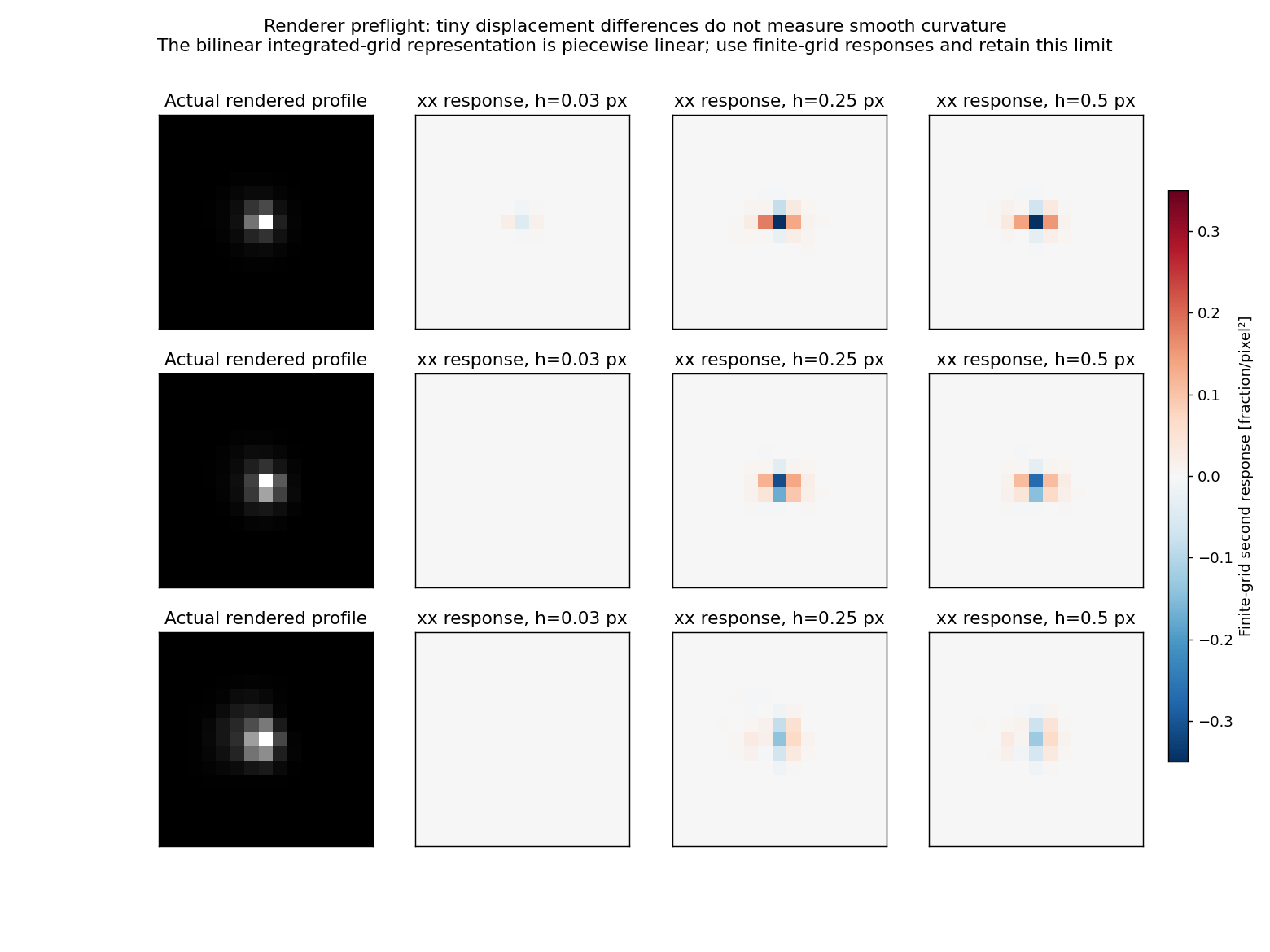
Renderer calibration: native model profiles and finite-grid curvature responses. Tiny-step curvature is unreliable for the piecewise-linear interpolation; the measurement uses separate position and Richardson-corrected grid-scale shape responses.

Method and limits

ComponentContract
CodeIsolated main-based branch codex/s24-temporal-measurement-20261016, based on 278461c1. Live production checkout untouched.
PSF and sourcesRun5 paper1_final_step1 radial/coma colour model; verified assoc_r2 removed neighbours to T=17. Original 18,334 source identities, including 6,857 nuisance sources, retained.
Image generationCurrent calibrated F=4 bootstrap template, exposure-specific Hotpants kernel and rf5 background policy. These are preliminary images, not a completed temporal per-band final-image chain. Only the smooth background seed/mask geometry is transported; science pixels stay native.
Reference checksAccepted-background replay agrees within floating-point representation; exact zero-time replay of baked source geometry. Differential proper motion is applied without changing the reference projection convention.
MasksScience-fit support retains bright-star cores; kernel-fit exclusion flags are not science rejection masks. All exposures share scored support after finite/dynamic/defect checks.
Local responsePer-exposure profile derivatives measure shifts and three second-order shape responses, with amplitude/background free. Detector checkerboard halves compare held-pixel prediction with and without shape terms. Known-shift/blur analytic Gaussian integration tests pass; this does not certify the real PSF model.

Remaining attribution checks include shape–position coupling, independent source groups, static-profile/subpixel sampling errors, template/background sensitivity, and variability preservation. Lower residuals alone do not establish unbiased fluxes. No per-star detrending or constant-flux constraint is applied.

Preflight corrections

A provisional alternative background seed was archived and abandoned before science fitting. The draft measurement harness also confused Hotpants kernel-fit flags with science support; a population-retention check caught the lost stellar cores, and support was corrected before fits. Missing proper motions remain recorded rather than invented.

Durable record: /astro/armin/koji/syndiff/dev_runs/s24_temporal_measurement_20261016/README.md. DAG 7970, plscience3 schedd. This page is a saved checkpoint, not a live scheduler dashboard.

Conclusion at this checkpoint

The completed controls establish a substantial directional shape change in the high-jitter processed image, with centre-convention changes tracked separately. All 24 selected exposures are measured. Directional broadening is strongly associated with jitter, while WCS motion and model-centre conventions must be treated separately. No temporal law or light-curve precision floor is accepted. Next compare orbit-wise WCS splines and constrained shape models on held-out exposures and sources, then test injected variability recovery before choosing a mode.