source /astro/armin/koji/syndiff/dev_runs/faint_cog_20261009/scripts/env.sh
python /astro/armin/koji/syndiff/dev_runs/weight_residual_stacks_20261019/objective_comparison/compare.py
One exact global normalization constraint per arm matches the mean radius-3 aperture flux of mid-colour (BP−RP 0.8–1.2) TRAINING stars. This prevents dipole-only fitting from arbitrarily changing overall brightness. It differs from the previous diagnostic's all-sample median normalization, so absolute numbers should not be spliced between the two experiments.
A fixed linear projection inside radius 3 pixels decomposes each residual into the adopted model profile, its x/y gradients, and a constant. All four basis columns are solved simultaneously, separating gradient coefficients from profile amplitude and constant sky. The adopted model includes the frozen local scene; consequently these are gradient-mode coefficients, not independent astrometric centroid measurements. The x/y gradient coefficients $d_{xs},d_{ys}$ have equivalent-displacement units of pixels. Their signs follow the gradient basis, not an asserted physical displacement direction. An asymmetric profile mismatch can contribute to them.
The joint objective is $$J=\sum_s\frac{1}{n_{g(s)}}\left[\left(\frac{f_s}{0.01}\right)^2+\lambda\frac{d_{xs}^2+d_{ys}^2}{(0.01\,{\rm pixel})^2}\right].$$ Here $f_s$ is the data-minus-model radius-3 aperture flux divided by fixed catalogue flux (dimensionless); $g(s)$ assigns a star to one of six colour × magnitude bins; $n_{g(s)}$ is the number of training stars in that bin, giving each bin equal total influence. The denominators are chosen trade-off scales (1% flux and 10 millipixels), NOT estimated measurement errors. $\lambda$ is dimensionless: 0 for flux-only, 1 and 10 for the joint trials. Dipole-only omits the flux term but retains the common mid-colour normalization constraint. Fits use non-negative coefficients and SLSQP on the convex quadratic objective with an exact linear constraint.
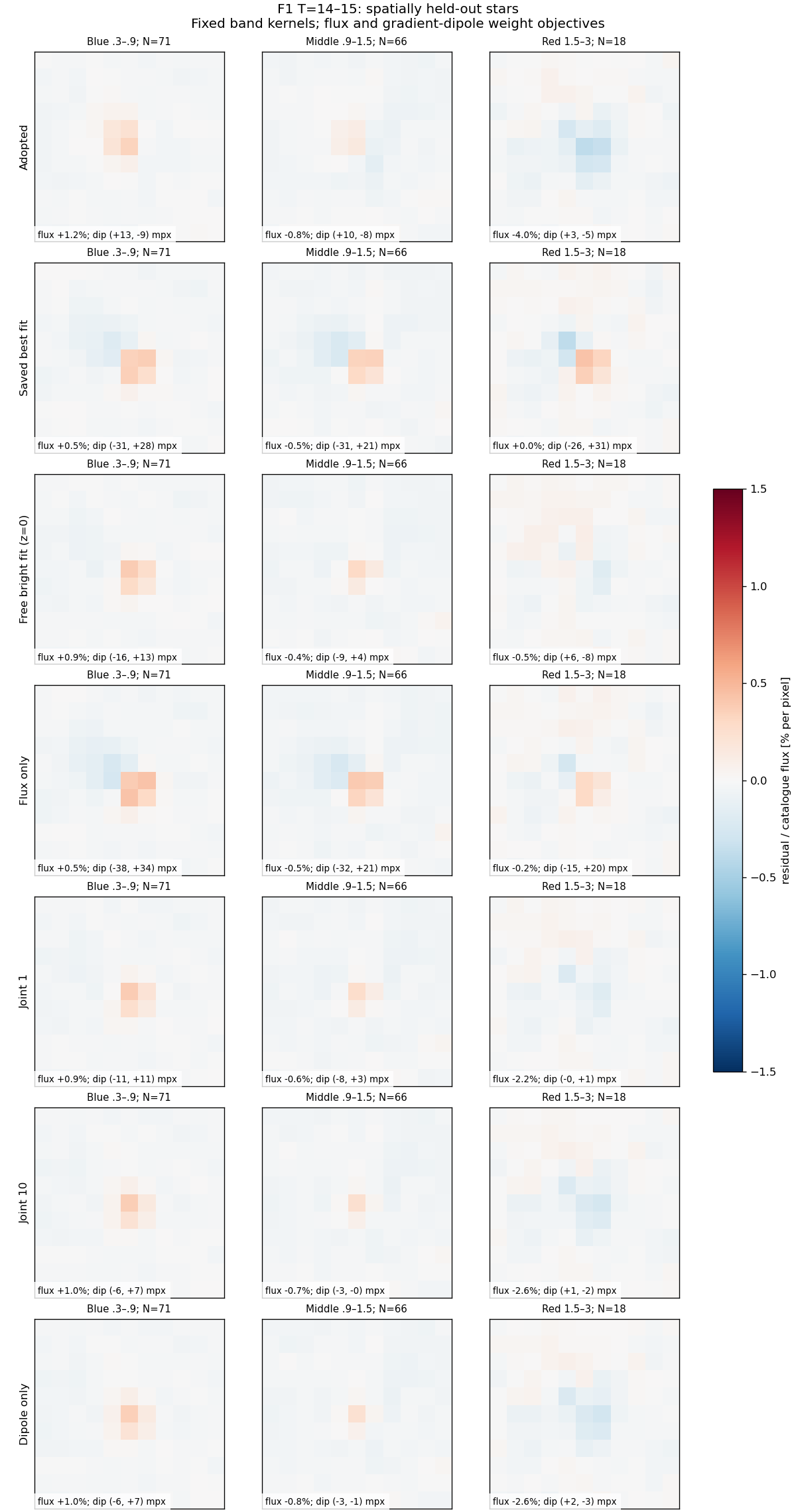
Bin errors in results.json are star-bootstrap scatter with weights and normalization fixed; they omit fitted-weight uncertainty and correlated spatial/calibration errors. No formal significance is attached to small differences between joint methods. The red T14–15 held-out bin has only 18 stars; T15–16 has 37. This is one spatial split on one historical FFI, so no universal optimum is established. Colour/magnitude grids and pooled 3×3 spatial stacks are provided; the sample is too small for precise joint colour × magnitude × cell claims.
| Arm | r / i / z / y | Flux score (%) | Dipole score (mpx) | Stack pixel RMS (%) |
|---|---|---|---|---|
| Adopted | 0.2540 / 0.4368 / 0.1654 / 0.1438 | 2.94 | 14.0 | 0.135 |
| Saved best fit | 0.2950 / 0.4505 / 0.1320 / 0.1225 | 0.99 | 42.8 | 0.164 |
| Free bright fit (z=0) | 0.3356 / 0.4307 / 0.0000 / 0.2338 | 1.52 | 13.4 | 0.106 |
| Flux only | 0.3863 / 0.2550 / 0.2647 / 0.0940 | 0.77 | 40.6 | 0.160 |
| Joint 1 | 0.3325 / 0.3417 / 0.1817 / 0.1440 | 1.72 | 11.3 | 0.107 |
| Joint 10 | 0.3324 / 0.3068 / 0.2383 / 0.1226 | 1.99 | 6.6 | 0.111 |
| Dipole only | 0.3420 / 0.2671 / 0.2876 / 0.1033 | 1.97 | 6.1 | 0.114 |
Train: 310; test: 303.
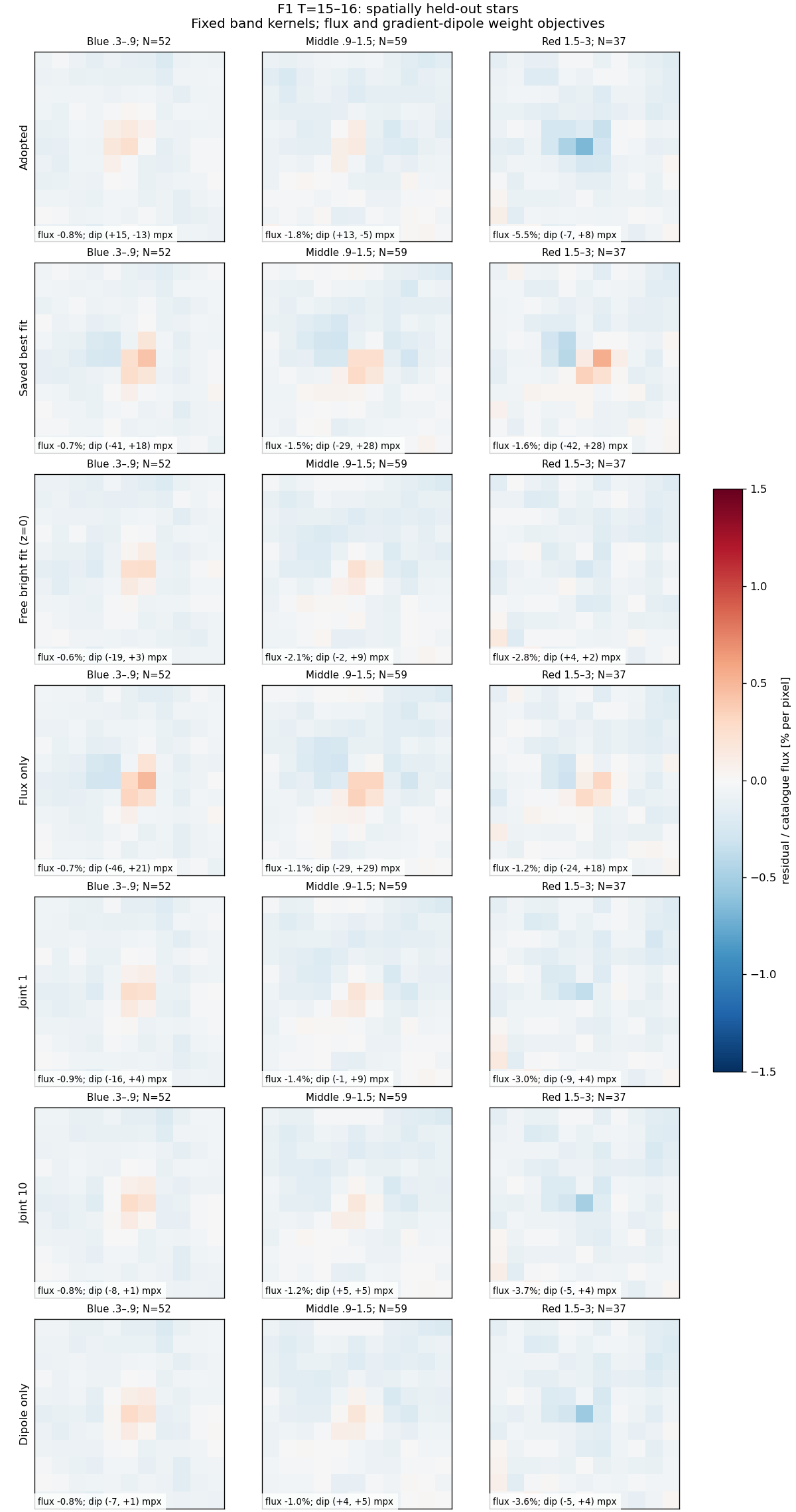
The saved and flux-only mixtures leave a coherent diagonal positive–negative core in both magnitude bins. Joint and dipole-only arms attenuate it, but the red negative core returns. The blue and middle-colour positive cores also remain. All residual panels share the same ±1.5% scale; annotations are per-star median aperture/gradient measurements, not sums of median stack pixels.
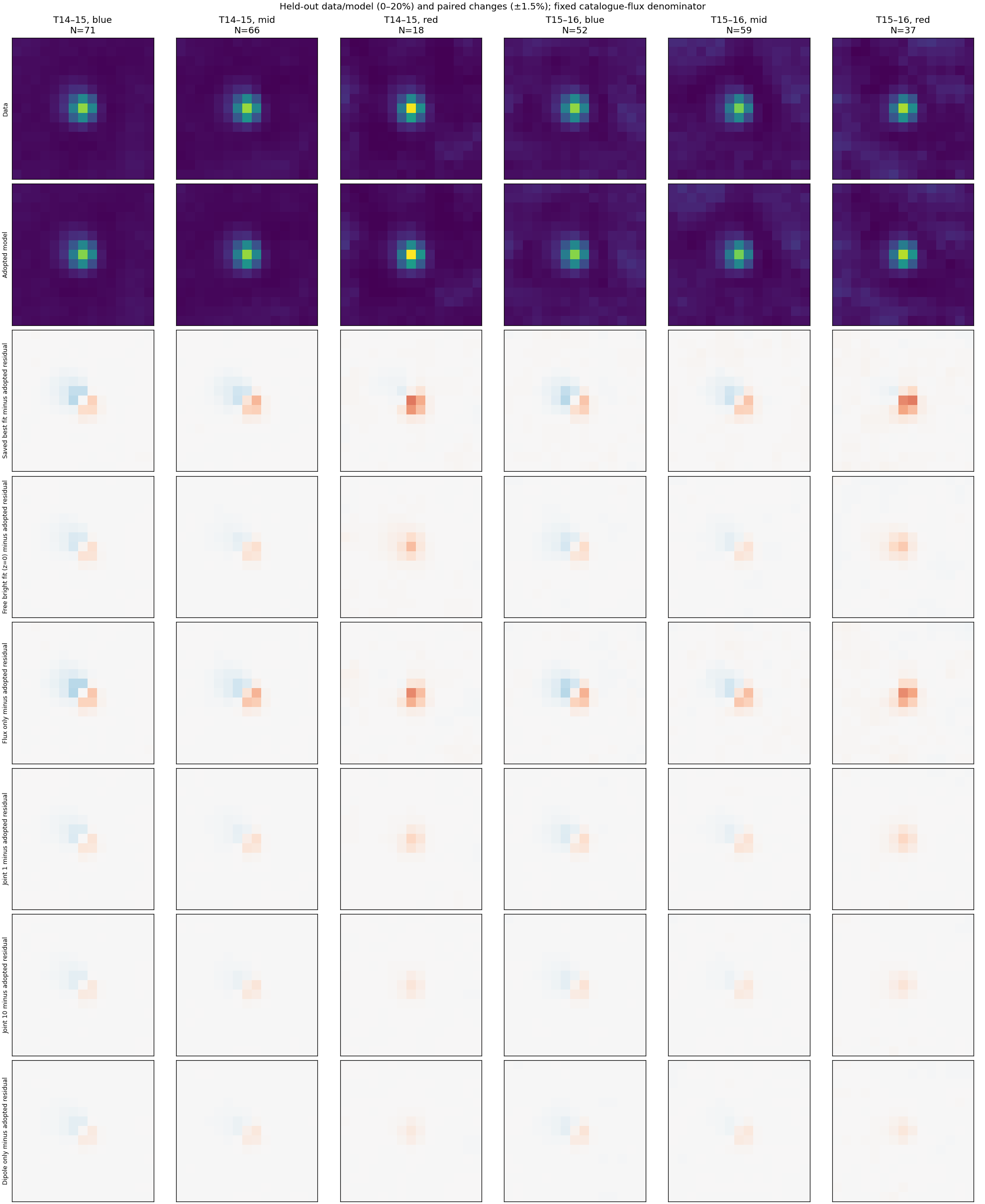
The data and adopted model use the same 0–20% display scale. Each other row is the median paired residual change from adopted, using the same stars and ±1.5% scale. These show how altering weights moves light spatially as well as changing total subtraction.
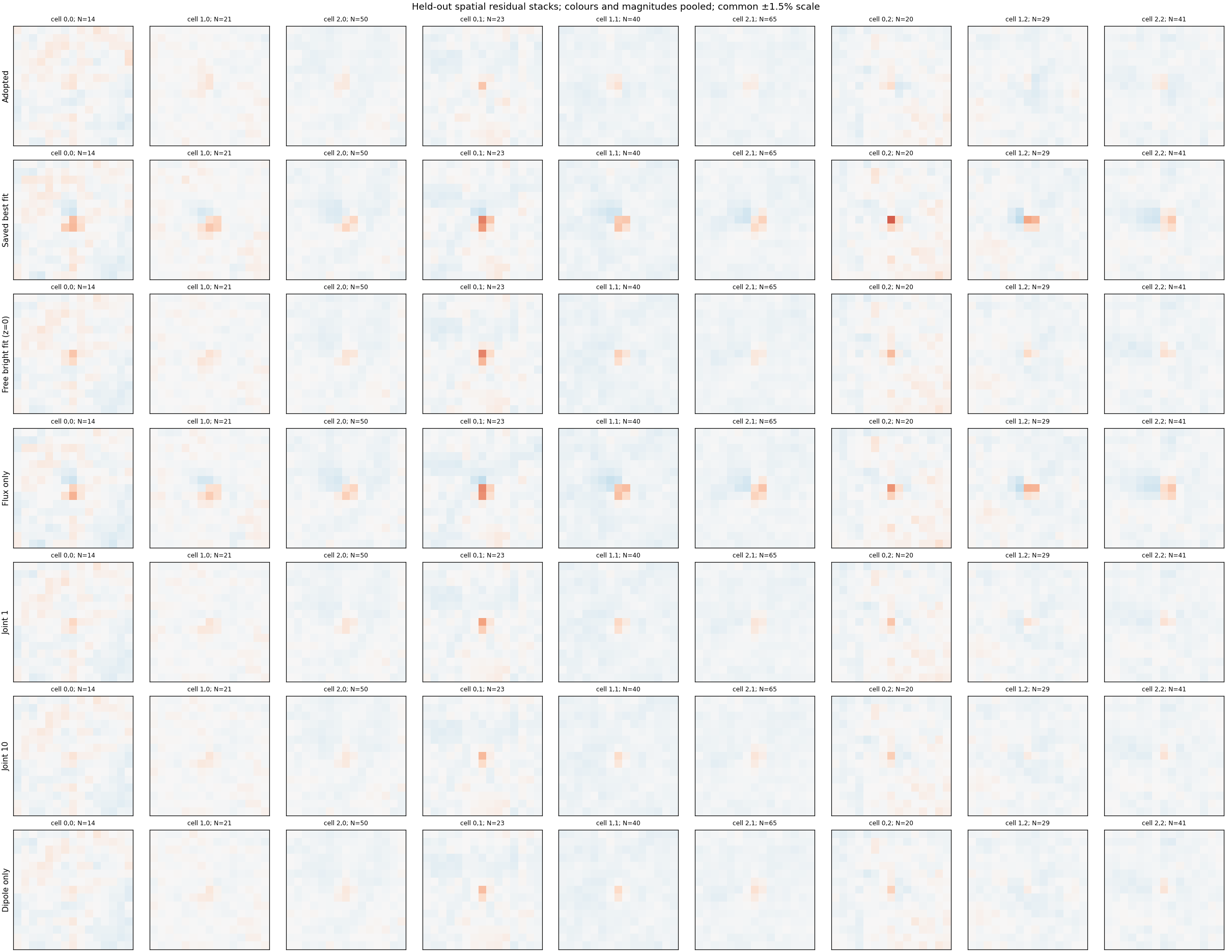
Nine detector cells, pooled colours/magnitudes, same ±1.5% scale; counts shown. Spatial heterogeneity persists. Pooled cells are not matched for their colour/magnitude composition.
Conclusion: fitting a dipole penalty works, but the fixed four-band mixture has a trade-off on these images. The next discriminating experiment is to allow a separately constrained spatial displacement alongside the spectral weights, keeping held-out evaluation and flux/shape metrics separate, then replicate on current paper products and other fields. A broad conclusion about true bandpass weights is not warranted by this single-field test.