Approved implementation: Gaia + PS1 ledger plan · Progress and validation.
Paper C4: sector 23, camera 4, CCD 2 · 2026-10-02 · frozen footprint_v1 recipe e17a198a4942aa2d
No production code, catalogue, template, or fit was changed. This report and its supplementary CSVs describe the existing products; they do not replace their authoritative ledger.
The code first detects PS1 sources with SEP, masking bright cores, then zeros pixels outside detected source segments and the bright-core mask. It forms connected components from source segments, bright-core pixels, and pixels carrying both the PS1 saturation and star-core bits.
The bright-star pass uses catalogue TESS-equivalent magnitude T<13. It zeros the selected component within a 480-PS1-pixel disc around the triggering star. The saturation-flag pass can zero remaining whole components. Thus the deleted object is a pixel footprint, potentially containing several sources or fragments of a halo. It is not a fitted, individually subtracted star.
The accounting catalogue is Gaia DR3 RP<18. Here RP is Gaia red-photometer magnitude; G is Gaia broad-band magnitude; T is the pipeline's Gaia-derived TESS-equivalent magnitude. The removal trigger threshold and catalogue completeness limit are different quantities. There is no ordinary radial Gaia cross-match in the footprint ledger: assignment tests the rounded catalogue centre's component label.
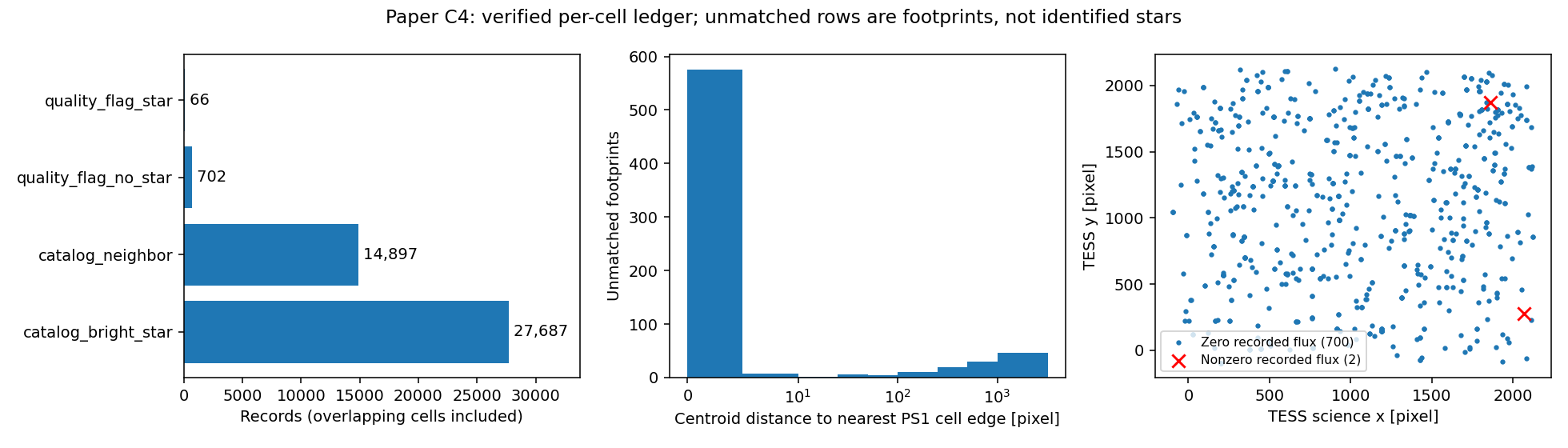
Re-read all 975 authoritative cell ledgers, checked their saved SHA-256 hashes, recipe IDs and fingerprints. These are per-cell records; skycell overlaps mean they are not unique-star counts.
| Record category | Rows | Meaning |
|---|---|---|
| catalog_bright_star | 27,687 | Bright catalogue trigger |
| catalog_neighbor | 14,897 | Catalogue centre sharing a selected component |
| quality_flag_star | 66 | Catalogue centre inside a flag-selected component |
| quality_flag_no_star | 702 | No in-cell catalogue centre assigned; this is a component record |
There are 43,352 rows and 33,571 distinct known Gaia IDs. Of the 702 unmatched components, 700 have zero recorded flux; 582 centroids are within 10 PS1 pixels of a cell edge. A zero sum alone is not a full pixel-level proof for all 700. Four zero-flux components in the replayed cells were checked directly: all their pixels were already zero before the saturation pass.
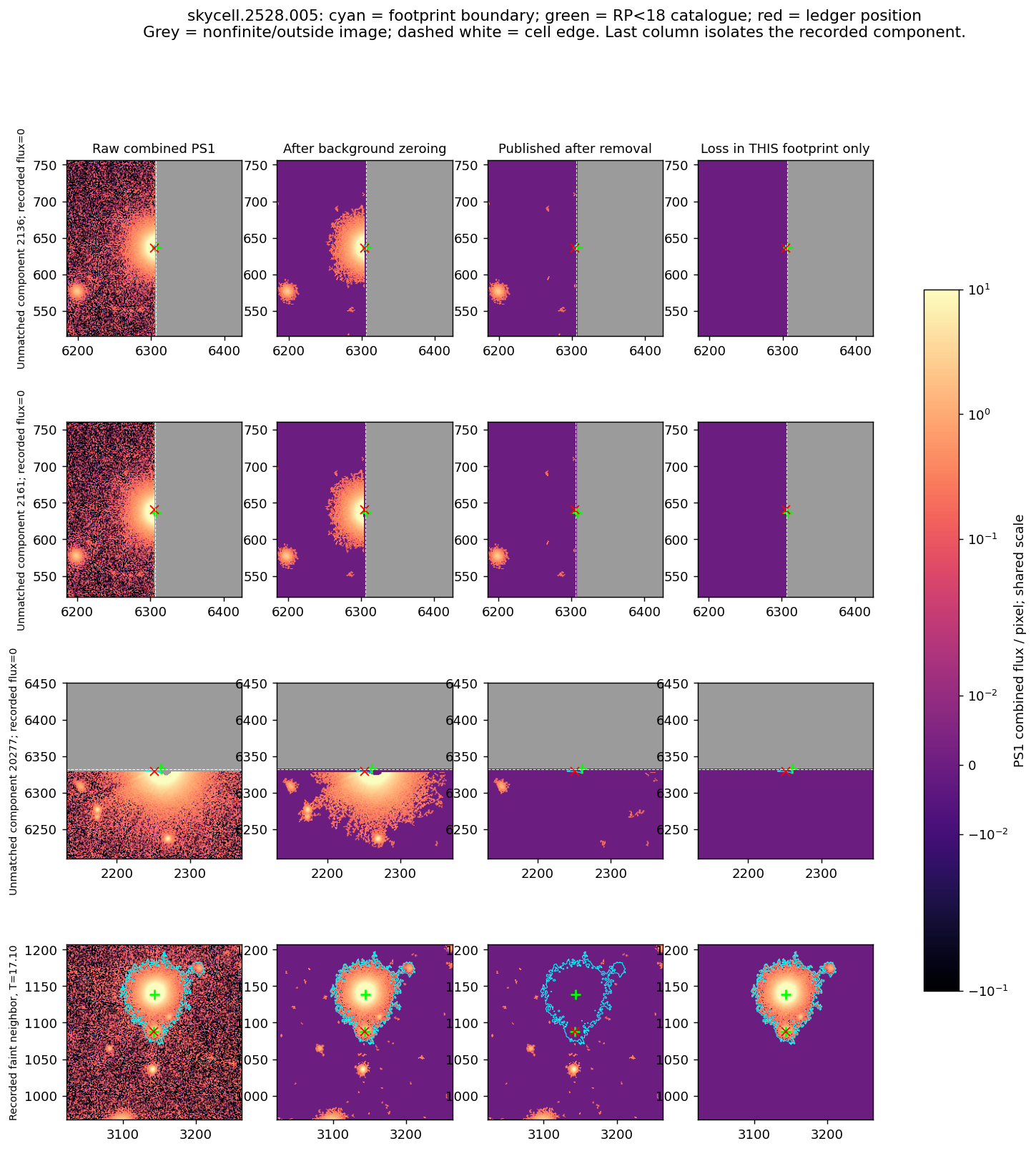
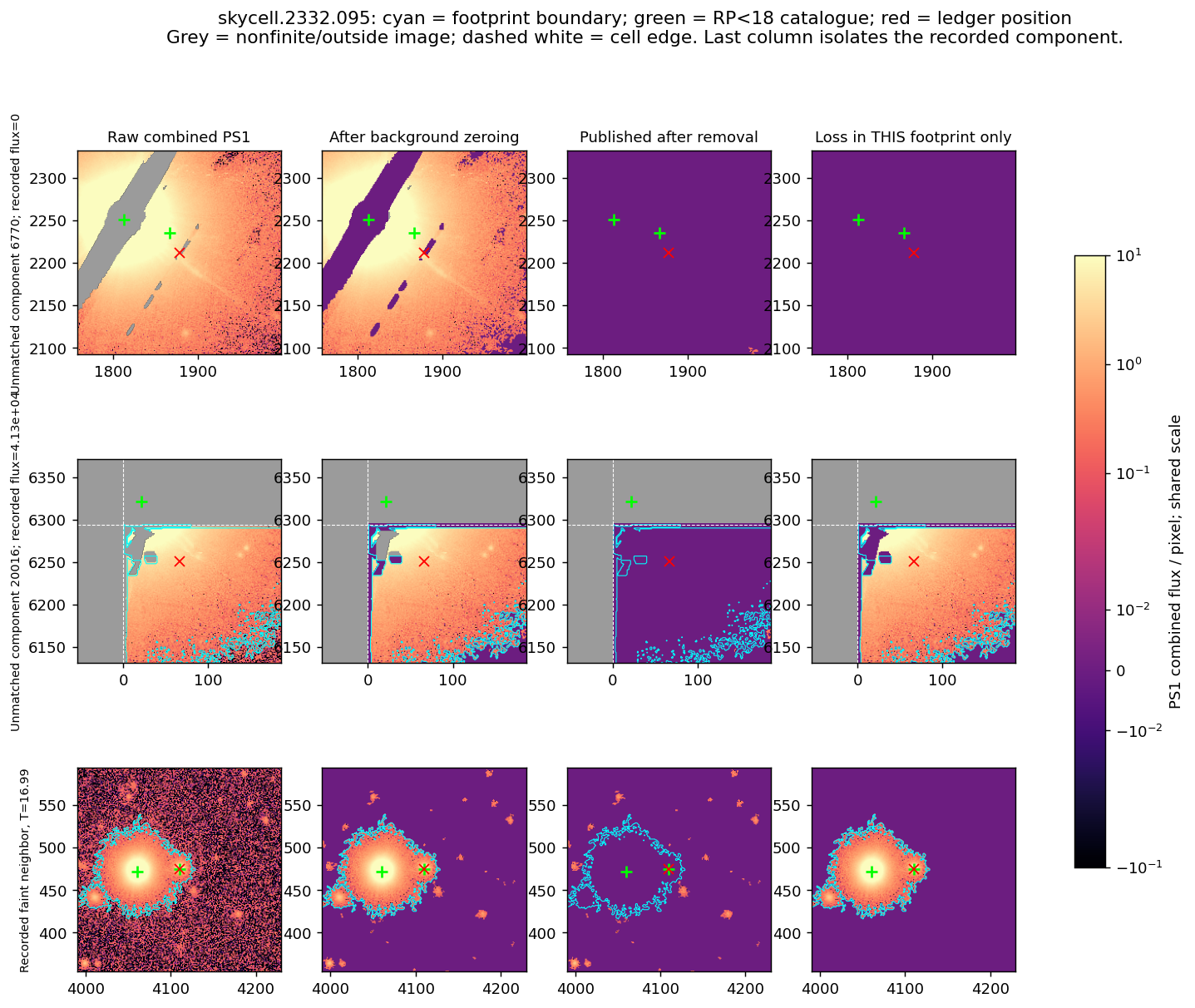
Both have a nearby bright Gaia source already present in the projection catalogue, but centred outside the skycell. The primary off-cell lookup returns no usable pixel within its ten-pixel inward search. The later saturation pass removes the halo; its association loop considers only in-cell catalogue centres, so the bright source is not eligible and the record receives source_id=-1.
| Cell / component | Nearby Gaia source (candidate association) | Geometry and validation |
|---|---|---|
| 2390.080 / 16237 | 2150034897230546432; T=9.30 | Star x=-2.89 PS1 px, just outside left edge; 30.69 px from flux centroid. Whole-cell replay exactly equals published image. |
| 2332.095 / 20016 | 1415769418609732096; T=7.29 | Star y=6320.95 PS1 px, beyond upper edge; 83.11 px from flux centroid. Whole-cell replay exactly equals published image. |
The images support bright-star halo associations. These are labelled candidates in the supplementary table, not blindly substituted IDs. A centroid distance is not a calibrated cross-match probability, and a halo can contain additional faint sources.
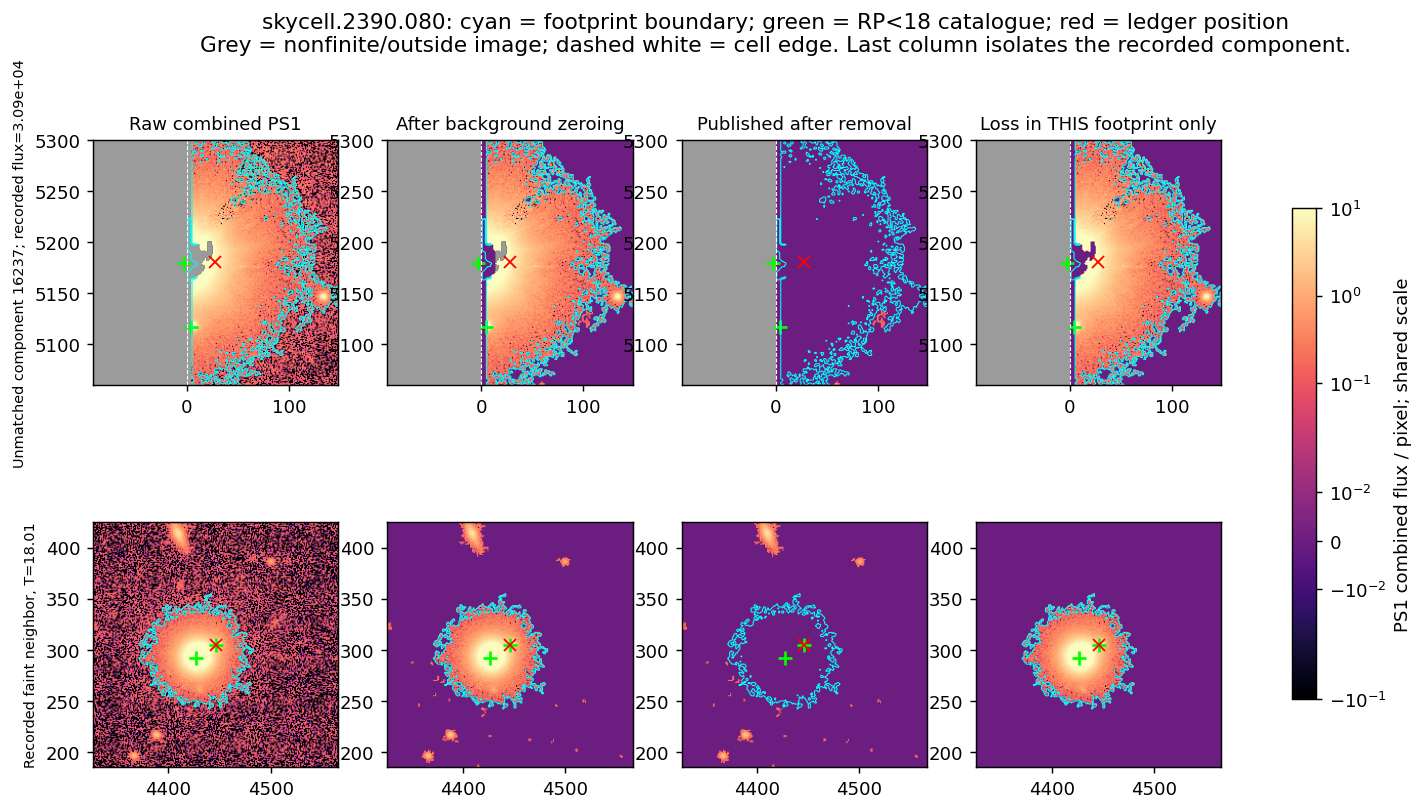
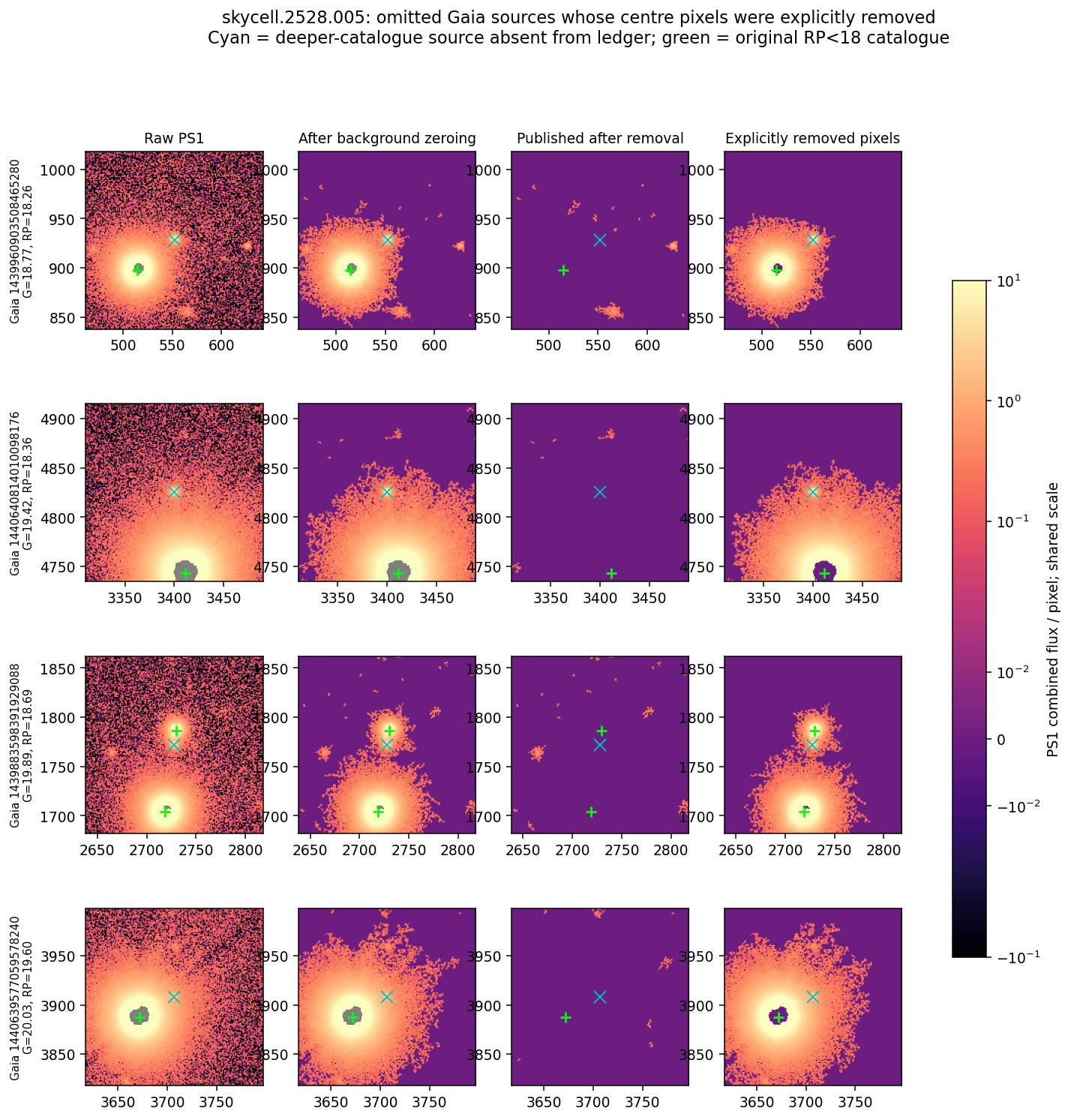
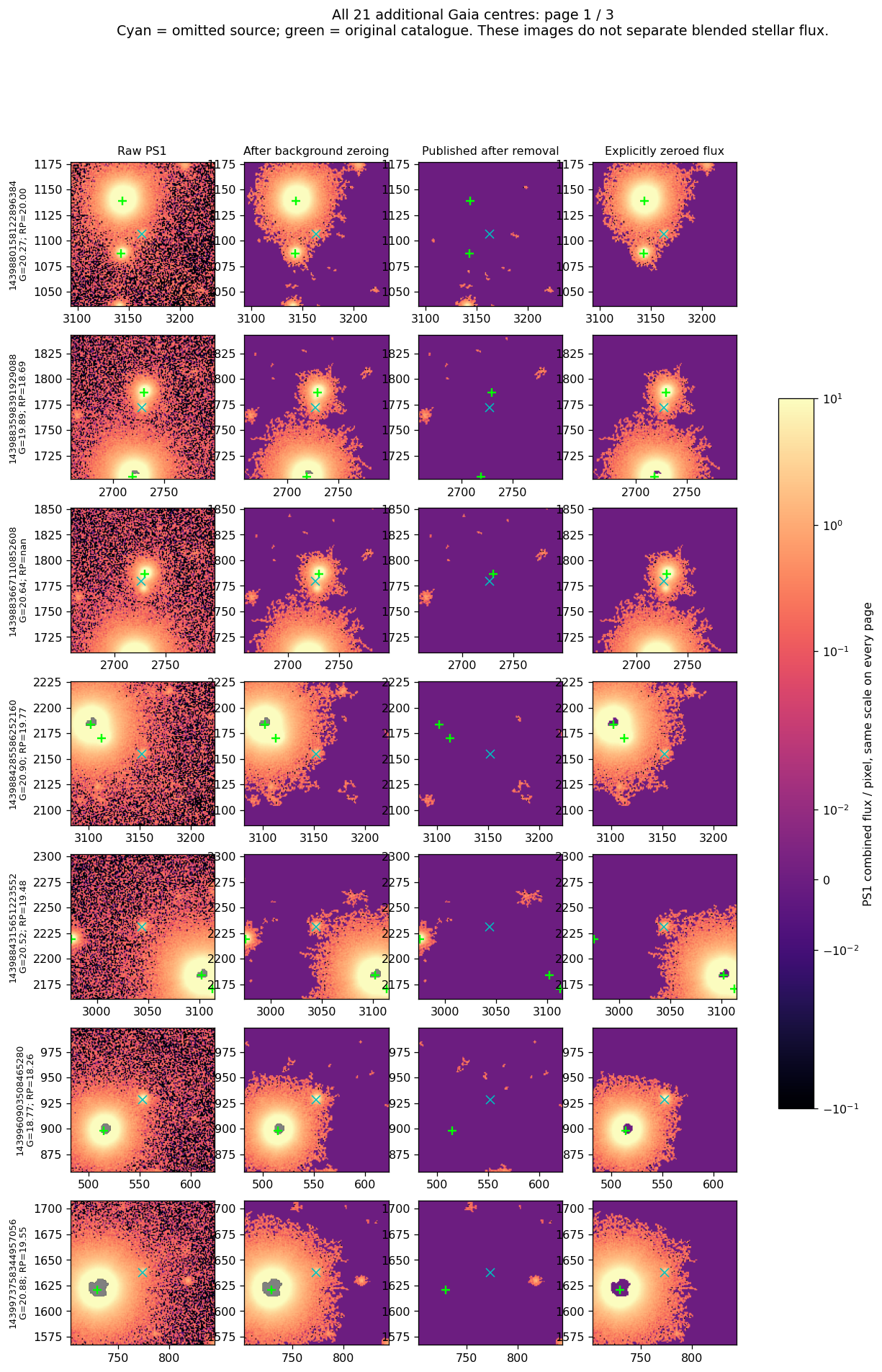
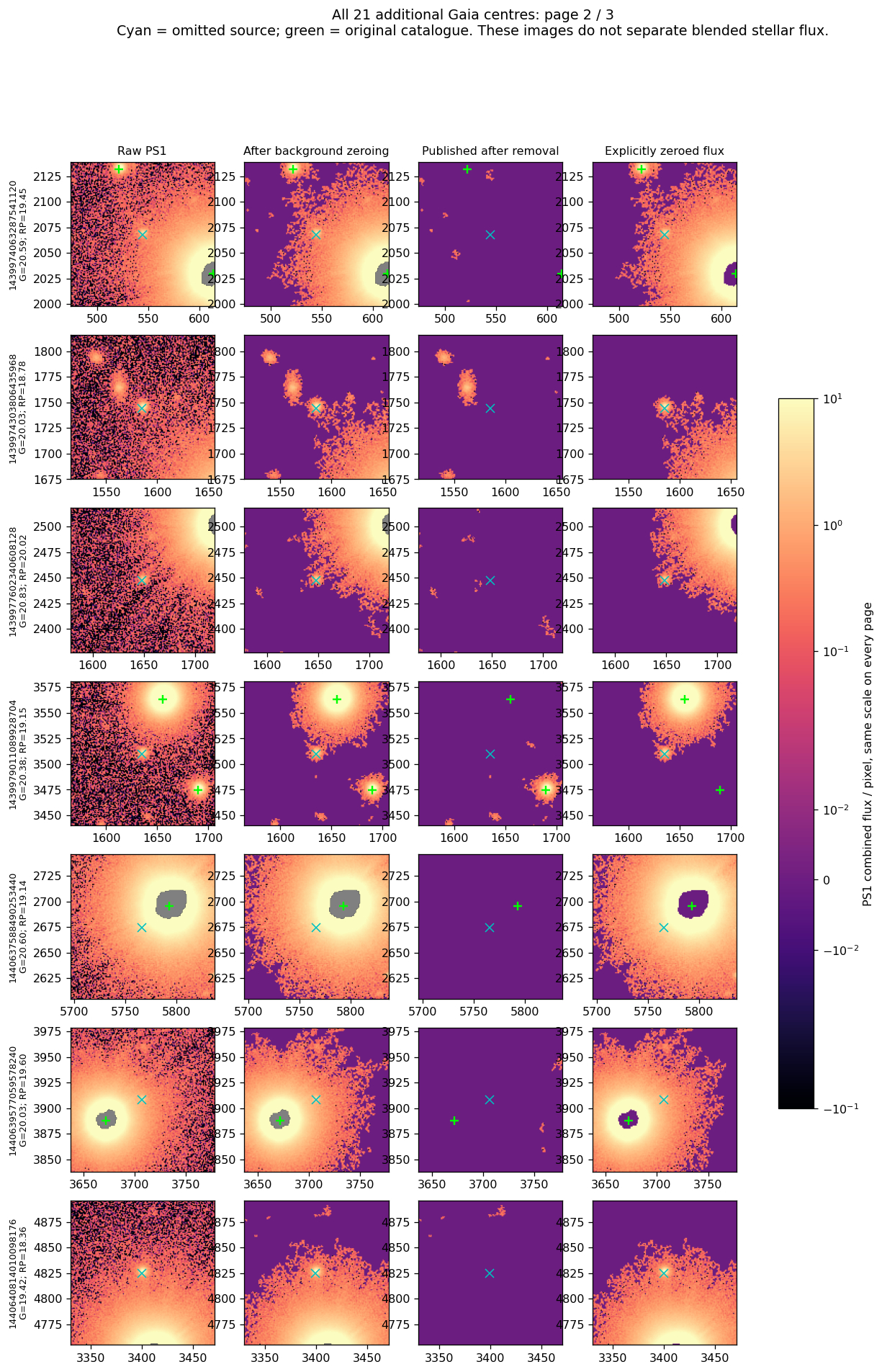
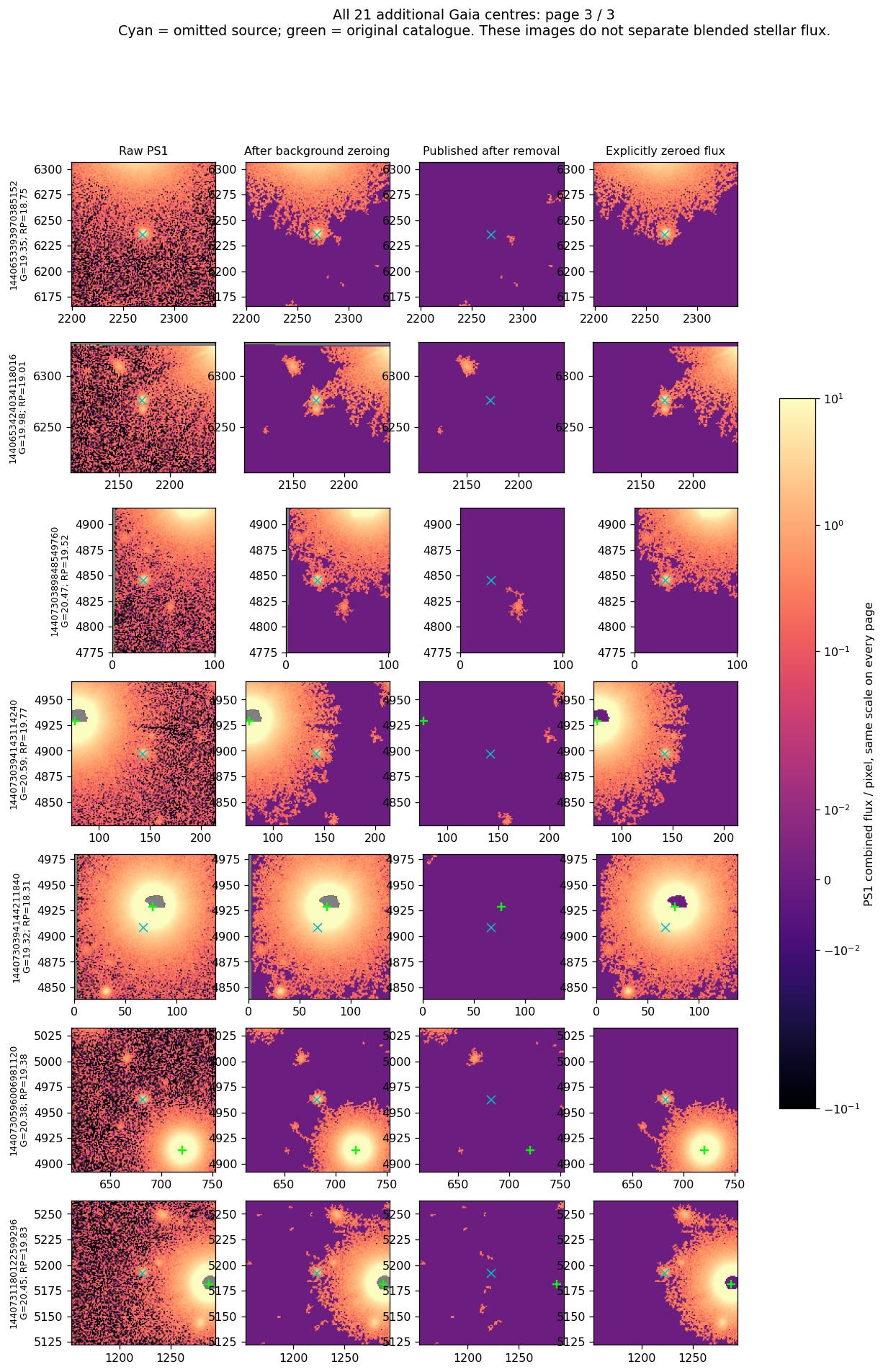
For cell 2528.005, queried an independent deeper Gaia DR3 catalogue with G<21 and no RP requirement, then projected it with the same WCS. Of 1,437 in-cell sources, 764 are absent from the original input catalogue. 21 of those absent sources have finite, nonzero centre pixels after background suppression that become exactly zero in the published source-removal output. Twenty have RP≥18 and one lacks RP. None of the 21 is in the original removal ledger.
This is a direct lower-bound demonstration of incomplete accounting. It does not measure each blended star's removed flux, prove Gaia completeness below G=21, or account for partly deleted wings whose source centre survives. All 21 positions are shown below on the same flux scale. Grey marks nonfinite or unavailable pixels.
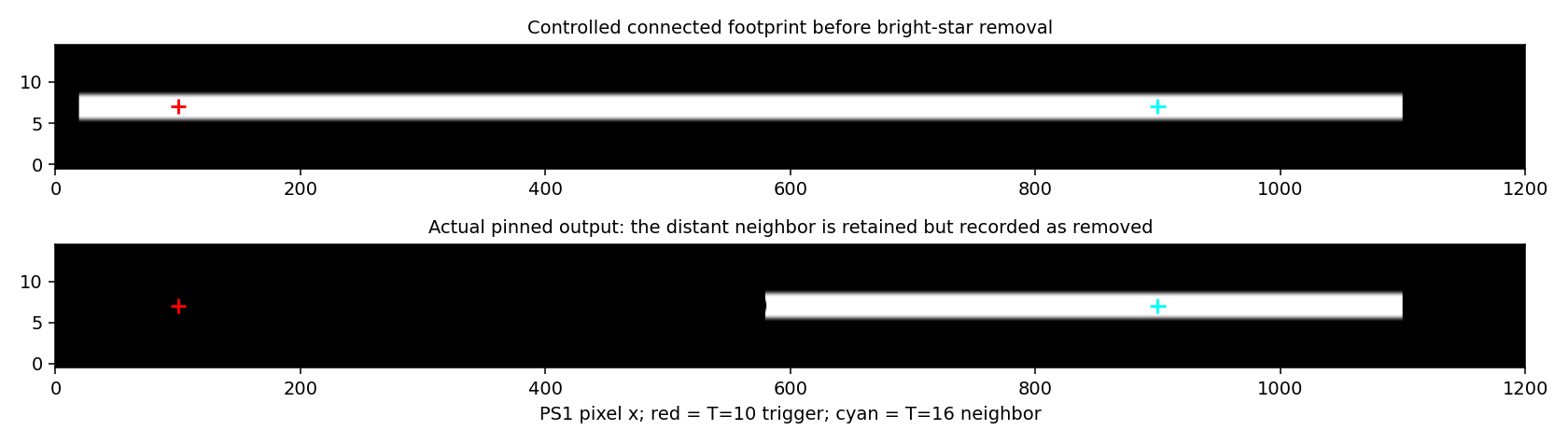
A controlled test using the actual pinned removal function and a known connected segmentation shows a distant faint neighbour recorded as removed even though its pixels remain unchanged. Removal applies the 480-pixel disc; neighbour recording tests only whether the component label was selected. This is a reproducible code defect, not a measured frequency across C4. No recorded in-cell source centre retained nonzero flux in the three real-cell replays.
Frozen-code replay matches every published pixel, including NaN locations, in cells 2528.005, 2390.080 and 2332.095: 118,950,692 pixels in total. The first uses a previously independently verified original-band cache; the other two were downloaded anew from PS1. Replay row counts also agree: 60, 78 and 37. Within the original RP<18 catalogues, these three cells have no unrecorded source centres explicitly zeroed by the star-removal pass. This limited centre check does not certify source wings or fainter populations.
Background suppression is a separate loss stage. In the first two cells one original-catalogue centre apiece was zeroed there without a source-removal record; this does not by itself demonstrate the loss of an identifiable star's full flux. Exact changed-pixel masks and catalogue-centre tables are saved for all three replayed cells.
The live checkout uses older segment-based removal, whereas these paper templates use footprint_v1. The legacy event export also drops source_id=-1 rows. Those observations concern different paths and must not be confused with the verified paper ledger. No complete PS1-source inventory or deleted-pixel mask was persisted by the original paper removal.
Code pin: 648c0bcf4b559691177f7b4764f721ac54aebdc8. Data and figures: /astro/armin/koji/syndiff/dev_runs/ps1_removal_audit_20261002/. Source inputs: /astro/armin/koji/syndiff/dev_runs/paper_dataset_20261001/C4/bootstrap/; authoritative cell inventory: /astro/armin/koji/syndiff/dev_runs/epsf_stage_trace_20261002/fields/C4/tables/cell_inventory.json.