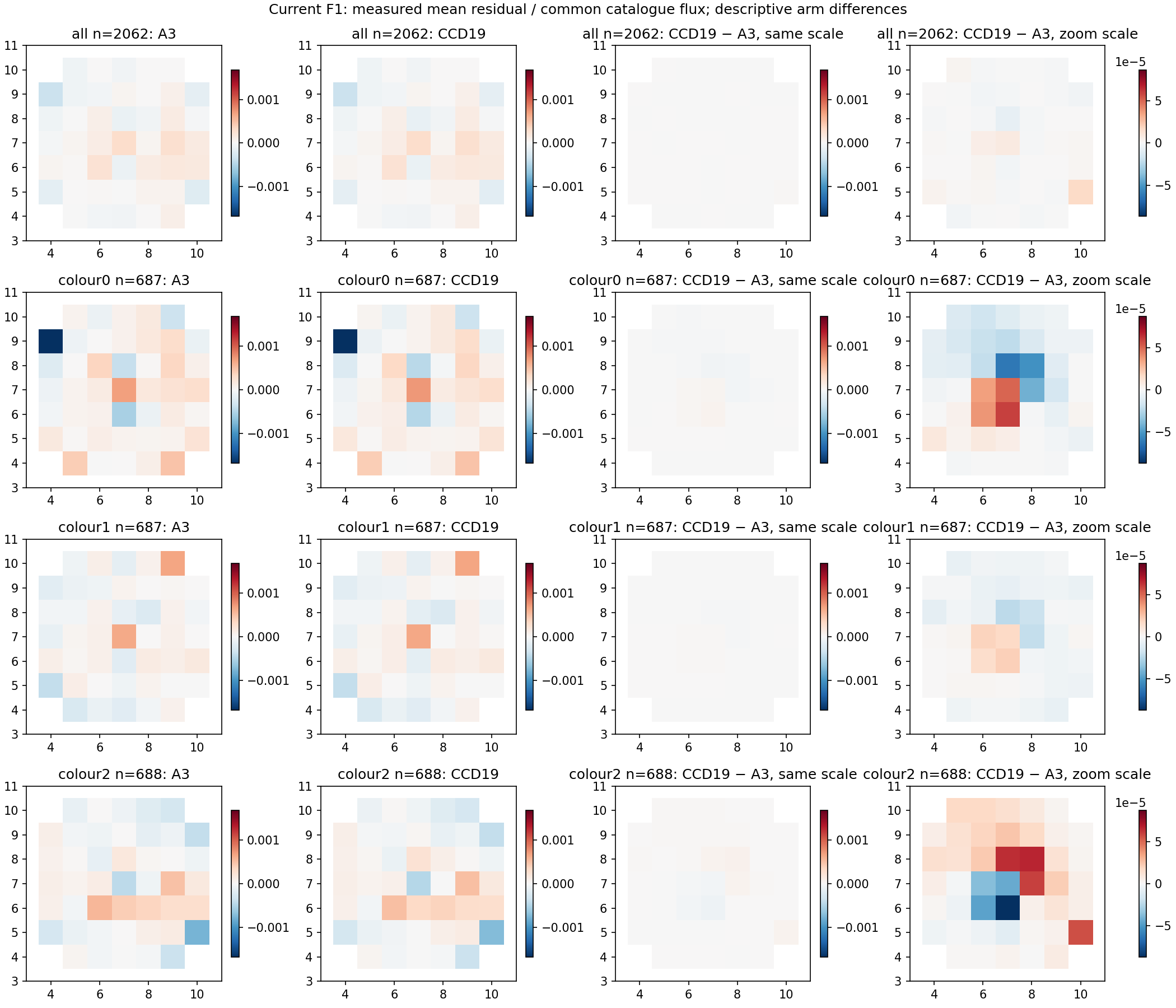
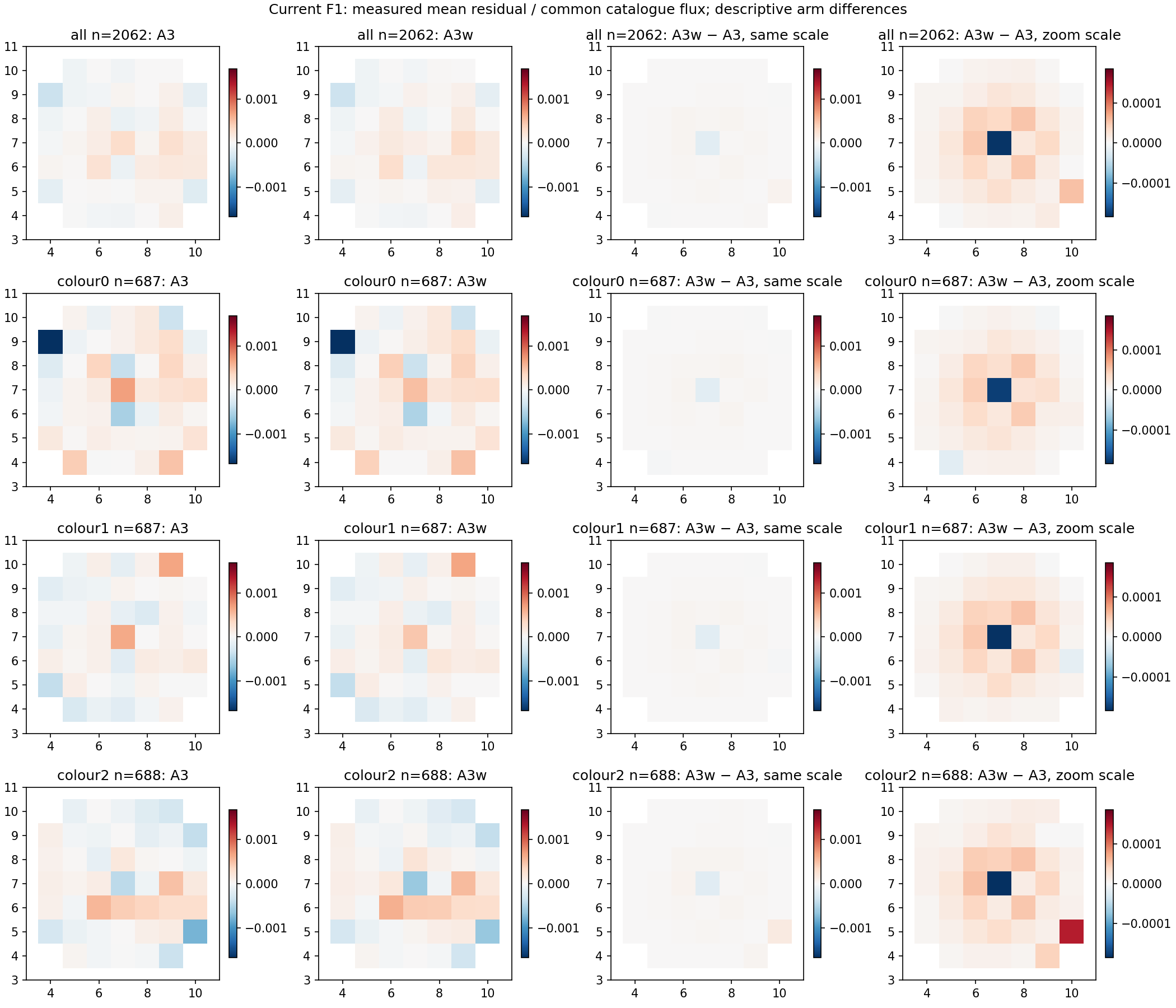
2026-10-04 conclusion: all three current full-generation F1 models (A3, CCD19 and fixed-width A3w) retain clear held-core structure relative to the supplied fixed-profile Gaussian reference. A compact central excess remains in descriptive median images; mean images also contain asymmetric structure and individual influential stars show dipoles. This is a failure of the stated conditional estimator/noise reference, not a physical “244 sigma” detection, an attribution to intrinsic magnitude width, or a comparison ranking the models. Neither CCD19 nor A3w shows a supported paired held-core score improvement over A3 in this development test. The prospective confirmation image has not been accessed by this analysis.
The input is /astro/armin/koji/syndiff/dev_runs/epsf_model_closure_20261004/models/inputs/full_generation/F1/scene_boot. Fits are the params_stage3.npz checkpoints beneath /astro/armin/koji/syndiff/dev_runs/epsf_model_closure_20261004/crossfit/F1_full_generation/fold0/{A3,CCD19,A3w}/fit/. The immutable renderer pin is 3609d467a7f17c9ed56a434d71f131ca5cf15528. Before loading any checkpoint, the frozen CCD adapter SHA256 49ad6a444f2470f203ec3526921c4f6cc861d11caabdb95214b95f16d0a267cb is installed. This prevents silently dropping the added parameter leaf.
Both evaluations exactly reproduce their stored native held-core chi-squared scores and fluxes: maximum differences are zero. CCD19 loads the nonzero coefficient pair (0.00122913, -0.00443268) in CCD pixels per recorded colour unit. Zeroing that leaf changes the native render; the independent native core ablation is recorded in the cross-fit verification. Our render manifest also records a nonzero ablation on the full held-source stamps; that full-stamp RMS is not the core-only RMS.
All three evaluations use 2,062 T8–13 stars, the same exact rows as the paired cross-fit evaluation. Selection requires original trainee role, fold zero, wholly held cores and at least 15 original valid radius-three pixels. It does not use residual, fitted flux, S/N or recentered-position cuts. All measured core pixels are held. Each amplitude denominator is the original catalogue flux times the single observed A3 prior scale, 165333458.6581584, shared unchanged by all three arms. The denominator is in electrons per second; the reported residual-mode amplitude is dimensionless, not integrated fractional flux bias.
All 14,733 scene rows, 14,731 unique source IDs and 2,262,747 unique physical pixels remain distinct in the solve. Two repeated numeric source IDs belong to nuisance rows; no ID dictionary is used to transfer parameters. Full row ordinal, source ID, bundle index and scene hash are preserved in each row_identity.npz and manifest.json. The scored IDs themselves are unique. The common-support audit verifies exact equality of rows, core masks, physical input data, catalogue denominators, colour boundaries, group counts, labels, and sparse measurement matrix between all three arms.
Groups are fixed by covariates: all stars; five one-magnitude bins; thirds of actual Gaia-XP colour u with boundaries 0.8000228876 and 1.0151295762; nine detector cells; and intersections of T=[8,10), [10,11.5), [11.5,13), colour thirds and the nine cells. Requiring at least 20 sources produces 50 groups × six modes = 300 measurements. Bright intersections lack broad support; marginal magnitude patterns cannot isolate a magnitude effect from colour and position. The exact test contract is saved in fixed_test_contract.npz and was enforced for the fixed-width arm.
The first three columns share one colour scale across both models and groups. The last column uses a separately labelled magnified difference scale. The mean correction has colour-dependent lobes, while the central residual present in both models remains. This figure is descriptive; no paired-difference probability is assigned.
A3w fixes the historical width coefficient at $b=0.8\times10^{-3}$ square CCD pixels per $10^4$ electrons per two-second read. Here $b$ is the configured extra blur covariance per axis, not a fitted coefficient in this comparison. Its flux-dependent proxy $q$ is the saved training-only quantity in bright_width_q.npz, with its recorded reference value 17184.419082832468 electrons per two-second read and the original cap. No held evaluation flux is used to regenerate $q$.
The frozen width adapter SHA256 ea46a5b518dbc3d0867fcc3e1477b9349b3f31a07153896e0c89ca7cc2bdbe35 is installed after the CCD adapter and before importing the build/score API. It restores $q$ by exact ordered source ID, bundle index, row ordinal and native geometry, not an ID dictionary. The CCD-shift leaf is verified exactly zero and frozen. The width coefficient is verified fixed, and zeroing it has a nonzero native rendering effect. Saved training-state flux and core-score replay agree with maxima of 0.000244 electrons per second and 2.861e−6 respectively; maximum per-row scaled errors are 8.50e−8 and 2.61e−7. The maximum absolute log core-score replay difference is 2.613e−7 on 10,971 positive training-score rows (see A3w/training_replay_logscore.json). The 2e−6 replay gate is only a float32 arithmetic tolerance, not a scientific tolerance. The independent native evaluation score export and the template renderer agree exactly in flux/core score.
All three source/geometry/held-core/colour/group/denominator checks and the complete sparse measurement matrix are identical. The width common-denominator difference image shows a compact central reduction with nearby positive changes, but substantial residuals remain.
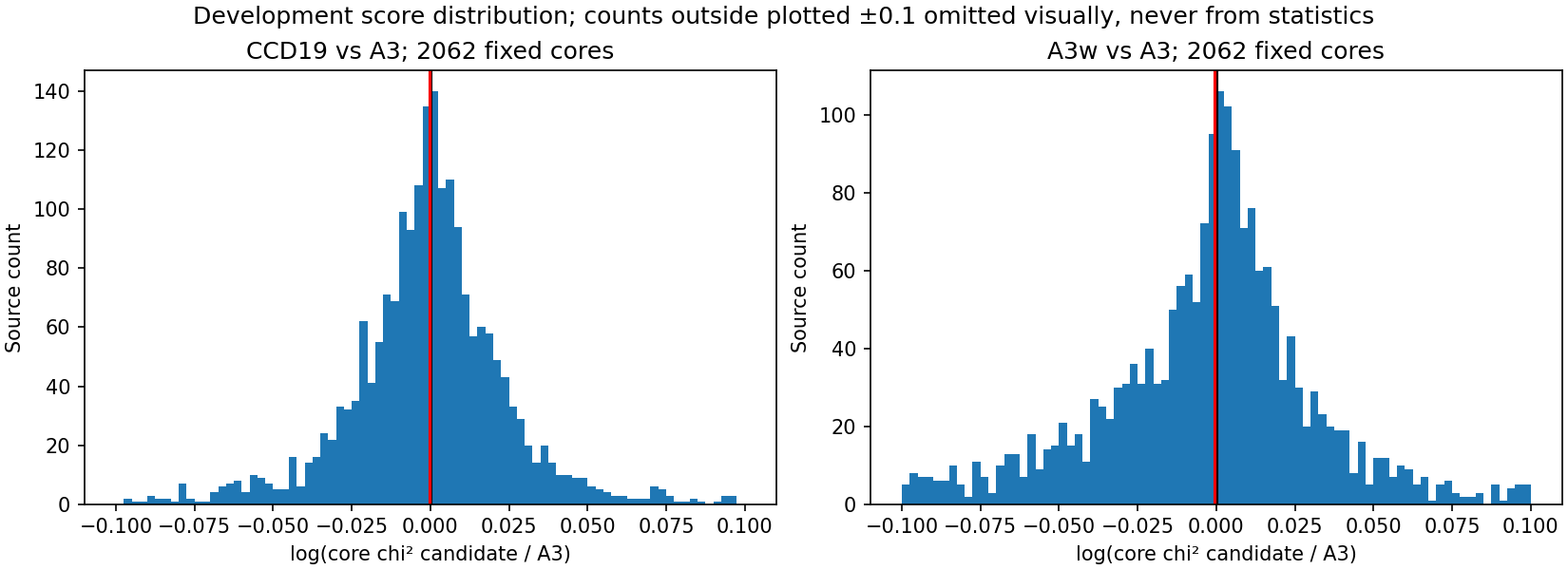
A separate predictive comparison uses each source's native mean squared noise-normalized residual on the fixed core. It takes the median log ratio to A3. This is distinct from the group-mode noise-reference maximum. Forty-nine dependence components join scored tiles sharing overlap-solve islands or physical support; their largest source fraction is 4.90%. Ten thousand component resamples provide conditional percentile intervals. The two declared contrasts use 97.5% intervals each, retaining a Bonferroni allocation for the pair; these bootstrap intervals are conditional approximations, not exact coverage guarantees.
| Development contrast | Median log core-score ratio | Ratio | Conditional 97.5% interval for log ratio |
|---|---|---|---|
| CCD19 / A3 | −0.000117491 | 0.999882516 | [−0.001162049, +0.000715235] |
| A3w / A3 | −0.000499151 | 0.999500973 | [−0.003092223, +0.001767167] |
Neither interval excludes zero. Thus neither alternative has a supported held-core score improvement in this development population, irrespective of which has the smaller conditional residual maximum. The paired endpoint table and exact source rows are saved in paired_endpoint_summary.json and {CCD19,A3w}_paired_endpoint.npz; the actual native width endpoint is A3w/endpoint_score.npz.
$$H=X^T W X+\Lambda+\rho\,\mathrm{diag}(X^TWX),\qquad \widehat f=H^{-1}(X^TWd+\Lambda p).$$
Here $X$ is one arm's own native finite 15×15 profile design, with a row per physical image pixel and a column per scene source row; native normalization is preserved. $d$ is the image data vector in electrons per second. $W$ is diagonal valid-pixel inverse variance, using supplied noise squared plus $10^{-6}$ in squared data units. $\rho=10^{-6}$ is the configured ridge strength. $\Lambda$ is the diagonal original nuisance-star prior precision from the finite mask, native template and configured $\kappa=0.1$. $p$ is the original two-pass evaluation prior vector in electrons per second. $\widehat f$ is the fitted flux vector, also in electrons per second. No background column is fitted; the scorer rejects models requiring one. Repeated stamp copies share one physical pixel and one noise realization. Flux refits use the original full evaluation support, including pixels outside held cores.
$$C=LVL^T-B(LX)^T-(LX)B^T+BGB^T,\qquad B=LXH^{-1},\qquad G=X^TWX.$$
Here $L$ is the fixed 300-row group/mode measurement matrix, including the common catalogue denominator and group averaging. Its six per-source modes are a Gaussian core, two dipoles, a radial term and two quadrupoles at original fractional catalogue positions, each normalized to unit sum of absolute pixel weights on original valid radius-three support. $V$ is diagonal supplied physical-pixel variance in squared data units. $C$ is covariance of the dimensionless mode amplitudes; $B$ and $G$ are the deterministic matrices defined above. This is the covariance of $L(I-XH^{-1}X^TW)$, with nuisance prior, ridge, overlaps and finite support included.
For each arm separately, the plug-in noiseless truth is its own rendered $X\widehat f$. Refitting this noiseless image with the frozen prior gives a small nonzero ridge/prior residual. Its measured mode vector is subtracted before standardization. Both the operator and this null mean are recomputed for each model.
| Quantity | A3 | CCD19 | A3w |
|---|---|---|---|
| Strongest endpoint | all/core | all/core | all/core |
| Observed dimensionless mode amplitude | 8.922408e-05 | 8.926696e-05 | 8.628871e-05 |
| Plug-in null amplitude | 1.005346e-07 | 9.833061e-08 | 9.586154e-08 |
| Conditional standard error | 3.650615e-07 | 3.650638e-07 | 3.652068e-07 |
| Maximum absolute standardized mode | 244.132995 | 244.254936 | 236.011093 |
| Separate-arm 95% max-300 threshold | 3.76269 | 3.75845 | 3.76242 |
| Validation rejection fraction, 5000 draws | 0.0436 | 0.0484 | 0.0460 |
| Null draws exceeding observed maximum | 0 / 20000 | 0 / 20000 | 0 / 20000 |
| Sparse/native maximum feature mismatch in conditional SE | 0.012167 | 0.0120288 | 0.0102993 |
| Flux reconstruction relative L2 error | 9.38937e-09 | 9.61989e-09 | 9.3148e-09 |
Native data, noise and valid mask values agree exactly across duplicate pixel occurrences. The direct physical-pixel simulation and adjoint residual projection agree to below $1.4\times10^{-19}$ in dimensionless mode units. Numerical reconstruction errors are negligible relative to the reference scatter. The reported standardized values are not physical Gaussian significances.
A3, CCD19 and fixed-width A3w are the three declared development checks. Within each arm the maximum already covers its 300 fixed measurements. To protect against selection among these three checks, the Bonferroni rule allocates a false-rejection rate of 0.05/3 per arm. Corresponding max-300 critical values are 4.04151 for A3, 4.04618 for CCD19 and 4.03545 for A3w. Cross-model covariance is not estimated, so this is a conservative union-bound construction, not an unadjusted joint simulation or a paired-difference test.
Each of the three completed arms has 0 exceedances in 20,000 reference trials. A one-sided 98.333% binomial upper bound is 2.04696e−4 per arm; multiplying by three yields the conservative adjusted upper bound 6.14089e−4. Allocating Monte Carlo confidence failure probability 0.05/3 to each declared arm gives simultaneous 95% coverage over all three model-specific Monte Carlo bounds. This probability bound concerns only the stated conditional simulators. All three declared arms are now included; this Monte Carlo coverage is distinct from the inferential family false-rejection rate. Comparing the three maxima or tail bounds does not quantify model improvement.
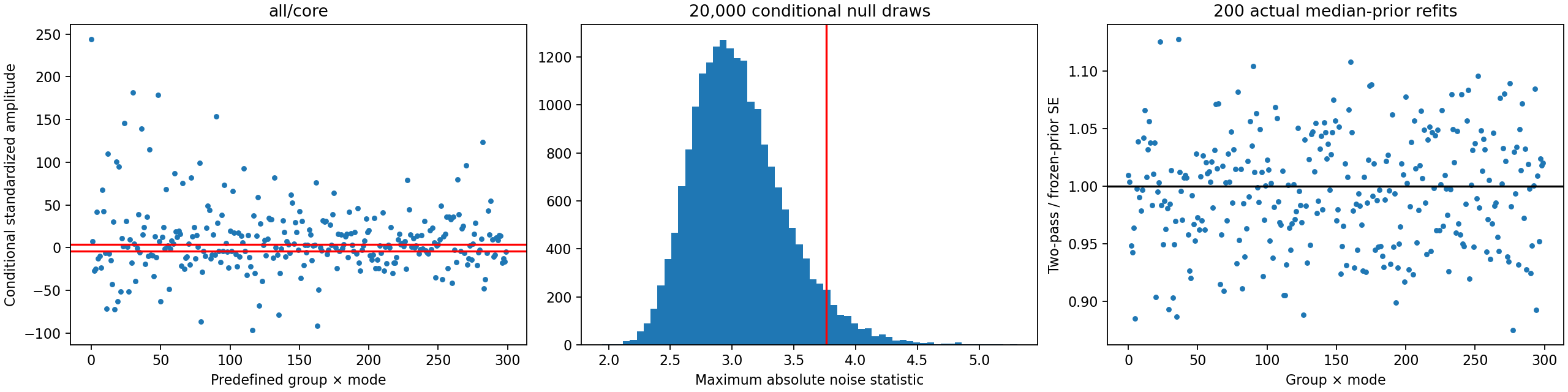
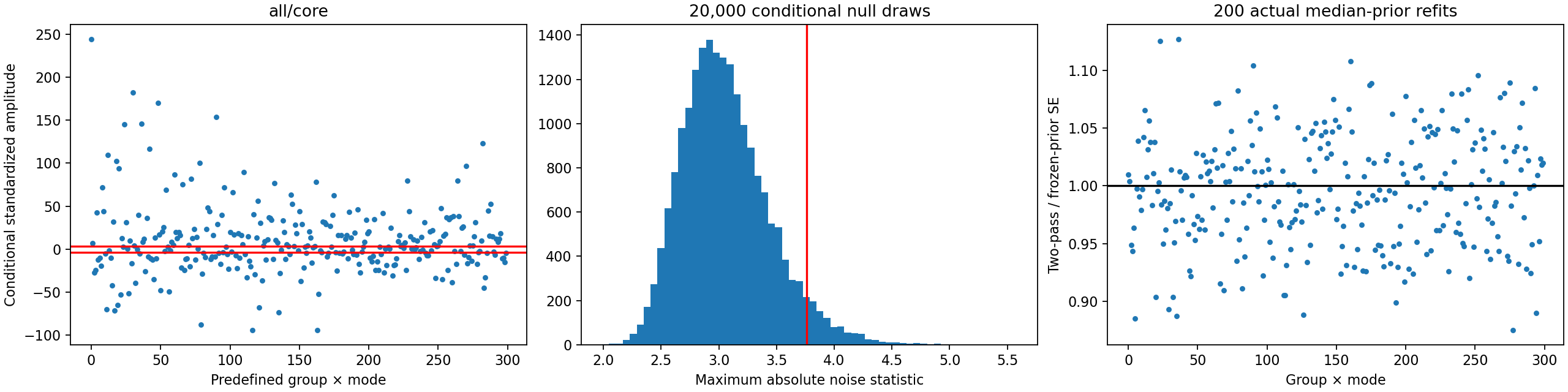
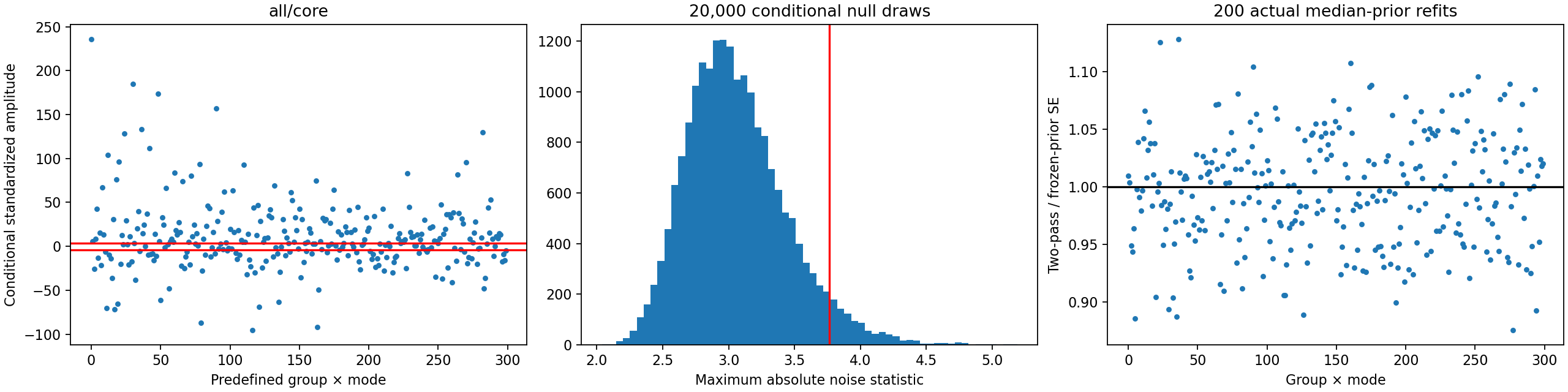
The plotted red thresholds are the original separate-arm 95% thresholds. The stricter three-arm thresholds are reported above and in comparison.json.
The production evaluator solves first with zero prior, estimates a scale from the median positive contributor flux divided by catalogue flux, then solves again. Primary covariance freezes that observed prior. A separate 200-trial sensitivity regenerates one shared physical noise image per trial, repeats the initial flux solve, recomputes that positive-contributor median and propagates the resulting prior through the second solve. No learned profile or WCS parameter is refitted.
The two-pass/frozen-prior standard-error ratios have medians 0.9969/0.9968, 95th percentiles 1.0764/1.0764, and maxima 1.1277/1.1270 for A3/CCD19. These estimates themselves have substantial 200-trial sampling uncertainty. The observed maxima after this nonlinear plug-in centring remain 244.133/244.255, measured using the original fixed standard errors. For A3w the median, 95th percentile and maximum standard-error ratios are 0.9969, 1.0764 and 1.1284; its re-centred maximum is 236.0111 using the primary standard errors. No Monte Carlo tail claim is made from the 200-trial sensitivity.
The largest and top-five absolute individual contributions to the strongest mean mode are 3.69% and 10.10% for A3 and 3.66% and 10.07% for CCD19. Deleting any one detector cell leaves the amplitude between 8.1744e−5 and 9.2618e−5 for A3 and 8.1777e−5 and 9.2829e−5 for CCD19. For A3w the largest/top-five fractions are 3.77%/10.29%, and deleting a cell leaves the amplitude between 7.8000e−5 and 9.0519e−5. These are descriptive influence checks, not new confidence intervals or post-selection tests. The feature is not explained by a few dominant stars or one detector cell. Median images are descriptive; their covariance is not identified with the mean covariance.
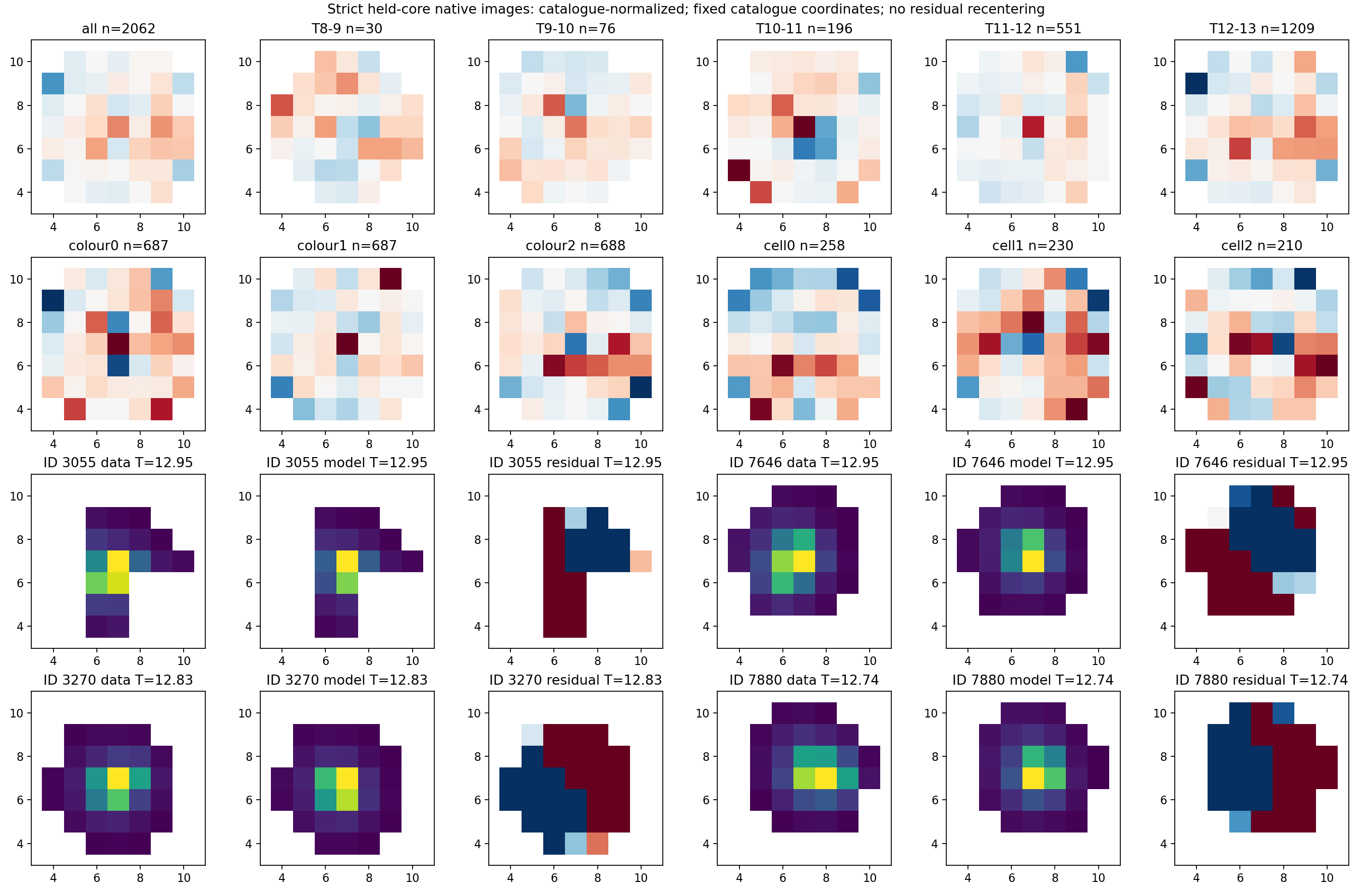
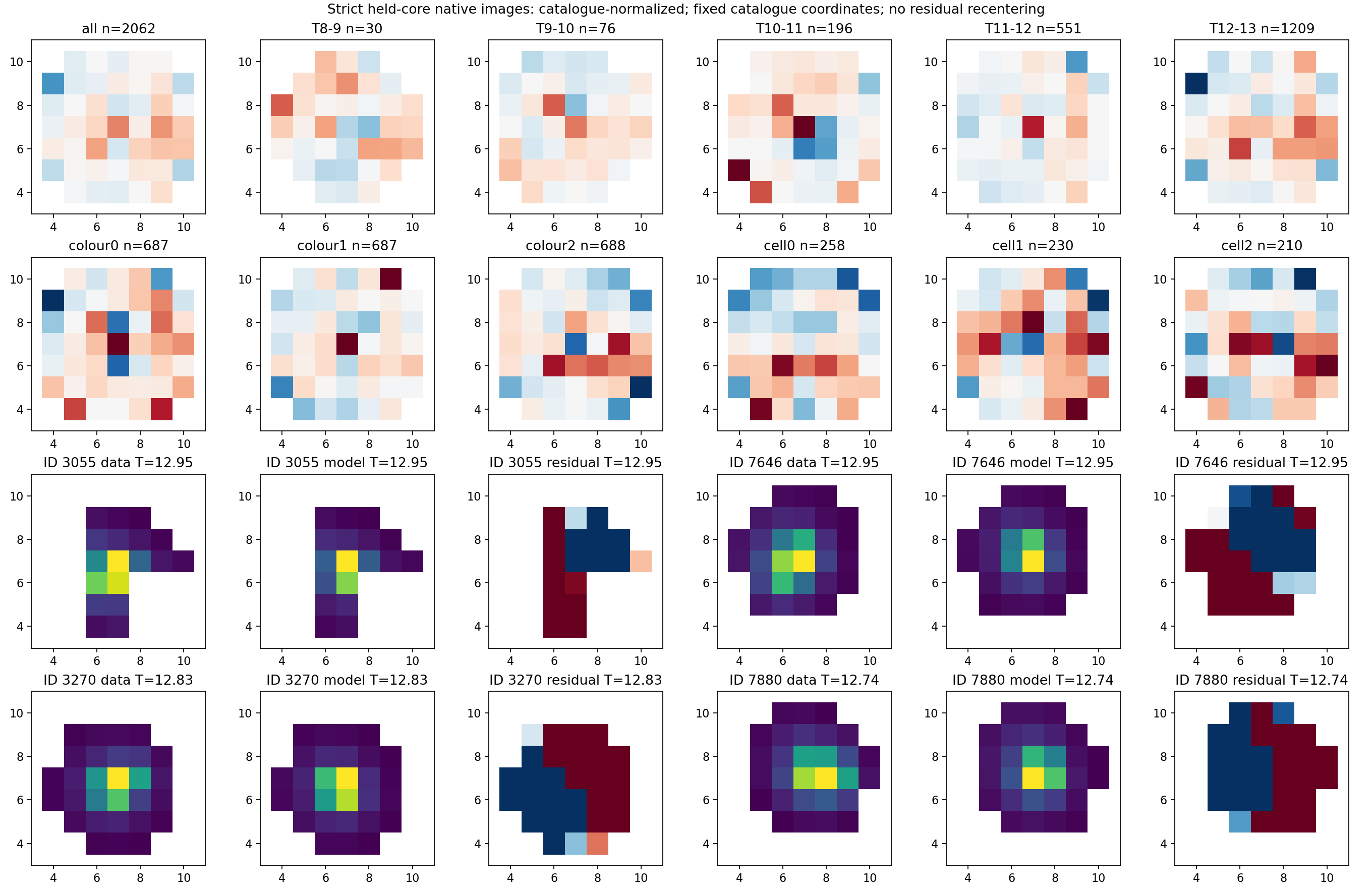
The “ID” labels in these native galleries denote original scene row ordinals, not catalogue source IDs; exact catalogue IDs are in row_identity.npz. Influential residuals have strong positive/negative lobes consistent with dipoles; the displayed images do not justify calling all structure an isotropic width error.
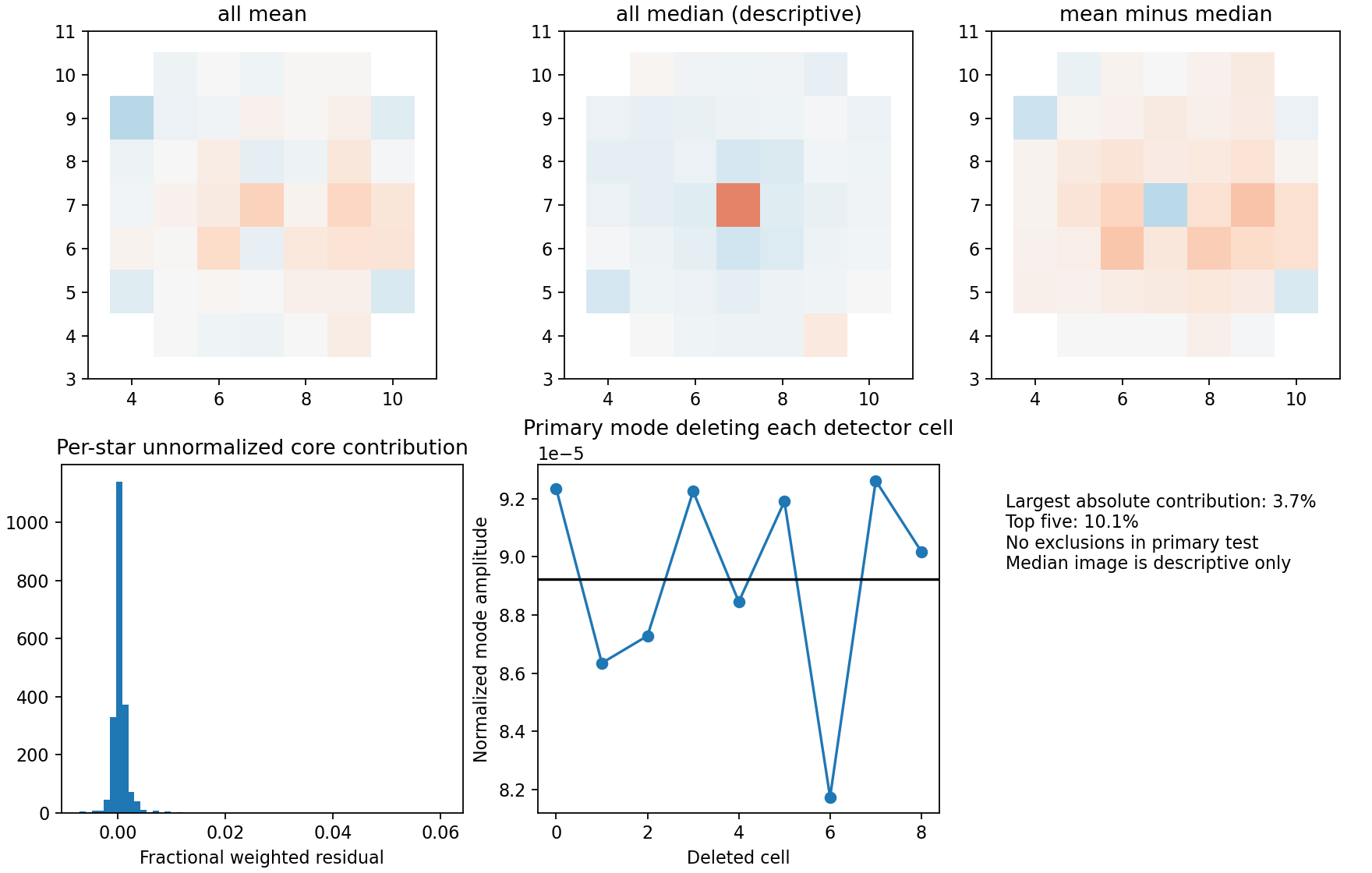
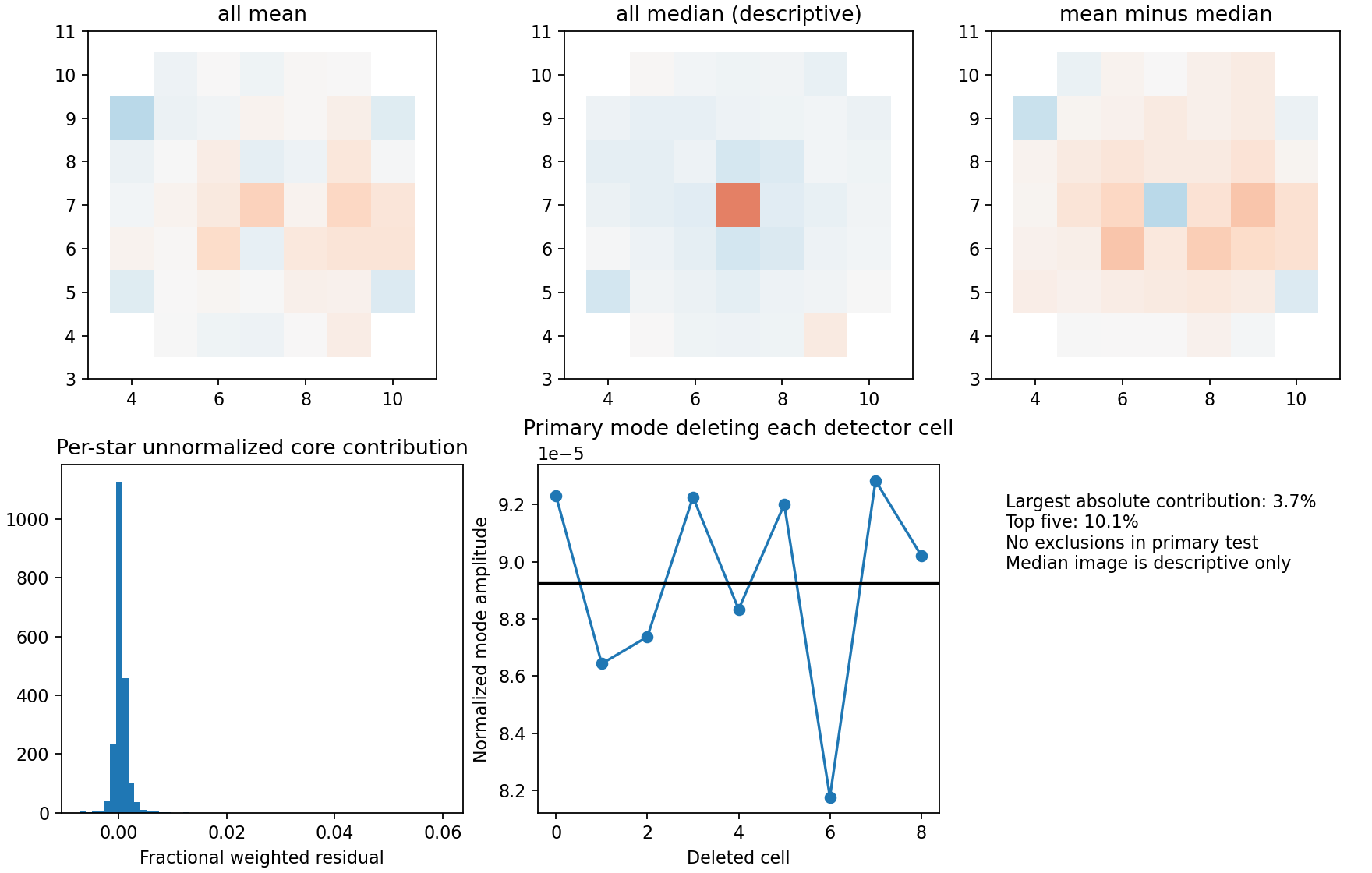
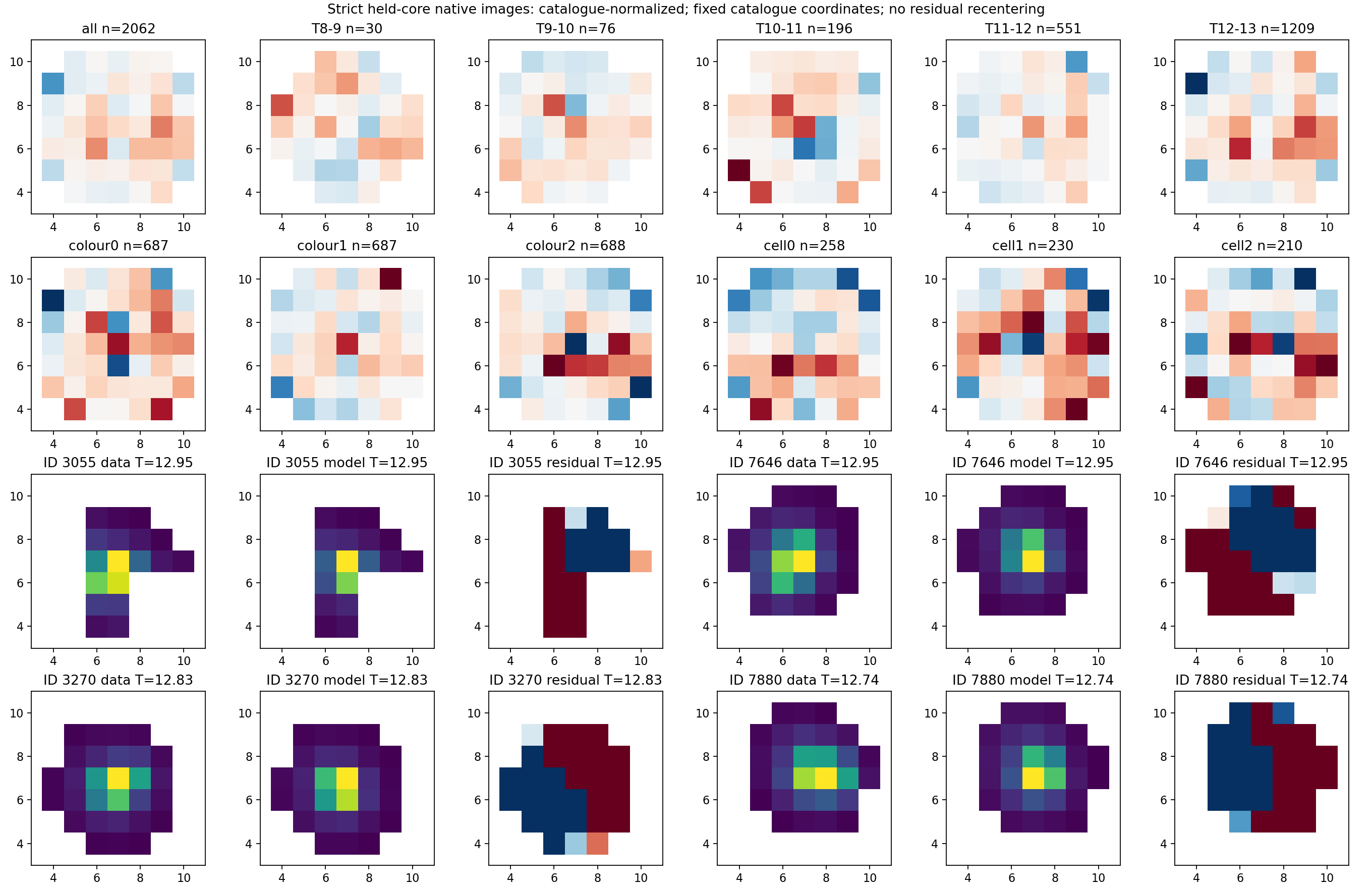
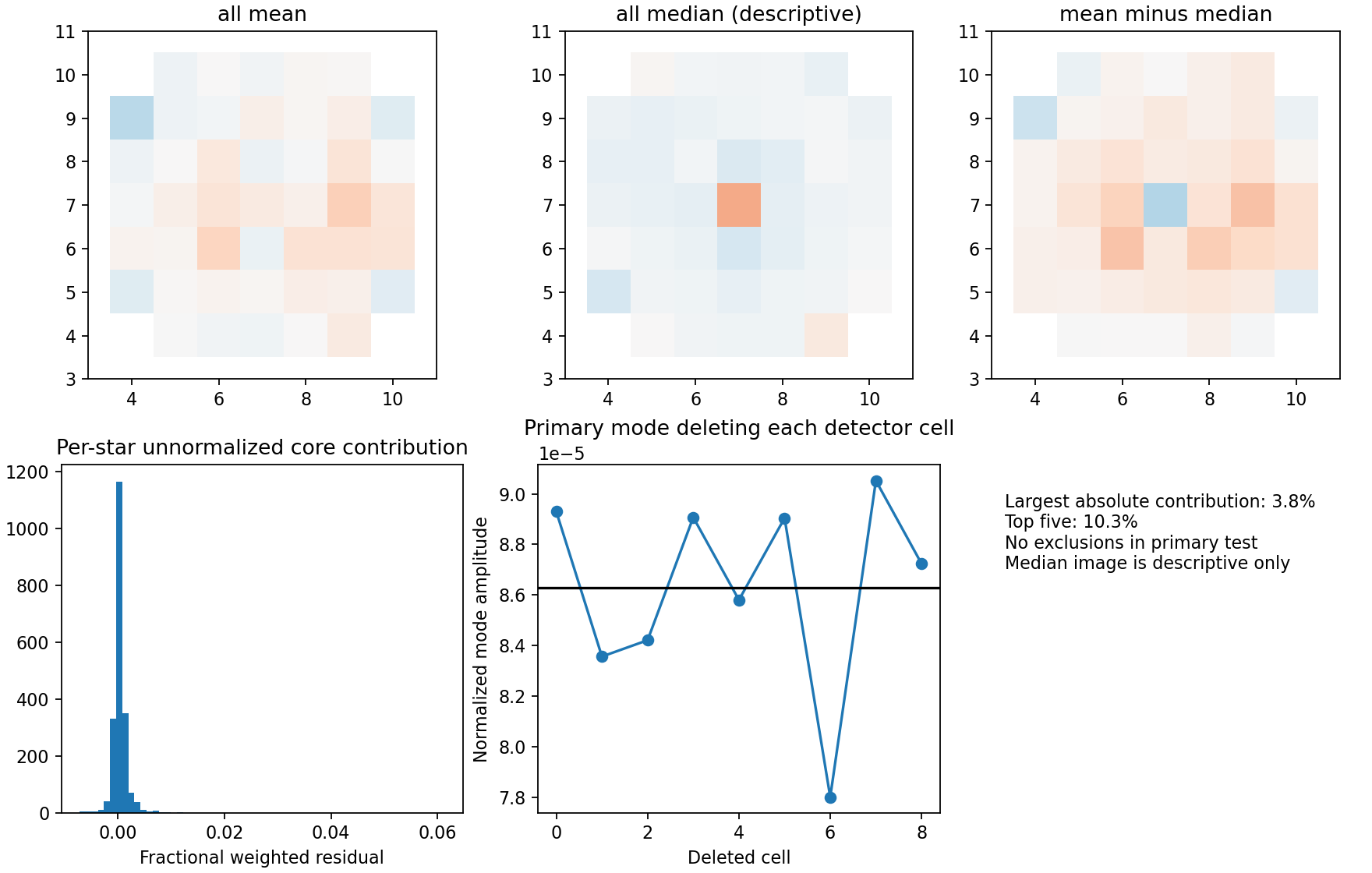
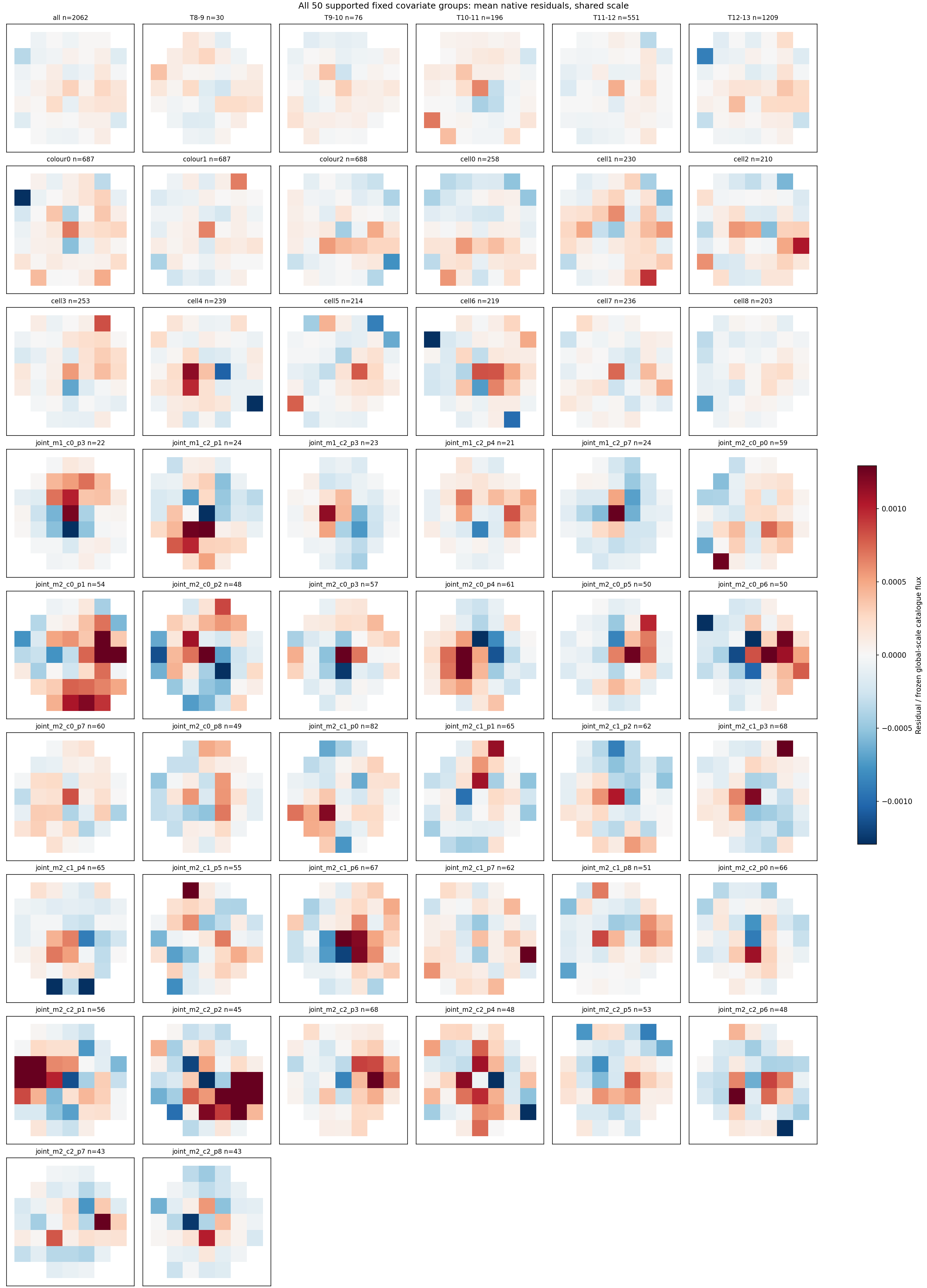
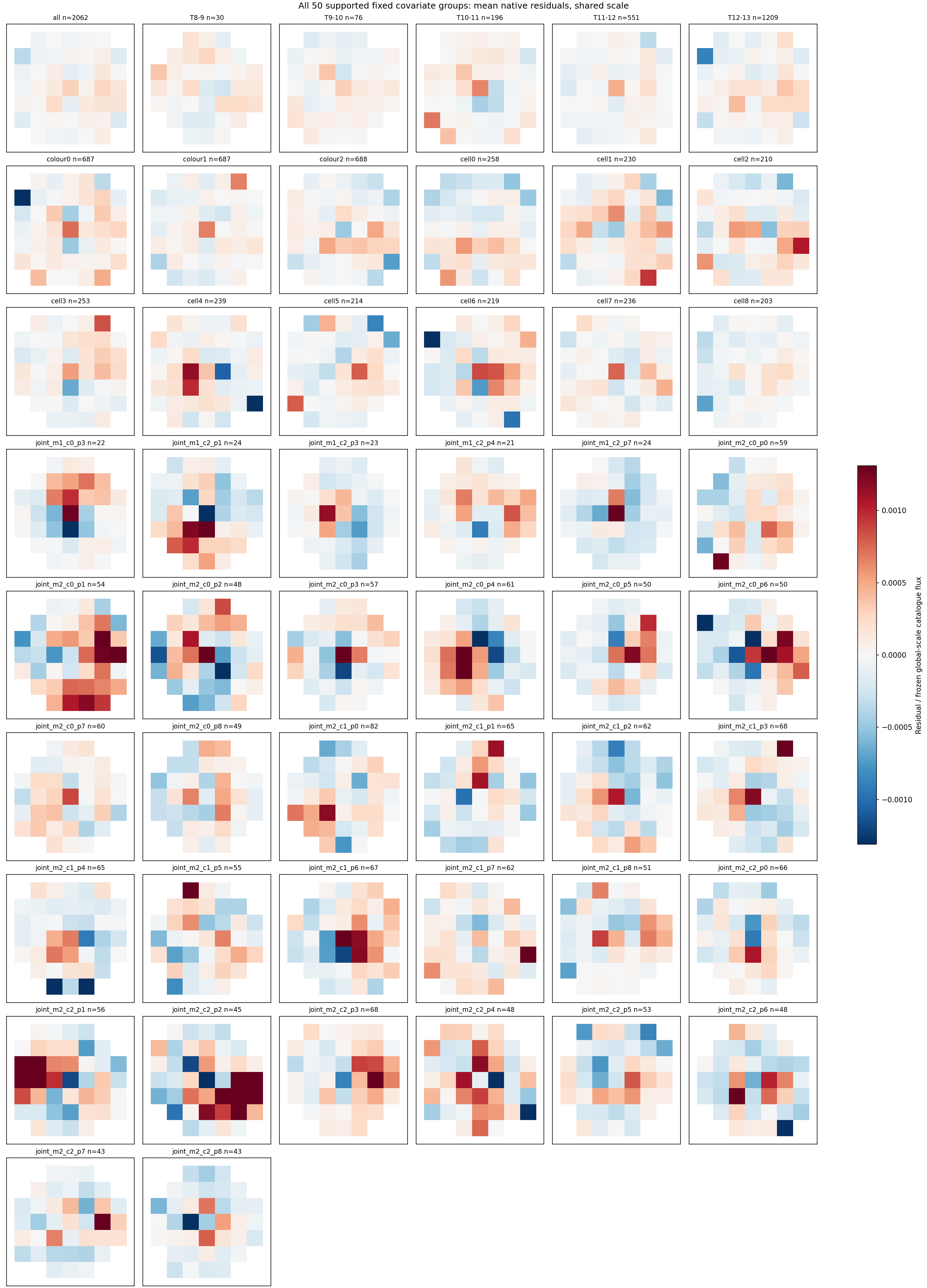
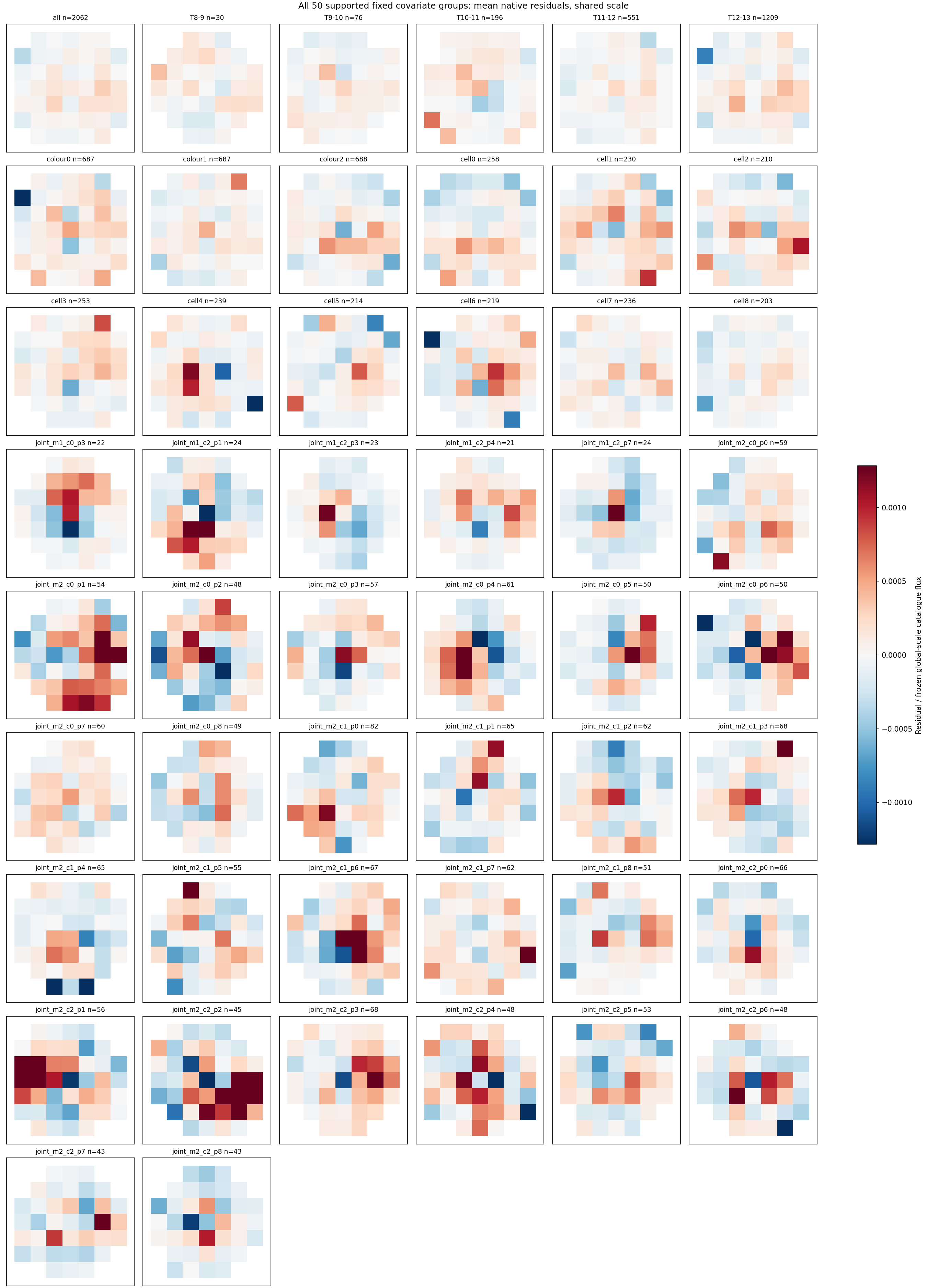
Each gallery shows all 50 supported fixed groups on one shared within-gallery colour scale. The comparison above enforces a shared scale across models. These are underlying images for the corresponding 300 statistics, not only their metric reductions.
Finite-difference x/y derivative and dilation generators use each arm's full original finite template, subtracting a multiple of that template so every injected source perturbation sums to zero on the original support. Injections are summed once into shared physical pixels, then passed through the original flux/prior solve. They are sensitivity controls, not independent physical profiles, exact nonlinear translations or outer-wing validation.
At a derivative-shift coefficient of 0.0001 px, separate-arm reference power is 70.38%/64.92% for A3 x/y and 70.54%/65.32% for CCD19. At 0.0003 px, all 5,000 trials detect either shift in both arms; the 95% binomial lower bound is 99.926%, not certainty. A fractional dilation-generator coefficient 0.0001 is detected in all sampled trials. These power figures use the original per-arm 95% max-300 threshold, explicitly not the stricter three-arm threshold. Their images show both the actual injected perturbation and the residual remaining after the flux refit.
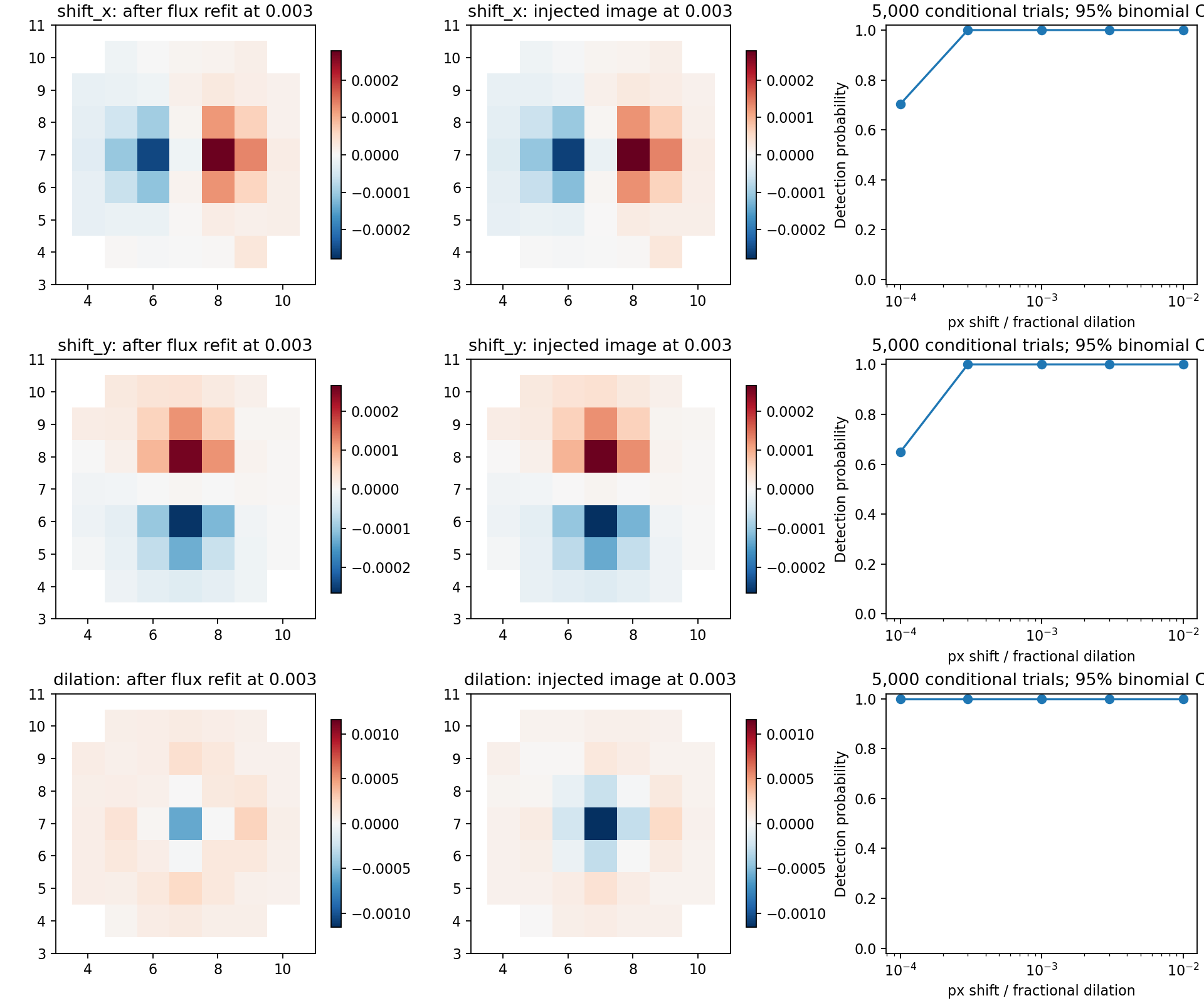
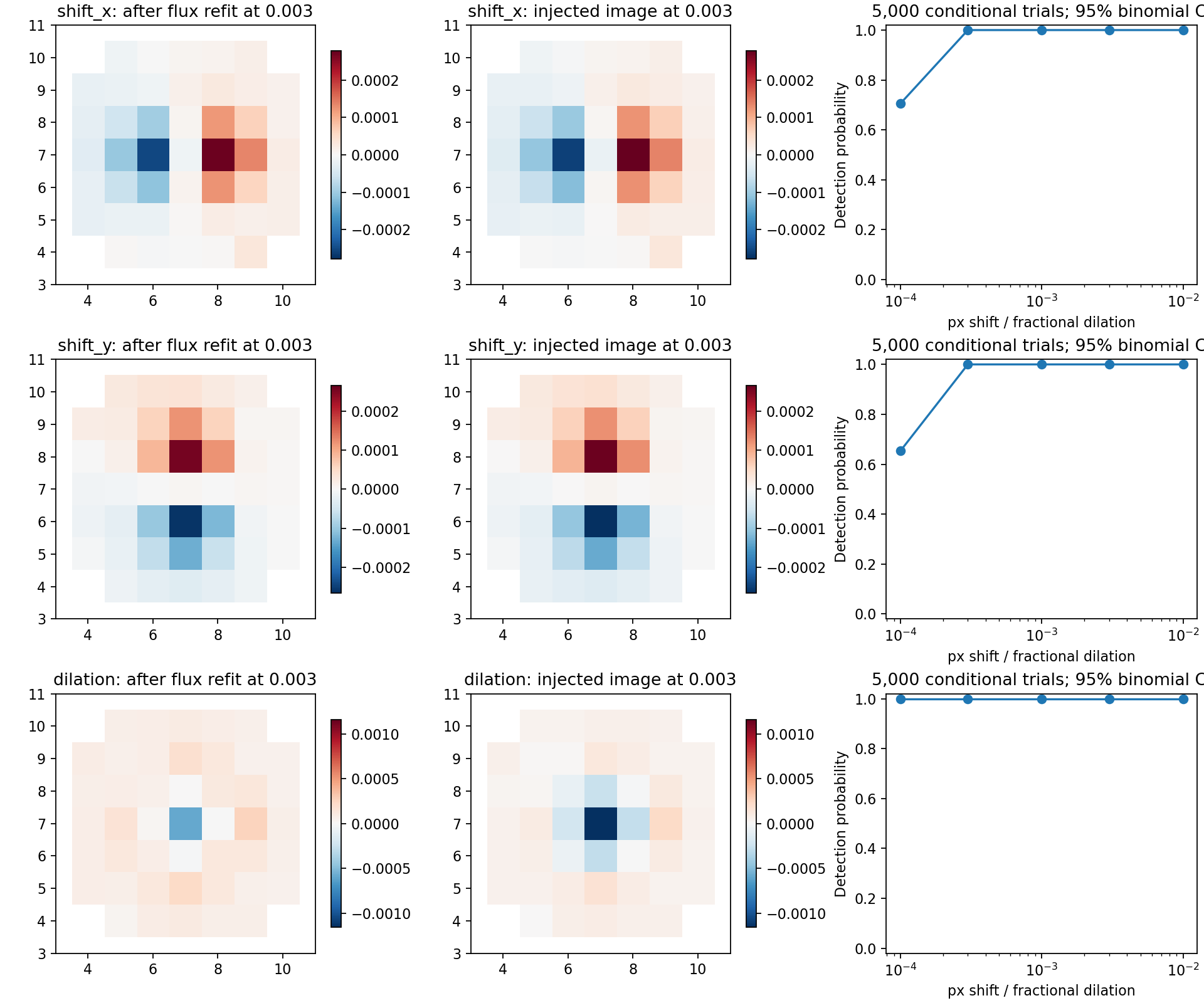
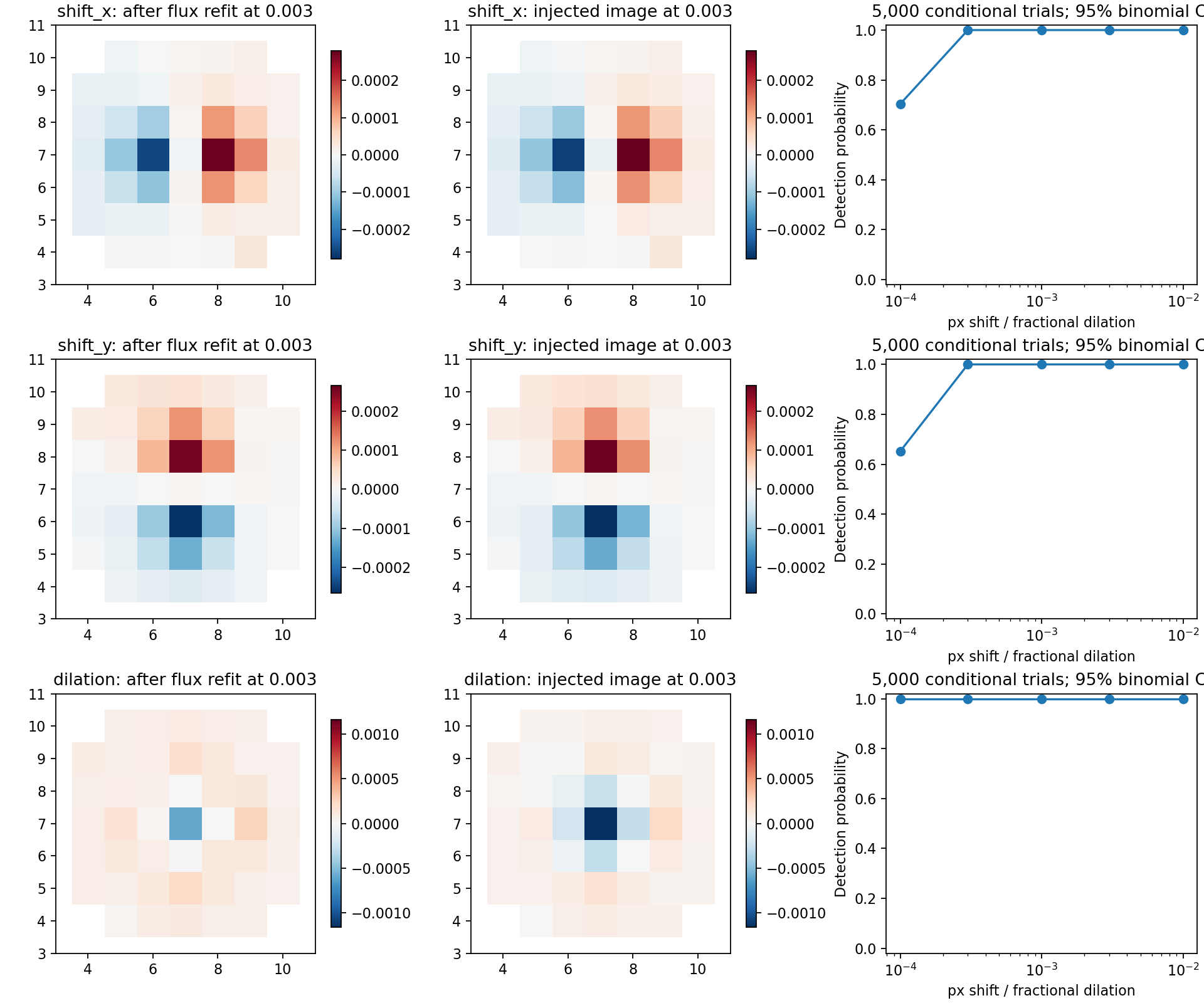
Flux-degenerate profile changes are invisible to a residual test. Injection-induced flux changes are responses to the selected synthetic generator, not actual photometric biases. These controls do not establish absolute photometry or science sufficiency.
These six standard grids use the same 2062 source rows, held-core pixels and A3 catalogue denominator in the rasters. They are descriptive auxiliaries, not the unclipped native-pixel significance estimator above: the standard helper rasterizes at quarter-pixel spacing, uses clipped means and Gaia BP−RP rather than fitted XP u, and derives its magnitude proxy from the common denominator. Sparse bright bins are marked by their counts and are not evidence of absent structure. Relative grids subtract each detector cell's all-star stack. The standard fitted width labels are projection summaries of the displayed residual images, not physical width estimates.
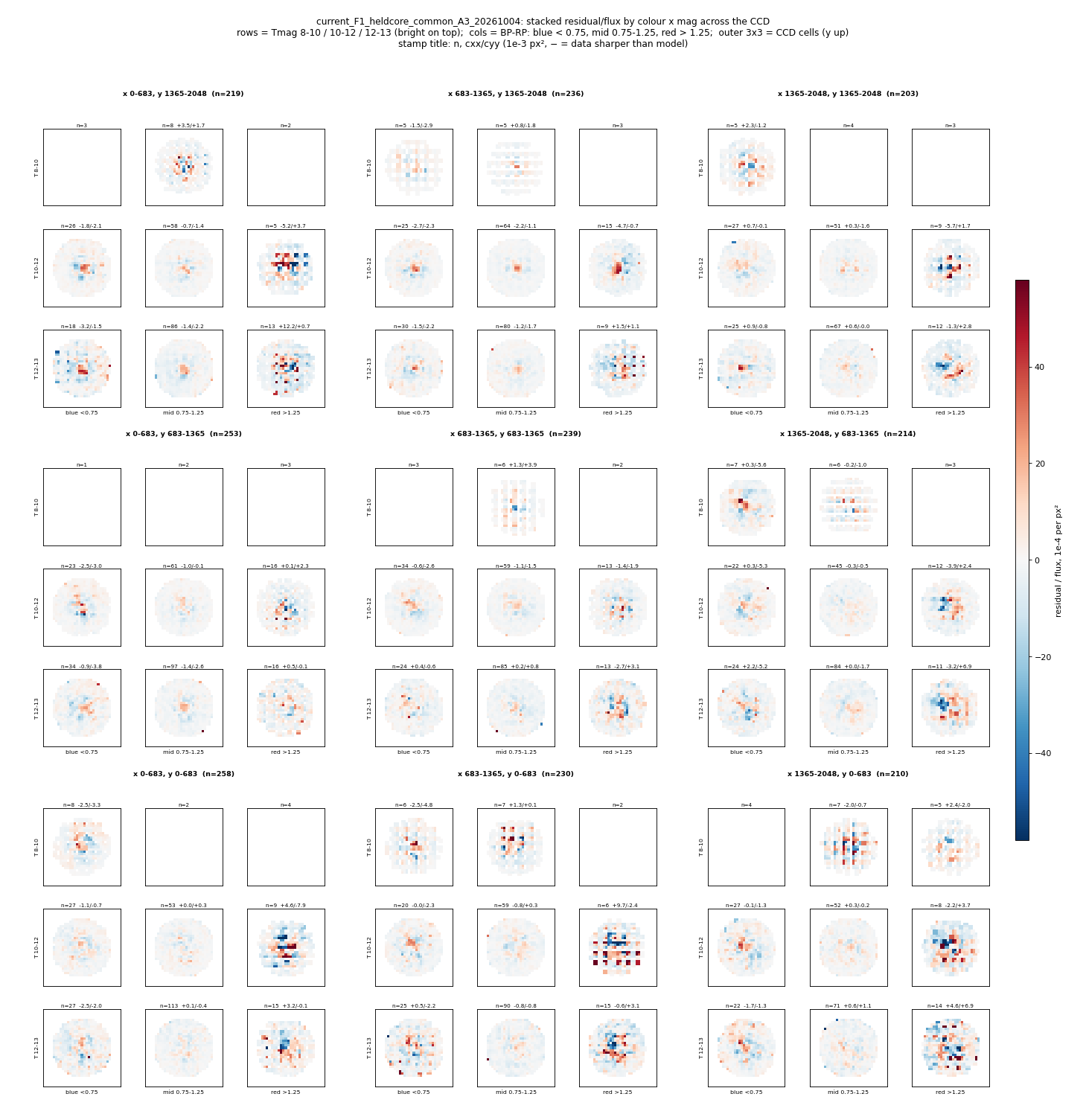
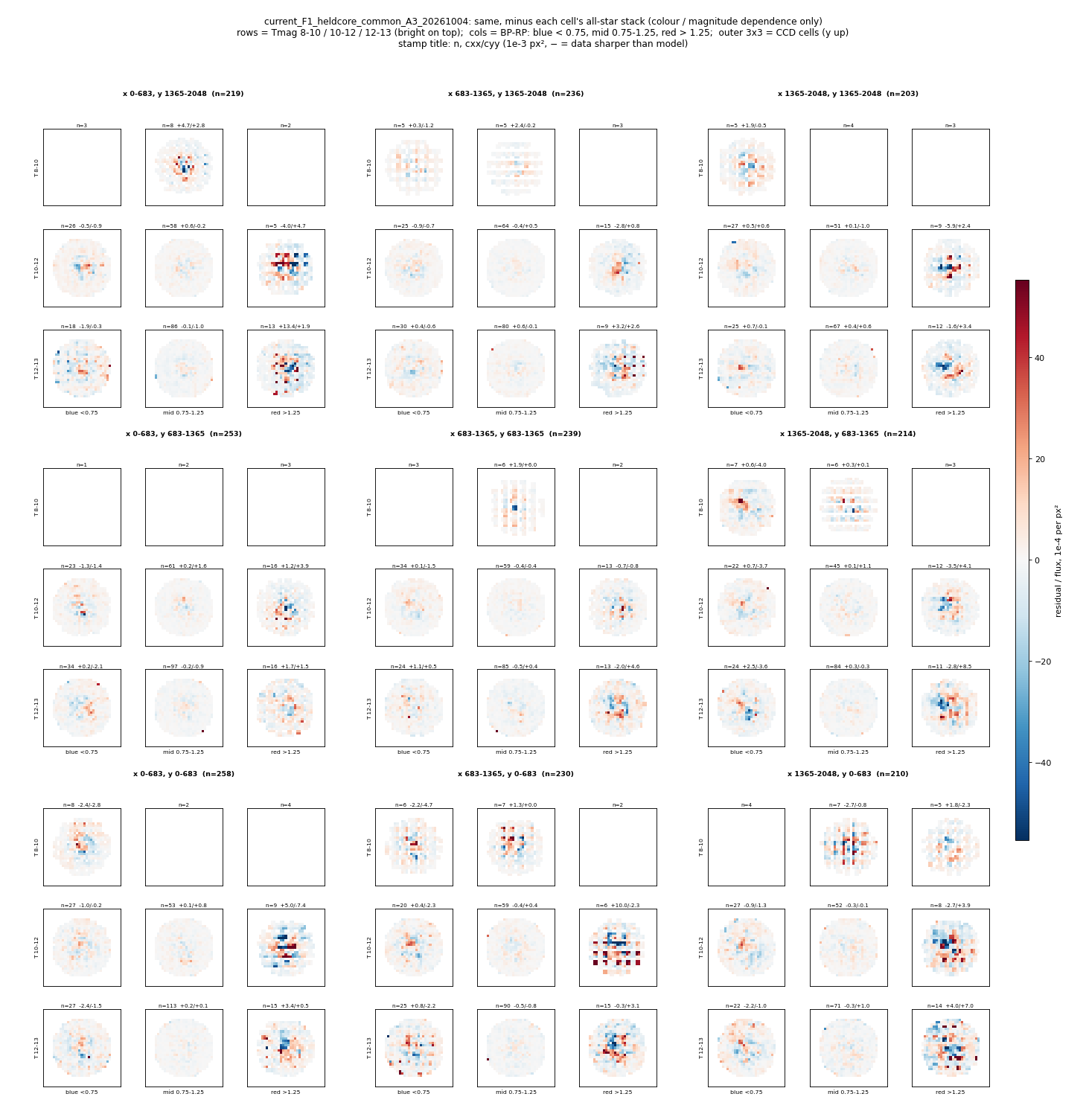
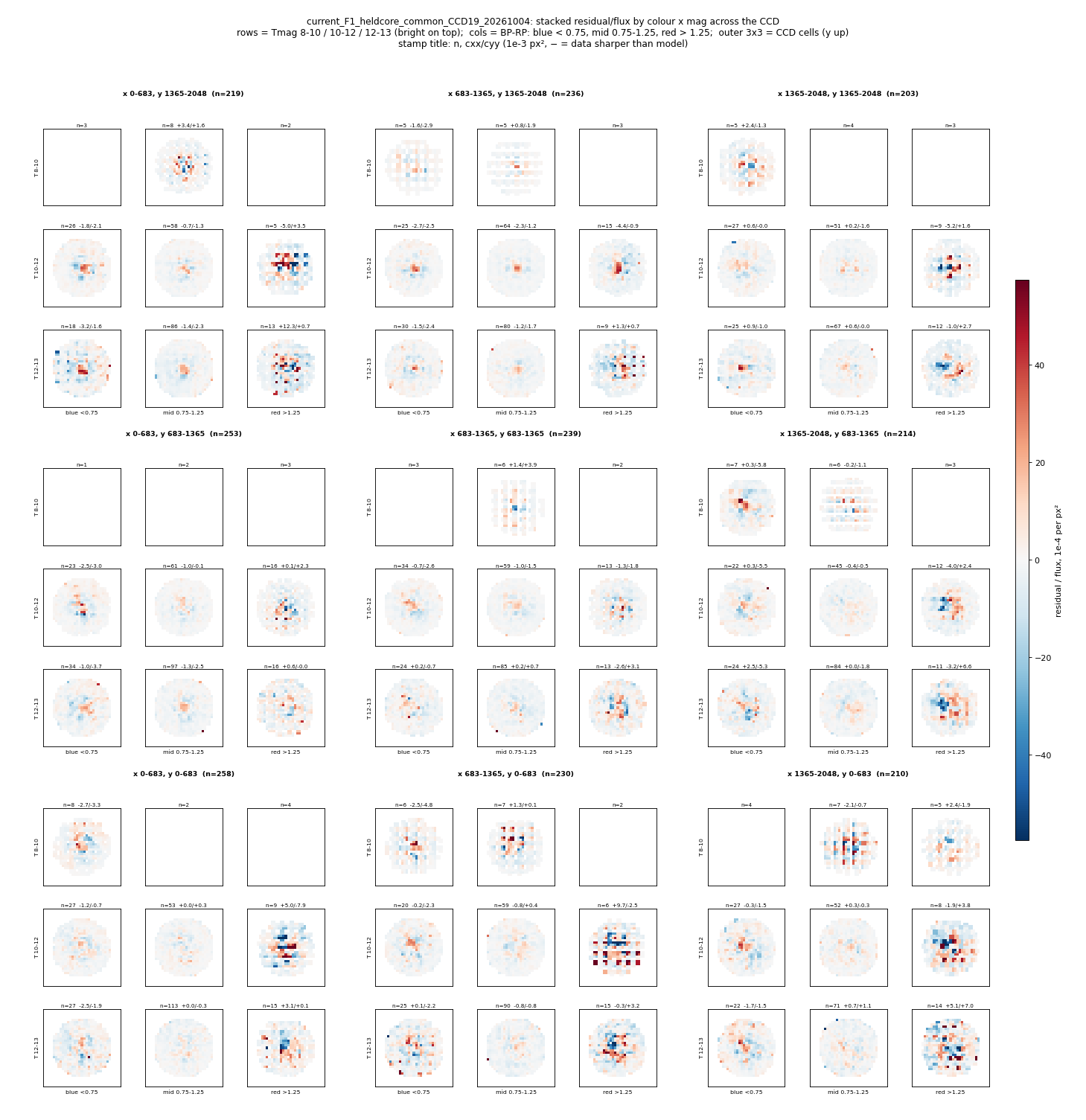
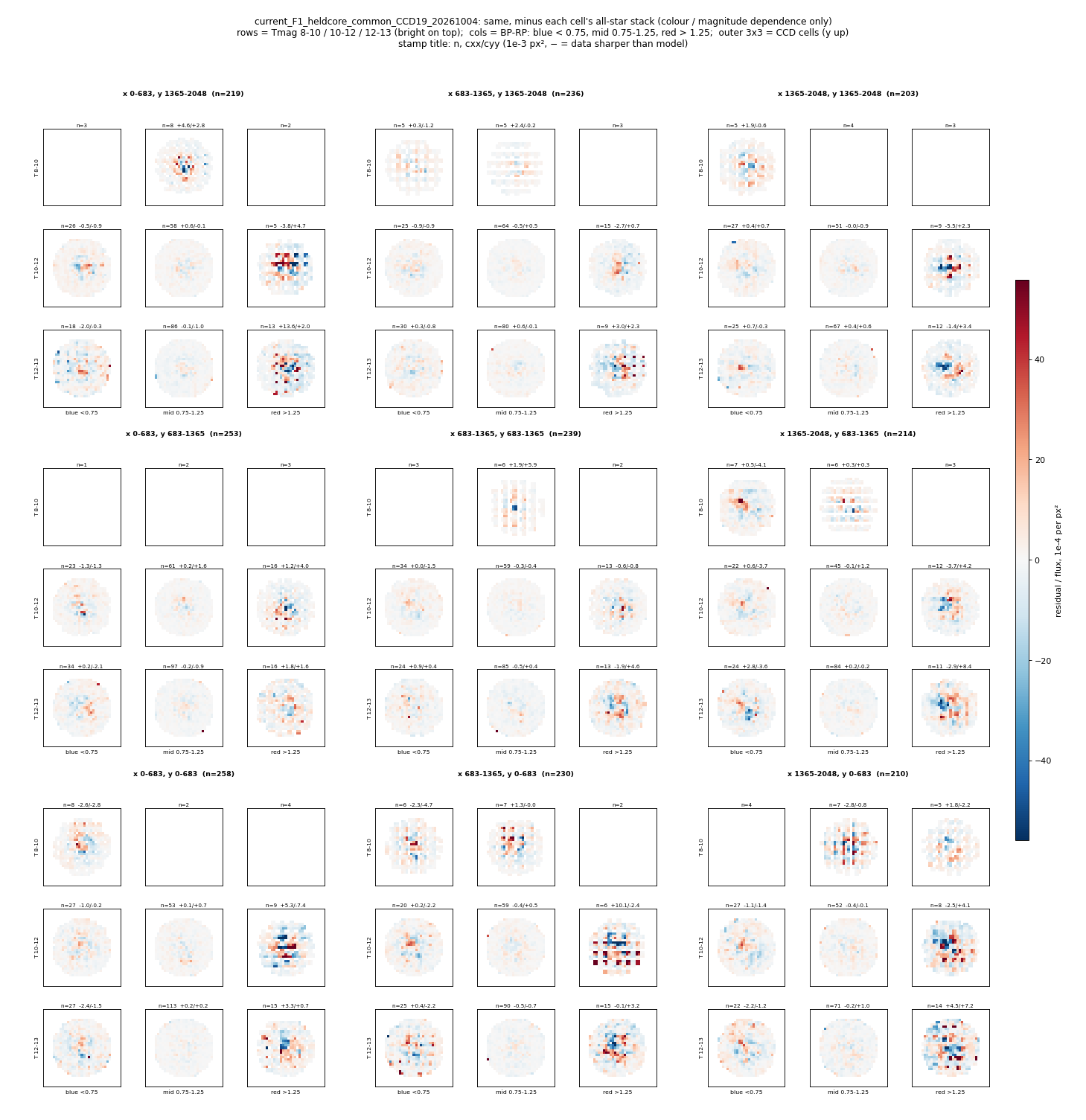
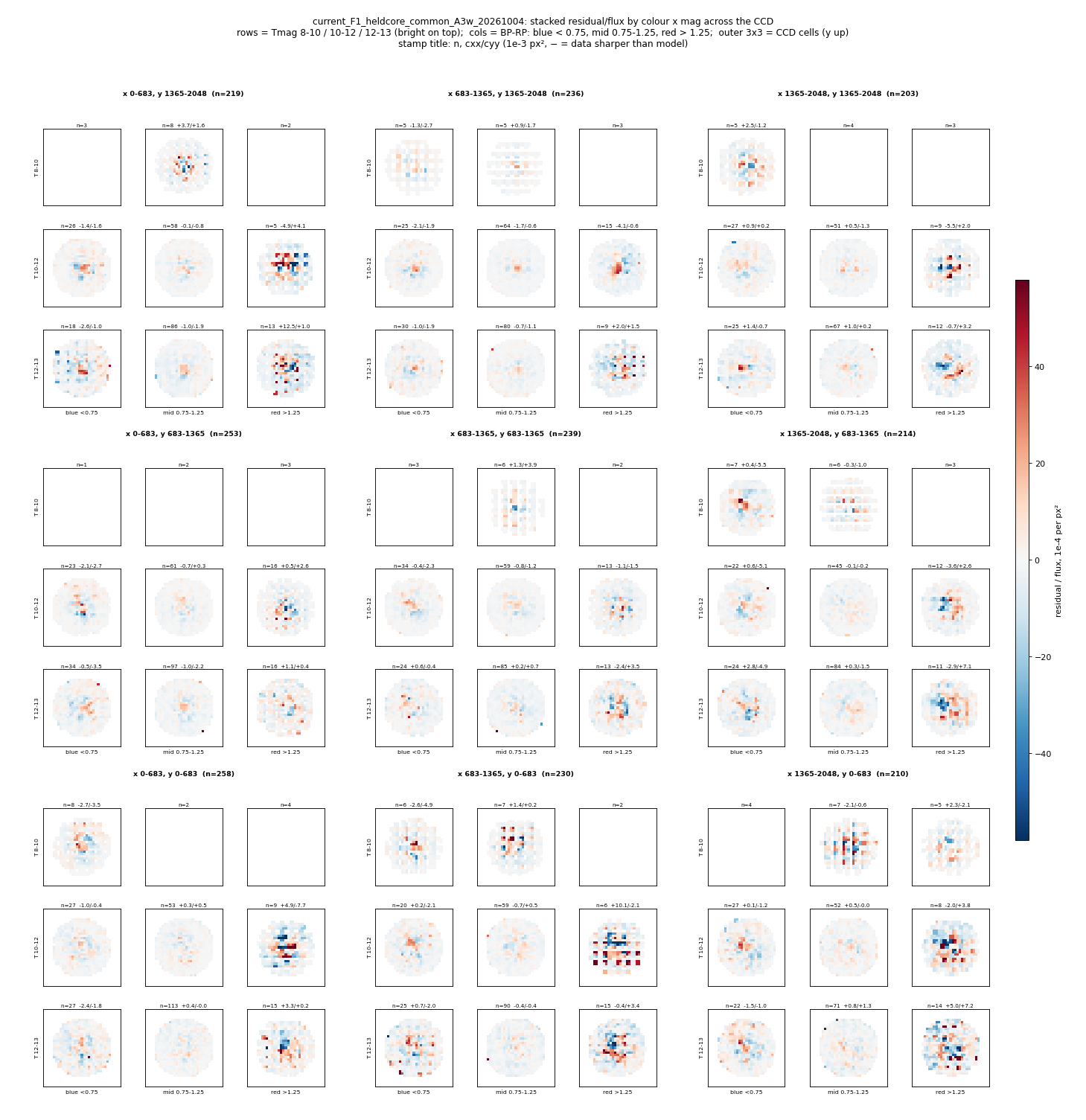
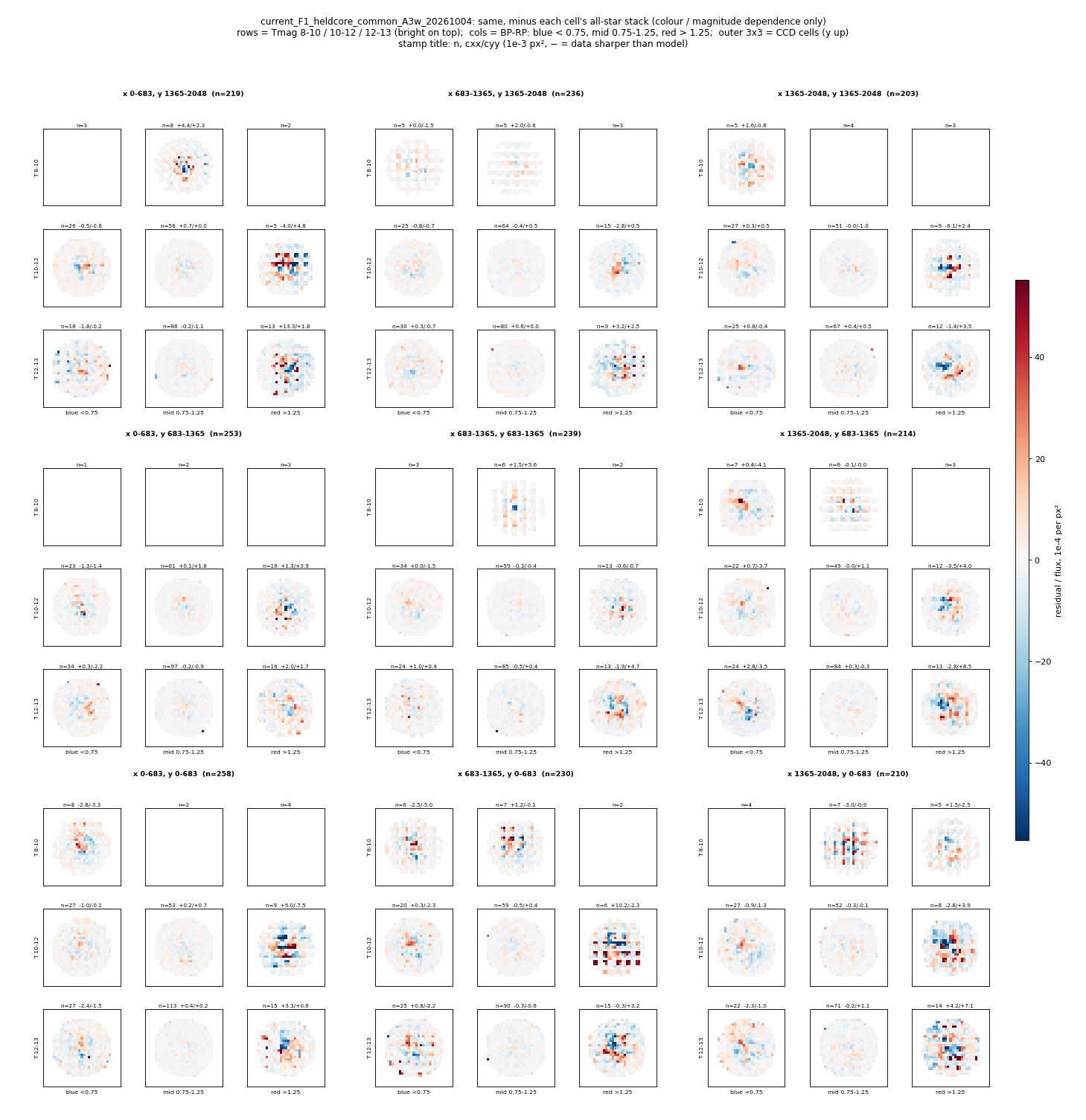
All six images were inspected and added sequentially to the existing shared residual-grid portal; the entry timestamp was refreshed. The external Claude Artifact mirror was not republished because that tool is unavailable.
The reference freezes profile, WCS, preparation and supplied noise law, while resimulating evaluation pixels also used outside the held cores during training. It therefore omits uncertainty and correlations from learning the profile. Template error, preparation effects, profile/training uncertainty, model selection and unmodelled physical noise covariance are not included. The fits are development checkpoints; successful training completion does not establish convergence. A quiet result would not certify the family, and the present failure does not identify its physical cause.
Exact commands are in job.sh; activate syndiff before Python. Local runs use CPU affinity 24–25 and two BLAS/OpenMP threads. render.py installs the frozen adapter before loading and verifies native replay, score.py builds each native shared-pixel operator and noise reference, controls.py supplies all-group images/influence/power, and compare.py verifies common support and applies the three-declared-arm correction. width_job.sh additionally verifies saved-state and exact-q replay before any width scoring. endpoints_and_rasters.py exports the paired score and common-denominator rasters; grids_job.sh generates the standard descriptive grids. config.json, comparison.json, the arm manifests and comparison_manifest.json preserve inputs and hashes. Peak measured resident memory was below 4.0 GiB. Parent owns campaign index, main canvas linkage and source backup; this task edits no production sources, historical reports or other jobs.
Conclusion: genuine held-core residual structure persists in all three current F1 models relative to the explicit fixed-profile Gaussian reference, even with a conservative correction across all three declared model checks. The morphology and robust images rule out an explanation consisting solely of a few influential stars or the global prior-scale estimator, but do not isolate intrinsic width or certify physical model inadequacy at “244 sigma.” The two paired predictive contrasts do not support improvement on these development cores. Use the separately frozen prospective protocol for independent confirmation; do not choose that protocol from the reserved image.