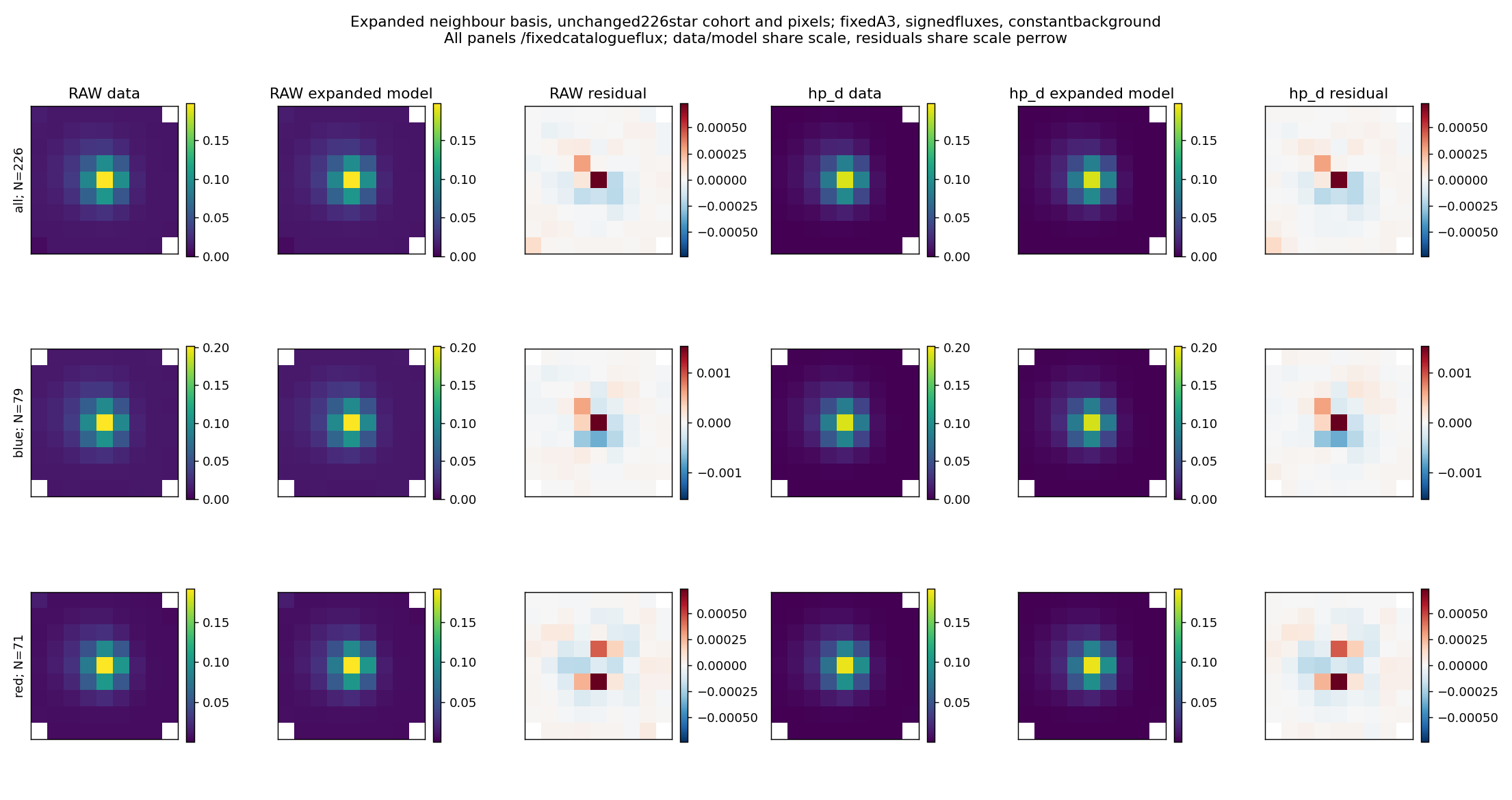
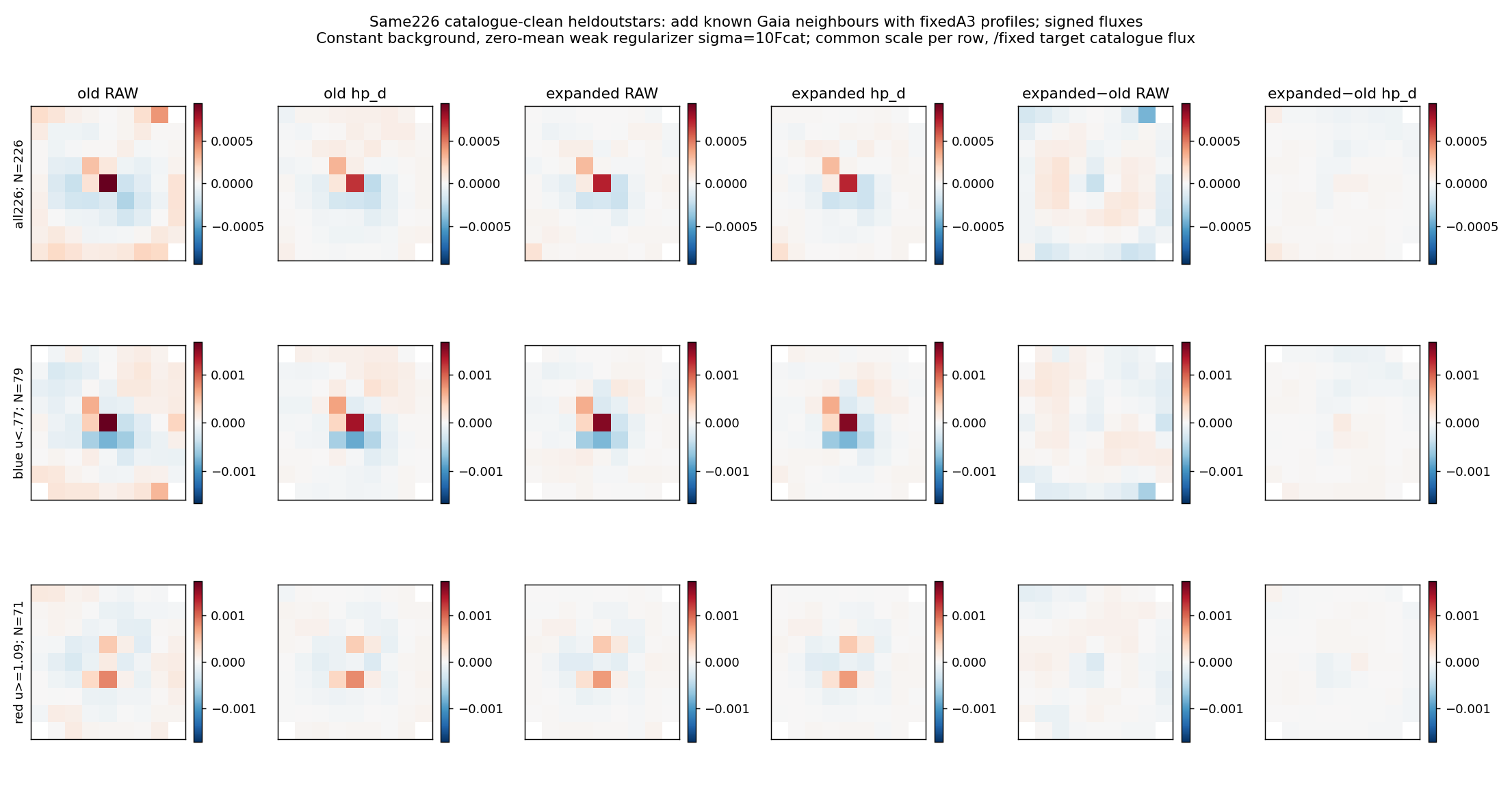
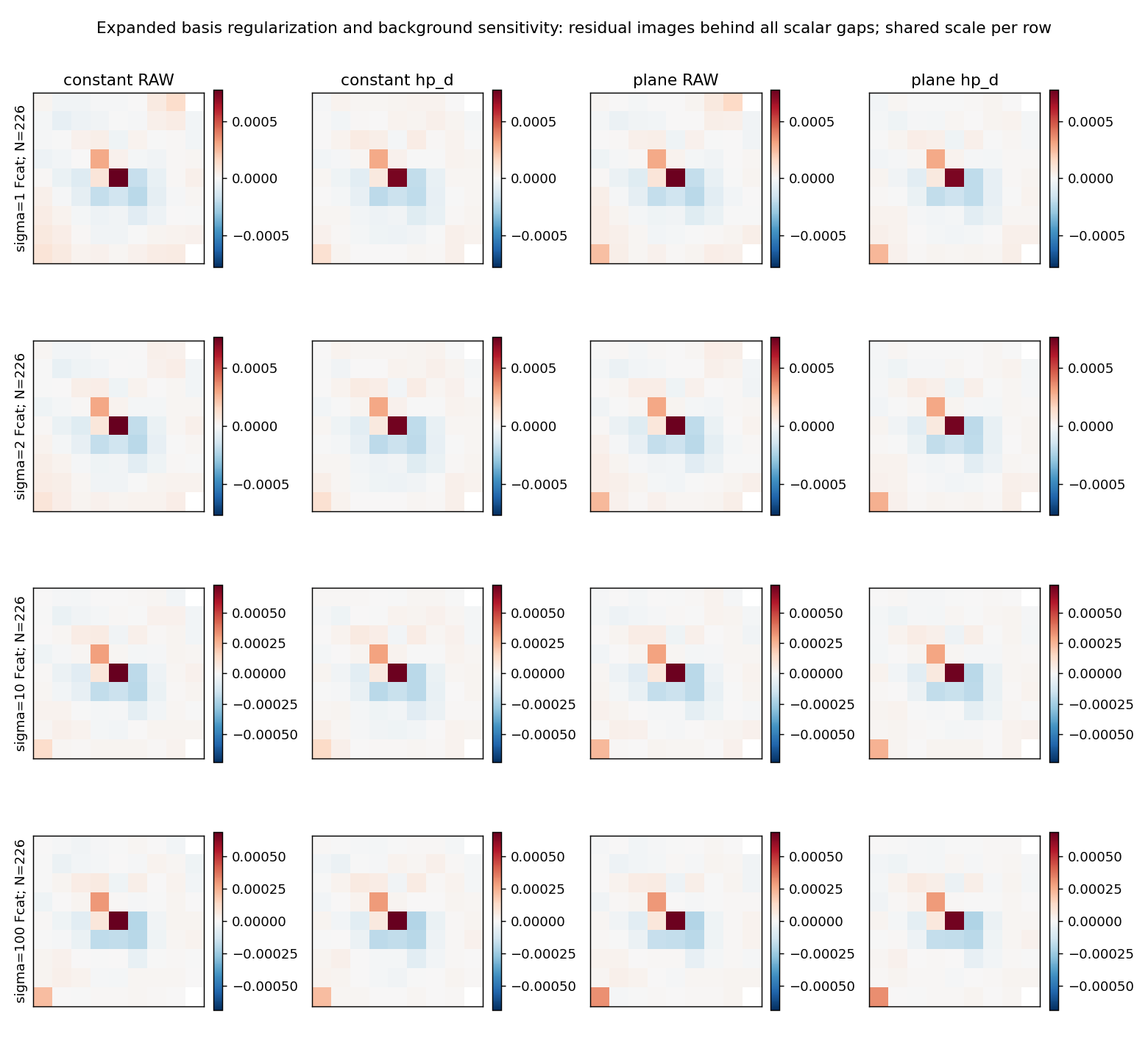
Conclusion: On the same 226 Gaia-G-proximity-selected held-out bright stars, adding known catalogue neighbours substantially reduces the RAW–hp_d radial/background discrepancy even with a one-catalogue-flux regularizer. The colour-dependent central residual pattern remains visible in both images. Some of the reduction is demonstrably fitting flexibility: the enlarged basis absorbs independent profile and centroid probes and lowers target identifiability. This is a conditional image-preparation/scene-completeness control, not proof of intrinsic PSF error or proof that every added component is real omitted starlight. Neither RAW nor hp_d is absolute truth.
The initial incomplete-neighbour RAW–hp_d interpretation is superseded by the expanded-neighbour controls below. Primary model-family selection remains the parent investigation's strict cross-fit test; this control does not independently establish a CCD19 improvement.
tess2020120182919-s0024-2-2, current full-generation hp_d and calibrated RAW FFI. RAW columns 44:2092 and rows 0:2048 map to the same science pixels as hp_d. RAW calibrated image and uncertainty are electrons/s; the same RAW error plane supplies weights in both arms. No hp_d-learned background is subtracted from RAW.../crossfit/F1_full_generation/fold0/{A3,CCD19}/fit. Immutable runtime commit 3609d467a7f17c9ed56a434d71f131ca5cf15528; adapter ../crossfit/adapter/ccd_colour_shift.py, SHA256 49ad6a444f2470f203ec3526921c4f6cc861d11caabdb95214b95f16d0a267cb. The adapter is installed before checkpoint loading and rendering. PSF shape, source positions and colour response remain fixed; no centroids are fitted.tess_flux alone is not electrons/s. This is a catalogue-shaped normalization calibrated by one archived global scale; no arm-specific fitted target flux is used as denominator.\(D_p\) is RAW or hp_d at physical science pixel \(p\), in electrons/s; \(V_i\) is the fixed valid radius-5 support of target \(i\); \(P_{jp}\) is source \(j\)'s unit-flux frozen native A3 or CCD19 response; \(f_j\) is its fitted signed amplitude in electrons/s; \(B_p\) is the fitted constant or plane with coefficients \(\boldsymbol b\); \(\sigma_p\) is the RAW uncertainty in electrons/s. The final sum is only for added catalogue neighbours \(N_i\); their \(F_{j,\mathrm{cat}}\) is a Gaia-to-TESS catalogue estimate on the same global flux scale. \(k\in\{1,2,10,100\}\) is an explicit regularization multiplier, not a calibrated catalogue uncertainty. Its mean is zero in both arms. The original-basis comparison has no final sum.
Residuals are divided by each target's fixed catalogue denominator. RMS is the per-target root-mean-square of normalized residuals on radius-3 core pixels, then averaged equally across targets. The signed radial statistic is mean residual at radius<1.5 minus mean at 1.5–3 px. It is a diagnostic, not a fitted width. Recorded derivative projections are also diagnostic functionals scaled by catalogue normalization, not marginalized centroid measurements.
All quoted ± values are one conditional spatial-tile bootstrap standard error, 600 resamples of whole 128x128 tiles, with RAW/hp_d paired. They are not confidence intervals and omit common catalogue/profile systematics. Tile boundaries are not merged when supports overlap across boundaries, so formal independent-block significance is not claimed.
Values below are per fixed target catalogue flux per core pixel. The expanded controls use the same 226 targets and support throughout.
| Basis / regularizer | RAW core RMS | hp_d core RMS | RAW−hp_d radial statistic ± conditional SE |
|---|---|---|---|
| Original scene, constant | 0.00111328 | 0.00101980 | (11.678 ± 2.020) × 10⁻⁵ |
| Expanded, \(k=1\), constant | 0.00098082 | 0.00096937 | (1.773 ± 0.661) × 10⁻⁵ |
| Expanded, \(k=2\), constant | 0.00097524 | 0.00096630 | (1.005 ± 0.477) × 10⁻⁵ |
| Expanded, \(k=10\), constant | 0.00096525 | 0.00095842 | (0.097 ± 0.281) × 10⁻⁵ |
| Expanded, \(k=100\), constant | 0.00094140 | 0.00093432 | (−0.316 ± 0.267) × 10⁻⁵ |
| Expanded, \(k=1\), plane | 0.00097173 | 0.00095696 | (1.496 ± 0.477) × 10⁻⁵ |
The blue and red central patterns survive in RAW and hp_d. These are native detector-oriented stacks; common phase blur is retained, with no interpolation/recentering of per-star measured pixels. The images support persistence of a structured central mismatch but do not identify its physical cause.
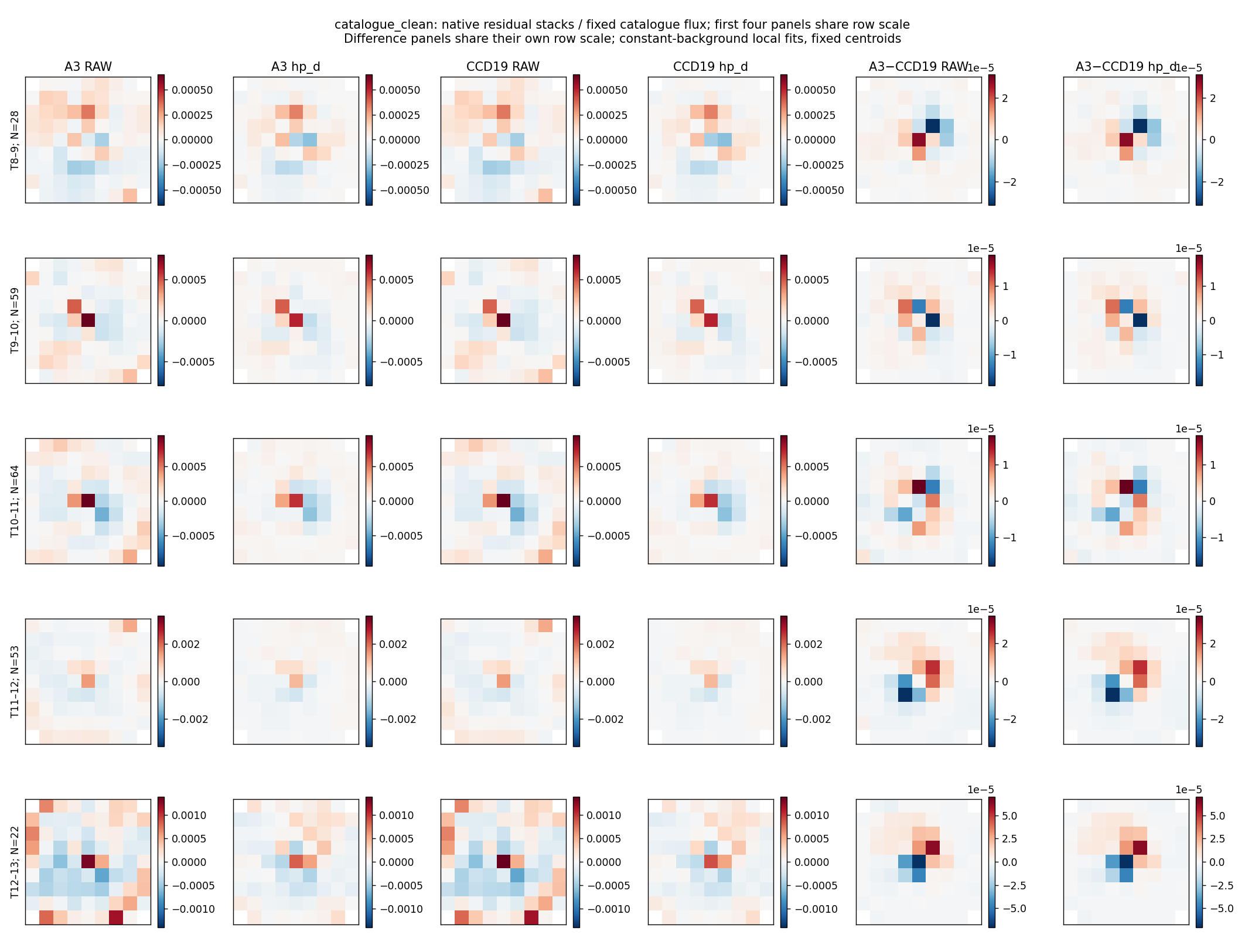
The ordinary 2,062-star sample and model-family comparisons are retained in A3/summary.json, CCD19/summary.json, and comparison.json. In the 226-star subset, old-basis A3−CCD19 mean core-RMS decreases are \((1.16\pm1.44)\times10^{-6}\) on RAW and \((1.03\pm1.55)\times10^{-6}\) on hp_d: this local-fit diagnostic does not independently resolve a benefit.
The bounded extension rendered 7,821 unique missing catalogue neighbours, with median 31 added columns per local fit, using the same A3 checkpoint, WCS and native renderer. Their colour proxy is \(u=0.9773044(BP-RP)+0.0218762\), fitted only from 14,733 existing catalogue/model colour matches; three missing BP/RP colours use recorded model reference colour. Gaia positions are linearly propagated to FFI epoch 2020.3265474. Matched catalogue/bundle median discrepancies after propagation are effectively zero; extreme remaining discrepancies reach 0.64 arcsec, so the added astrometry is not exact for every source.
The numerical basis alone can absorb coherent errors. The unpenalized target-information fraction, defined by projecting the weighted target column off all nuisance columns and dividing its remaining squared norm by its original squared norm, has median 0.887 before versus 0.611 after expansion, with some expanded fits effectively unidentified. These are retained, not silently removed. Priors can restore numerical solvability without restoring independent information.
For a unit independent Gaussian profile of width 1.25 px, median residual-energy retention after expanded versus old-basis fitting is 0.855 at \(k=1\) and 0.784 at \(k=10\). For a frozen A3 x-derivative probe it is 0.916 and 0.888. These are noiseless linear sensitivity tests on the identical pixels, not actual stellar injections or proof of photometric recovery. The larger basis can hide part of a profile or centroid defect.
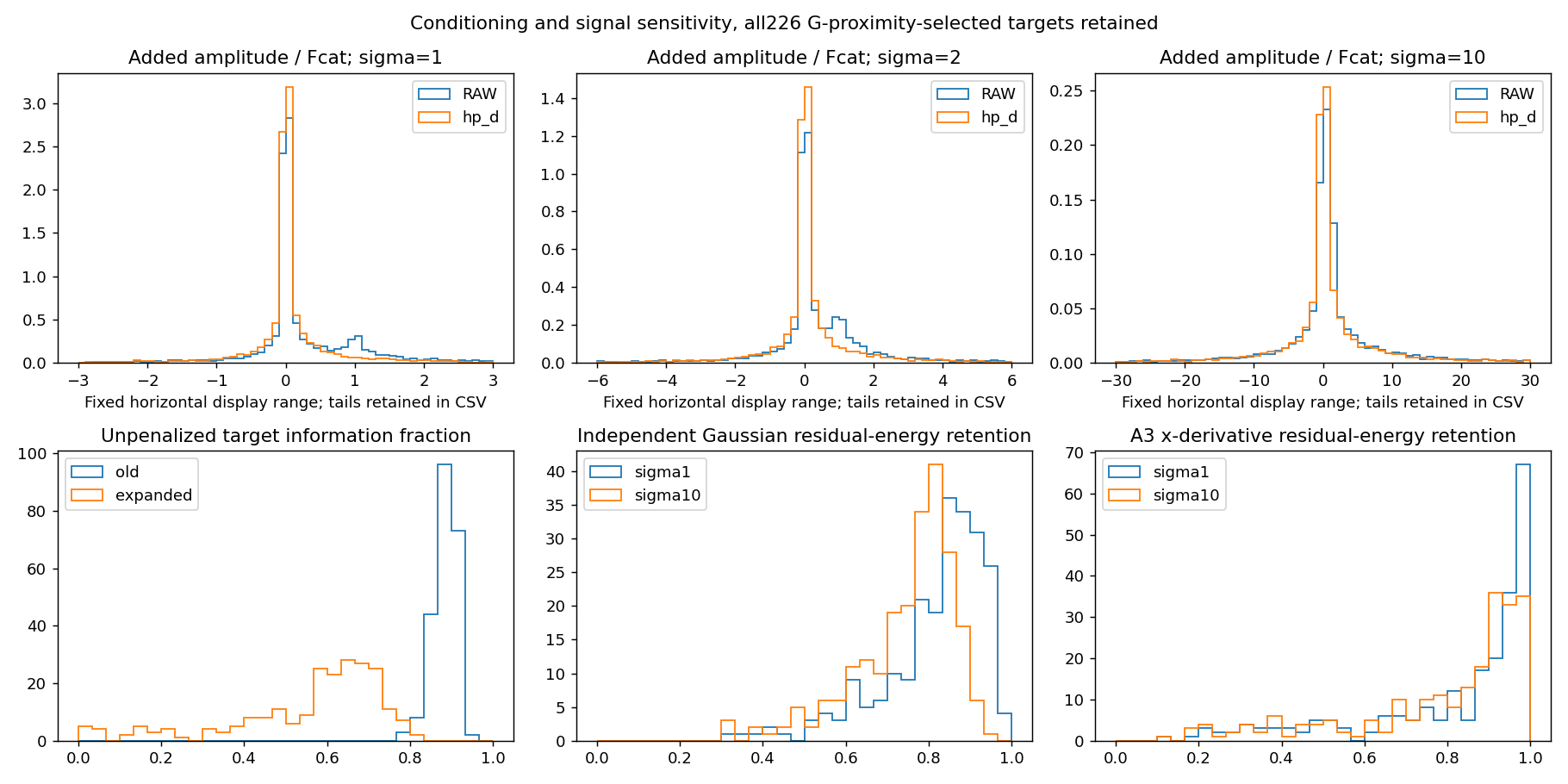
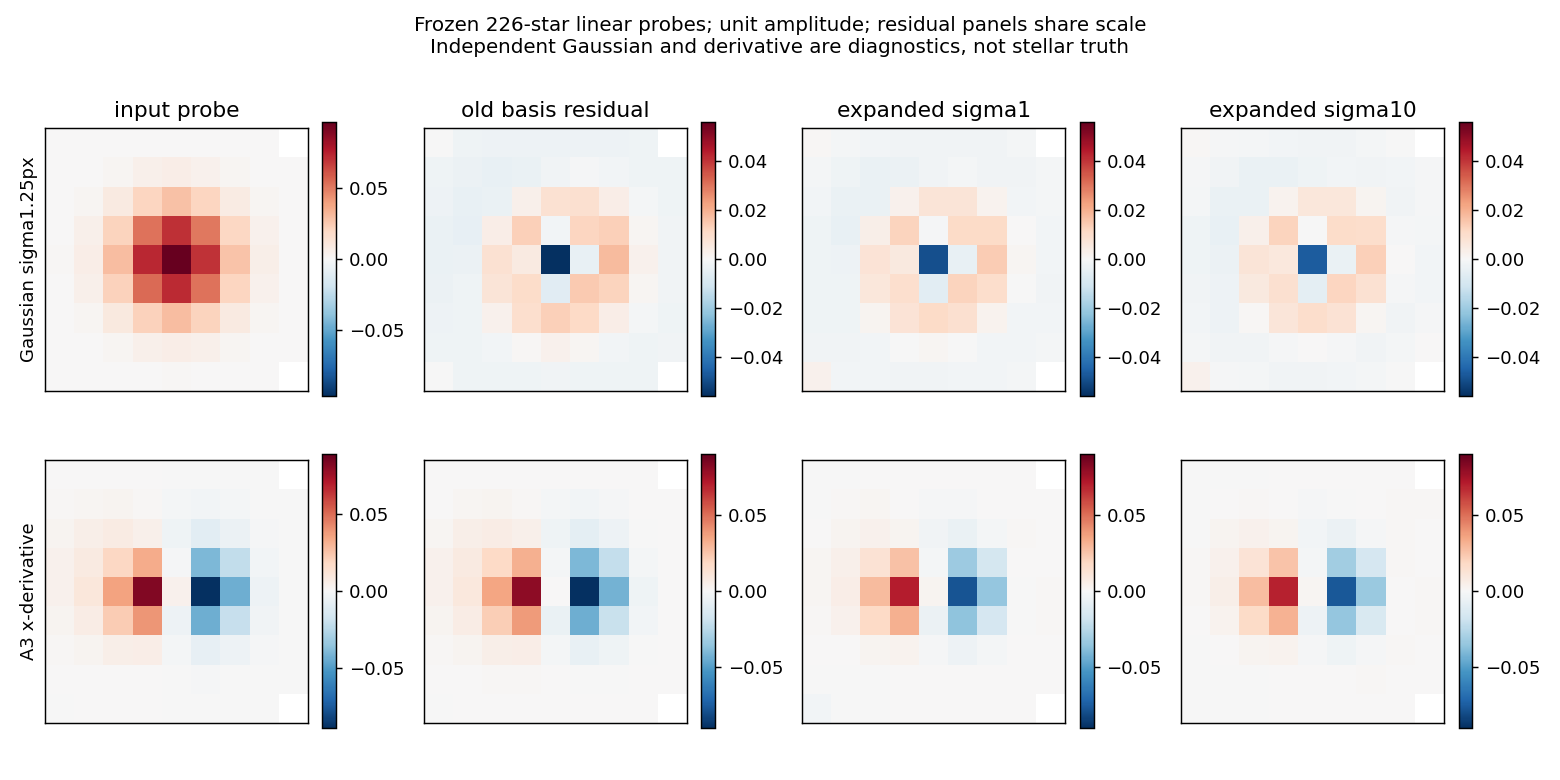
At \(k=1\), added RAW amplitudes/catalogue flux have 10/50/90 percentiles −0.254/0.009/1.458; 63% are positive. The median conditional posterior standard deviation is approximately one catalogue flux, indicating that many weak wing columns are prior dominated. At \(k=10\), the 10/90 percentiles extend to approximately −7/12 catalogue fluxes: this weak regularizer is a flexibility test, not a physical decomposition. Counts represent source occurrences in local fits; they are not independent catalogue objects. added_fluxes.csv preserves every signed occurrence and its conditional posterior uncertainty.
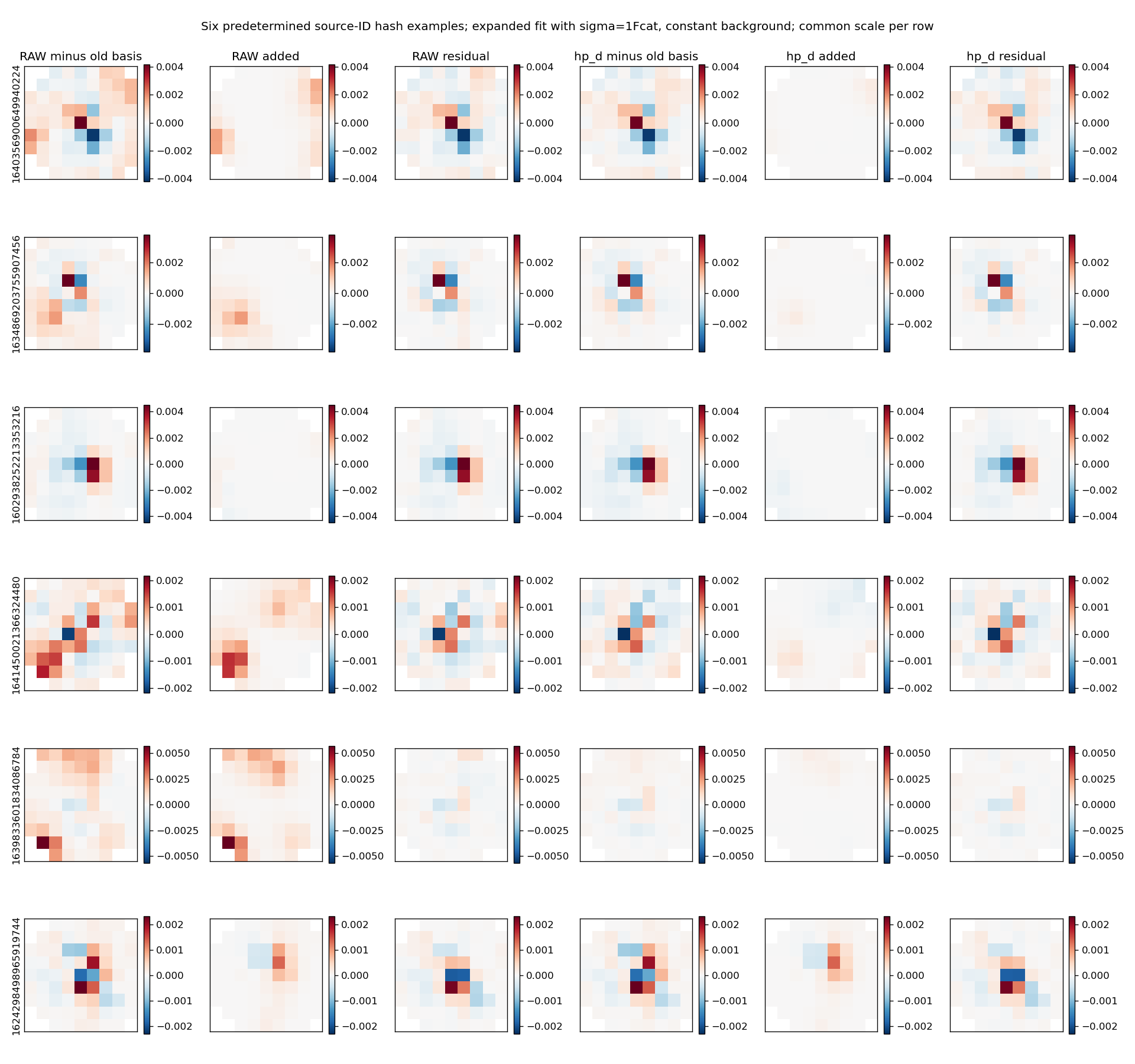
The six following targets were selected by a deterministic source-ID hash before looking at residuals. Each "minus old basis" image subtracts the fitted existing-source/background part of the expanded model, leaving the added component plus residual. Some added RAW features coincide with apparent off-target peaks and become small in hp_d; other added components overlap the target. This is evidence for a mixture of resolved contaminant response and fitting flexibility, not a universal attribution.
bash /astro/armin/koji/syndiff/dev_runs/epsf_model_closure_20261004/raw_control/run.sh reruns the bounded diagnostics using existing fits only. Scripts enforce two-core affinity where rendering/fitting occurs; BLAS is one thread. No training, catalogue query, upstream production mutation or main-worktree change was performed.
render.py, measure.py, compare.py: fixed A3/CCD19 original-basis comparisons.render_missing.py, measure_missing.py, finish.py: catalogue expansion, regularization/response diagnostics, figures.A3/, CCD19/: per-star CSV, NPZ measurements and JSON summaries.missing_profiles.json: colour/epoch/support audit; completeness_summary.json, completeness_stars.csv, added_fluxes.csv: expanded controls and conditioning.tess_flux interpreted without its global scale, and newly added Gaia coordinates initially missing epoch propagation. Current outputs supersede those provisional results.Final conclusion: The measured RAW–hp_d difference depends strongly on neighbour completeness. A common central colour-dependent mismatch persists after the bounded expansion and background/prior sensitivities, while explicit probes show that extra neighbours absorb part of such mismatches. The evidence limits attribution: a PS1-preparation-only explanation is not sufficient for the surviving pattern, and intrinsic PSF error remains unproven. Future discrimination requires independent astrometric/profile information or a trustworthy per-source retention decomposition, rather than simply allowing more nuisance freedom.